
Things
Diamond
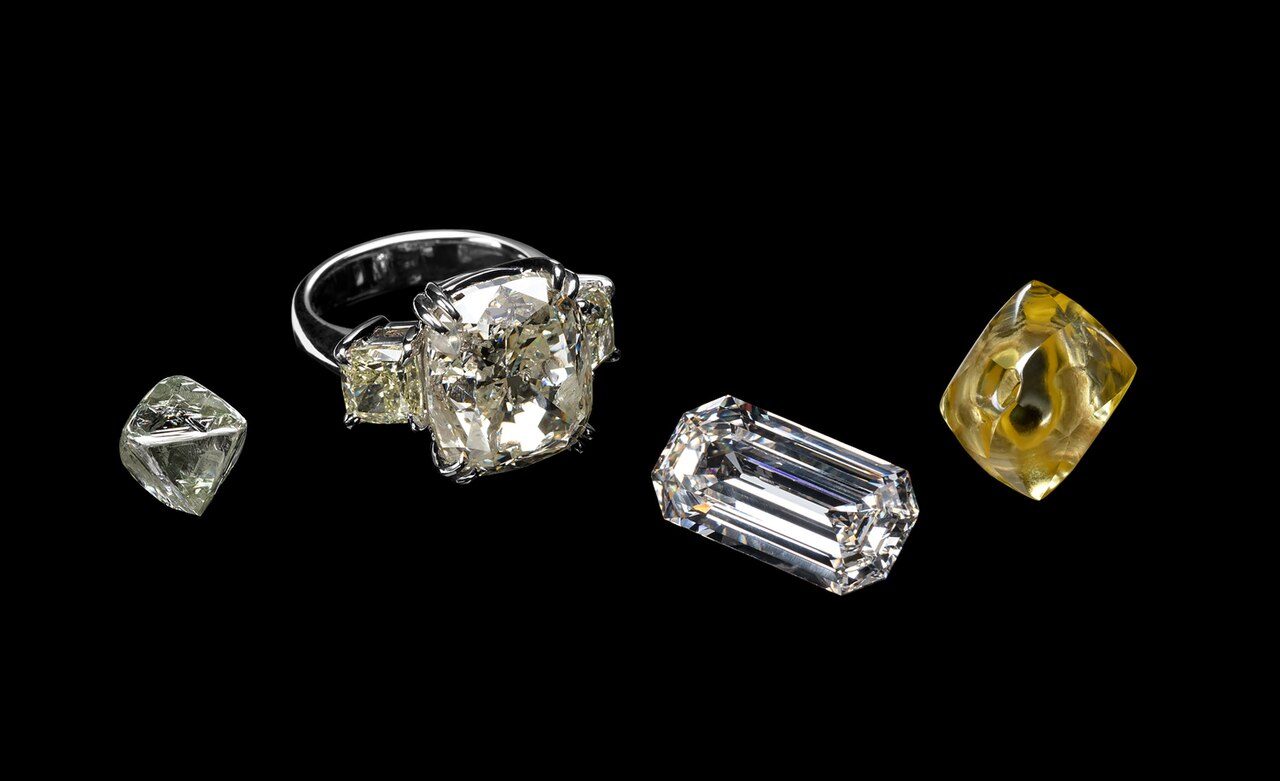
Diamond is carbon formed deep in the Earth, and for about two thousand years India - above all the Golconda region - was the only place on Earth it was found. The discoveries at Kimberley in South Africa from 1866 industrialised the stone, De Beers gathered its supply, a 1948 advertising slogan gave it its modern meaning, and from 1954 laboratories learned to grow it.
At a Glance
- What it is
- Pure carbon crystallised deep in the Earth - formed, GIA researchers find, 150 to 700 km down - and carried up in volcanic kimberlite
- The first source
- India, for about two thousand years the world's only known source; its Golconda gravels produced the Hope and the Koh-i-Noor
- The breakthrough
- South Africa, from 1866: diamonds found in their host rock, kimberlite, at Kimberley; world production rose tenfold within a decade
- The Big Hole
- Kimberley's hand-dug mine worked 1871-1914 and yielded about 14.5 million carats, Britannica records
- De Beers
- Formed by Cecil Rhodes in 1888; by 1900 it controlled an estimated 90 percent of world rough production, GIA records
- The slogan
- 'A Diamond Is Forever' - written by copywriter Frances Gerety in 1947 for De Beers' agency, in its advertising from 1948; an advertising fact, not an ancient custom
- Made in a laboratory
- General Electric achieved reproducible synthetic diamond in 1954; gem-quality laboratory-grown stones followed from the 1970s
Introduction
For roughly two thousand years, the world had exactly one source of diamonds: the river gravels of India. Diamonds are carbon, crystallised deep in the Earth and carried up in rare volcanic rock - GIA's researchers put their formation at depths of 150 to 700 kilometres - but until the eighteenth century every diamond ever seen had been gathered from Indian rivers and streams, above all from the region the trade called Golconda. They were stones for kings, and their history is a history of treasuries.
Then, in fifty years, everything changed. Diamonds were found in Brazil, then, in 1866, in South Africa - not in rivers only, but in the volcanic rock itself. Production multiplied tenfold within a decade, one company gathered the supply into its own hands, an advertising writer gave the stone its modern meaning in a single sentence, and in 1954 scientists learned to make diamonds in a laboratory.
India: Two Thousand Years of a Single Source
India's diamonds were already old when they were first described. The Arthashastra, a Sanskrit treatise of around the fourth century BC, describes diamonds among the treasures of kings, and for centuries afterwards India remained the only known source in the world. The stones came not from mines in the modern sense but from alluvial deposits - river gravels in the Deccan, along the Krishna River and around the fortress-city of Golconda, whose market gave its name to the finest old stones.
From Golconda came the great named diamonds of the old world. The blue stone the French merchant Jean-Baptiste Tavernier bought in India in 1666 - most likely, the Smithsonian says, from the Kollur mine - was sold to Louis XIV, recut as the French Blue, stolen in 1792, and recut again into the 45.52-carat Hope Diamond, which Harry Winston donated to the Smithsonian in 1958, famously sending it through the post. When Brazil produced diamonds in the 1720s, India's monopoly finally broke - but supply stayed small, alluvial and rare, and diamonds stayed royal.
Kimberley: The Rush That Dug the Big Hole
The modern industry begins with a boy's pebble. In 1866, GIA recounts, Erasmus Jacobs, a farmer's son, picked up a shiny stone near the Orange River; it proved to be a 21.25-carat diamond, named the Eureka. A still larger stone followed in 1869 - the 83.50-carat Star of South Africa - and the rush began. In 1871 digging started at a hill called Colesberg Kopje, on the farm of the De Beers brothers, where prospectors found diamond-bearing kimberlite - the volcanic host rock itself, named for the town that grew there, Kimberley. For the first time, diamonds could be mined in their source rock.
The pit they dug by hand became the Big Hole. Britannica records that Kimberley swelled to 50,000 people by 1872; the mine worked from 1871 to 1914 with some 30,000 miners at its peak, and yielded about 14.5 million carats. Within a decade, GIA notes, world production had increased tenfold - more diamonds than India had produced in two thousand years - and the stone became affordable to the wealthy middle class for the first time. Abundance created a new problem, falling prices, and the industry's answer shaped the next century.
De Beers and the Selling of Forever
The answer was consolidation. Cecil Rhodes, who had come to Kimberley as a teenager and made money pumping water from the diggings, bought claim after claim; by 1888, GIA records, he had bought out all the Kimberley mines and formed De Beers Consolidated Mines Ltd. By 1900, on GIA's account, De Beers controlled an estimated 90 percent of the world's rough production. For most of the twentieth century the company managed the flow of stones to market - the documented core behind every later debate about the trade. In 1905 the Premier mine yielded the Cullinan, at 3,106 carats the largest gem-quality diamond crystal ever found, cut into nine major gems, the two largest now in the British Crown Jewels.
The second answer was advertising. In 1947 the copywriter Frances Gerety, working for the agency N.W. Ayer on the De Beers account, wrote the line 'A Diamond Is Forever'; it appeared in De Beers advertising from 1948 and has accompanied its engagement advertising ever since. This page presents the slogan as what it is - a documented advertising fact of 1947-48, not a law of nature or an ancient custom. Diamond rings existed before it; what the campaign did, with historic success, was bind the stone to permanent love in the public mind. Advertising Age named it the slogan of the century in 1999.
Timeline
- By the 4th century BC
The Sanskrit Arthashastra describes diamonds; India, above all the Golconda region, is the world's only known source.
- 1866
Erasmus Jacobs finds the 21.25-carat Eureka diamond near the Orange River - the first significant South African diamond.
- 1871
Digging begins at Colesberg Kopje on the De Beers brothers' farm; the Kimberley rush and the Big Hole follow, and diamonds are mined in kimberlite rock for the first time.
- 1888
Cecil Rhodes forms De Beers Consolidated Mines Ltd.; by 1900 it controls an estimated 90 percent of world rough production.
- 1905
The Cullinan, a 3,106-carat crystal, is found at the Premier mine - still the largest gem-quality rough diamond known.
- 1948
'A Diamond Is Forever', written by copywriter Frances Gerety in 1947, appears in De Beers advertising - the most famous slogan in gem history.
- 1954
General Electric scientists announce a reproducible way to grow diamond in a laboratory; the first synthetics are tiny industrial stones.
- 2003
The Kimberley Process certification scheme comes into force, aiming to keep conflict diamonds out of the legitimate rough trade.
Significance
Diamond's significance in history is the tension between geology and story. After Kimberley the stone was not even rare at the surface; what the twentieth-century industry sold, with unmatched skill, was permanence - the hardest natural material recast as the symbol of permanent love. The 1948 slogan is the hinge of the modern history: before it, a luxury of kings and the rich; after it, a mass custom across America, Japan and eventually the world.
The stone also left its mark on science and institutions: kimberlite geology was born in the Kimberley pipes, and the effort to police the trade produced, in 2003, the Kimberley Process - a certification scheme named for the town where industrial diamond mining began.
Myths and disputes
Are diamonds forever? As a slogan, the line dates to 1947-48 and De Beers' advertising - that is the documented fact, and this page flags it as advertising, not ancient tradition. The diamond engagement ring itself is older than the campaign: a ring given by Archduke Maximilian to Mary of Burgundy in 1477 is widely cited as the first, though even that is best described as tradition rather than proof - and for centuries afterwards most brides had no diamond at all. The mass custom is a twentieth-century creation.
The Hope Diamond's famous curse is likewise a legend, not a record. The Smithsonian, which owns the stone, traces the documented chain - India, Louis XIV, theft in 1792, reappearance in London, Harry Winston, donation in 1958 - while the curse story was assembled in newspapers and retelling in the early twentieth century. The curse survives because it is a good story, which is exactly why this page labels it one.
Legacy
Diamond's legacy runs in two directions. Behind it lies the old world of Golconda: a two-thousand-year Indian monopoly, stones carried along trade routes into the treasuries of Mughals and kings, whose most famous survivors - the Hope, the Koh-i-Noor - now sit in museums and crown collections. Ahead of it lies the world Kimberley made: industrial mining on every continent, a global grading language, laboratory-grown stones chemically identical to mined ones, and an international certification scheme policing the rough trade.
Few materials show so clearly how value is manufactured - by geology first, then by scarcity, then by a sentence written in an advertising office in 1947. The stone itself has not changed in three billion years. Everything else about the diamond is human history.
Sources
- Gemological Institute of America (GIA 4Cs) - Where Are Diamonds Found? Spotlight on South African Diamonds
- Encyclopaedia Britannica - Big Hole
- Encyclopaedia Britannica - Kimberley
- Gemological Institute of America - Diamonds From the Deep (Gems & Gemology)
- ASME - The ASME Landmark That Made Diamonds With Heat and Pressure
The facts on this page were checked against these sources on 19 November 2026. The History Trail's permanent pages are researched and written for this site; the live profiles elsewhere on The History Trail are assembled automatically from Wikipedia and Wikidata.
About the Author
Researched and written by the The History Trail Editorial Team — the accountable editorial function behind this site's permanent story pages. The team works from the published sources cited on each page; it does not invent historians, reviewers or credentials, and it corrects errors openly.
Fact Check
Every load-bearing fact on this page traces to one of the sources listed above, and significant claims link to their source in the text. Our checking method is described on the methodology page; errors can be reported via the corrections page.
Sources & Citations
Cite this page as: The History Trail Editorial Team, The History Trail — this article's title, publication and update dates are shown beneath its headline. The full source list appears under Sources above; the site's source standards are on the sources page.