
Things
Antarctica
Antarctica was the last continent to be seen by human eyes — first sighted in 1820, with Russian, British and American expeditions claiming the honour within days of each other. It has no native population and no government of its own; since 1961 the Antarctic Treaty has reserved the whole continent, by agreement among nations, for peace and science.
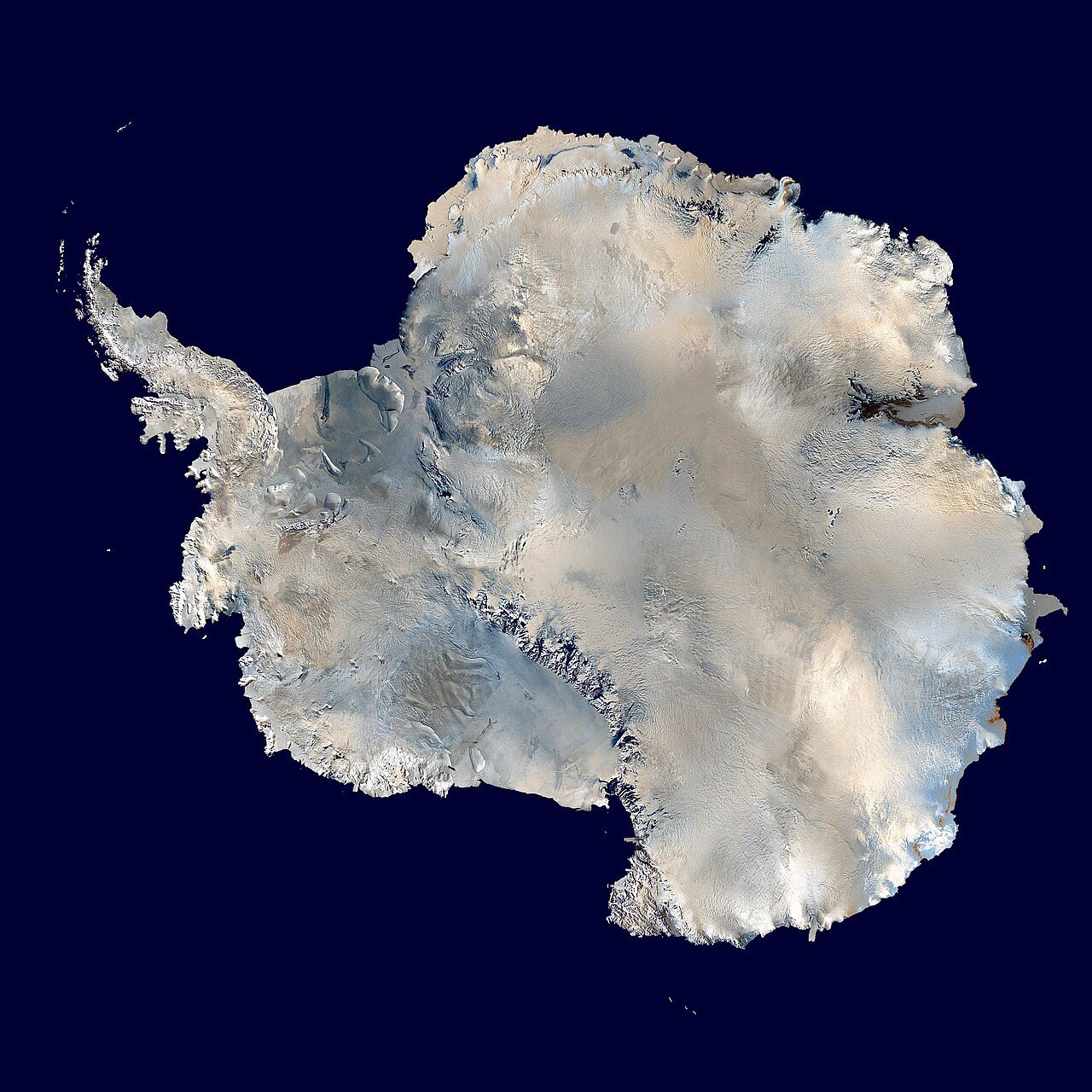
At a Glance
- First sighted
- 1820 — claims by Fabian von Bellingshausen (Russia), Edward Bransfield (Britain) and Nathaniel Palmer (United States) within days of each other
- First to the South Pole
- Roald Amundsen's Norwegian party, 14 December 1911
- Native population
- None — the only residents are rotating research station staff
- Governance
- The Antarctic Treaty, signed in Washington on 1 December 1959, in force from 23 June 1961; 58 parties today
- Treaty area
- Everything south of 60° South latitude, including all ice shelves
- Territorial claims
- Seven claimant states; all claims frozen by Article IV of the Treaty
- Environmental protection
- The 1991 Madrid Protocol designates Antarctica a natural reserve and bans mineral extraction except for research
The Last Continent Found
Antarctica was first sighted in 1820 — and by whom remains genuinely disputed. The Russian expedition of Fabian Gottlieb von Bellingshausen, sailing the Vostok and Mirny, recorded an ice shore of extreme height on 27 or 28 January 1820. Three days later, on 30 January, Edward Bransfield of the Royal Navy sighted Trinity Peninsula, the northern tip of the Antarctic Peninsula. The American sealer Nathaniel Palmer is the third claimant, said to have sighted the peninsula later that year. The honest summary, used by the US National Science Foundation among others, is that all three sighted the continent within days or weeks of one another.
The continent they glimpsed had been imagined for centuries before it was seen. Mapmakers filled the bottom of the world with a hypothetical Terra Australis, an unknown southern land supposed to balance the continents of the north. Captain James Cook crossed the Antarctic Circle in 1773 — the first recorded crossing — and sailed far enough south to make a large, habitable southern continent unlikely, but he never saw Antarctica itself. Sealers working the newly found South Shetland Islands from 1819 were the men on the spot when the mainland finally came into view.
Sealers, Scientists and the Heroic Age
Through the nineteenth century Antarctica was visited mainly by sealers and whalers hunting its coasts, with occasional scientific voyages. A whaling party led by Henrik Bull landed at Cape Adare in January 1895, generally described as the first landing on the mainland, and Carsten Borchgrevink's Southern Cross expedition spent the first deliberate winter ashore in 1899. Then, between about 1897 and 1922, came the Heroic Age: a rush of national expeditions, working with wool, wood, dogs and ponies, racing to map the continent and to reach its pole.
Its central figures still define Antarctic history. Robert Falcon Scott's Discovery expedition of 1901–04 based itself at McMurdo Sound and sledged to 82° south. Ernest Shackleton, who had sailed with Scott, returned with his own Nimrod expedition and in January 1909 turned back just 97 nautical miles from the South Pole, choosing his men's lives over the prize. Scott came back with the Terra Nova expedition to try again — and found that Norway's Roald Amundsen, a veteran of both polar regions, was racing him for the same goal.
Timeline
- 1773
James Cook makes the first recorded crossing of the Antarctic Circle, but never sights the continent itself.
- January 1820
Bellingshausen's Russian expedition sights an ice shore on 27 or 28 January; Bransfield sights Trinity Peninsula on 30 January; sealer Nathaniel Palmer is the third claimant of 1820.
- January 1895
A party from Henrik Bull's whaling expedition lands at Cape Adare — generally described as the first landing on the Antarctic mainland.
- 1901–1904
Scott's Discovery expedition establishes a base at McMurdo Sound and makes the first serious attempt on the South Pole, reaching about 82° south.
- January 1909
Shackleton's Nimrod party reaches 88°23′ south — 97 nautical miles from the Pole — before turning back to save their lives.
- 14 December 1911
Roald Amundsen and four companions become the first people to reach the South Pole, using skis and dog teams staged from the Bay of Whales.
- 17 January 1912
Scott's five-man party reaches the Pole to find Amundsen's flag already there; all five die on the return journey, their bodies found the following November.
- 1914–1916
Shackleton's ship Endurance is trapped and crushed by Weddell Sea pack ice; the crew's survival and eventual rescue close the Heroic Age's greatest story.
- 1957–1958
During the International Geophysical Year, twelve nations run coordinated scientific programmes in Antarctica, setting up more than fifty stations.
- 1 December 1959
The twelve IGY nations sign the Antarctic Treaty in Washington; it enters into force on 23 June 1961, reserving the continent for peaceful purposes and free scientific investigation.
- 1991
The Madrid Protocol on Environmental Protection designates Antarctica a natural reserve devoted to peace and science and bans mining; it enters into force in 1998.
A Continent Run by Agreement
The Antarctic Treaty is a short document with an extraordinary claim: a whole continent, south of 60° south, is to be used for peaceful purposes only. Military bases, manoeuvres and weapons testing are banned; scientific investigation is free to all; results must be exchanged and made freely available; and every station, ship and aircraft is open to inspection. Seven of the original signatories — Argentina, Australia, Chile, France, New Zealand, Norway and the United Kingdom — held territorial claims, some overlapping. The treaty neither recognised nor rejected them; Article IV simply froze them, and forbade any new or enlarged claim while the treaty lasts.
The arrangement grew directly out of the International Geophysical Year of 1957–58, when scientists of twelve nations worked side by side in Antarctica and cooperation proved easier than rivalry. The treaty has since grown to 58 parties, and the 1991 Madrid Protocol added comprehensive environmental protection, designating Antarctica a natural reserve and prohibiting all mineral resource activity except scientific research. Nobody lives on the continent permanently: its only inhabitants are the scientists and support staff of national research programmes, coordinated through COMNAP, present in their thousands in summer and reduced to around a thousand through the winter dark.
The Climate Archive at the Bottom of the World
The Heroic Age is preserved as carefully as it is studied: the Scott Polar Research Institute at the University of Cambridge was founded in 1920 as the national memorial to Scott and his companions, and its Polar Museum holds the expedition's letters, equipment and photographs alongside displays of modern research. Stations such as McMurdo, Palmer and the Amundsen-Scott South Pole Station — built on the very spot the 1911 race was run to — keep the continent's scientific watch through the polar night.
That watch matters far beyond Antarctica. The continent's ice sheet locks up most of the world's fresh water, its surrounding ocean drives global circulation, and its ice preserves a layered record of Earth's past atmosphere — which is why a continent with no voters, no industry and no army has become one of the most important places on Earth for climate science. The treaty that froze its politics in 1961 turned out to protect not just a wilderness, but the planet's own archive.
Sources
- Antarctic Treaty Secretariat — The Antarctic Treaty
- International Polar Year — Antarctica and the Antarctic Treaty explained
- Te Ara — The Encyclopedia of New Zealand: The Heroic Age of Antarctic Exploration
- Antarctic and Southern Ocean Coalition — Key Events in Antarctic Governance and Conservation
- Scott Polar Research Institute, University of Cambridge — The Polar Museum
- University of Alabama at Birmingham — Antarctica: History and Politics
The facts on this page were checked against these sources on 19 November 2026. The History Trail's permanent pages are researched and written for this site; the live profiles elsewhere on The History Trail are assembled automatically from Wikipedia and Wikidata.
About the Author
Researched and written by the The History Trail Editorial Team — the accountable editorial function behind this site's permanent story pages. The team works from the published sources cited on each page; it does not invent historians, reviewers or credentials, and it corrects errors openly.
Fact Check
Every load-bearing fact on this page traces to one of the sources listed above, and significant claims link to their source in the text. Our checking method is described on the methodology page; errors can be reported via the corrections page.
Sources & Citations
Cite this page as: The History Trail Editorial Team, The History Trail — this article's title, publication and update dates are shown beneath its headline. The full source list appears under Sources above; the site's source standards are on the sources page.