
Things
Rubik's Cube: The Teaching Aid That Became a Craze
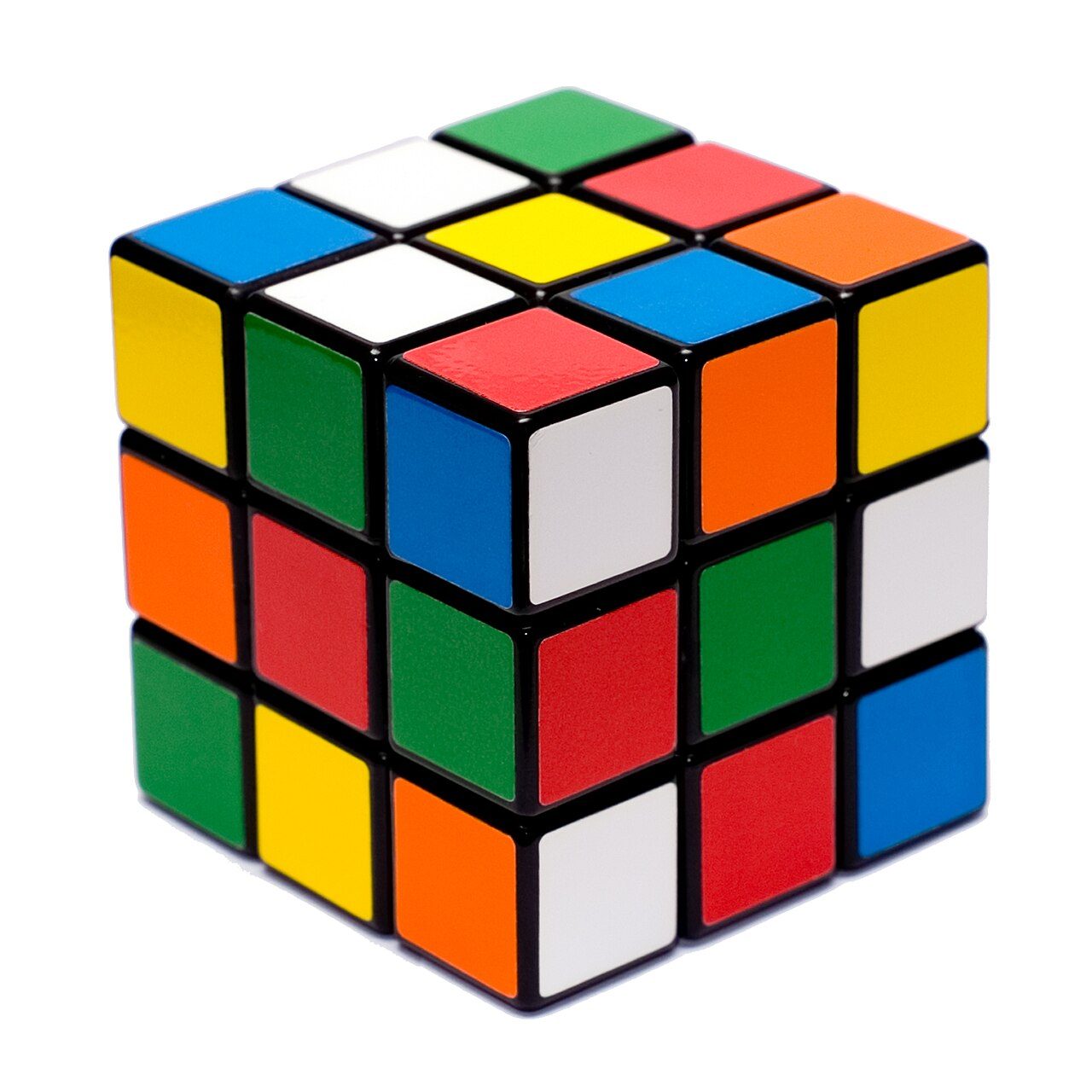
Ernő Rubik built a wooden cube in 1974 to teach his students about three-dimensional movement, then took a month to solve it himself. Within eight years his 'Magic Cube' had sold 100 million copies and become the best-known puzzle in the world.
At a Glance
- Inventor
- Ernő Rubik
- Invented
- 1974, Budapest, Hungary
- Original name
- Bűvös kocka (Magic Cube)
- Hungarian patent
- Applied 1975, granted 1977
- Worldwide launch
- 1980, by the Ideal Toy Company
- Possible arrangements
- More than 43 quintillion
- First world champion
- Minh Thai, 22.95 seconds, Budapest, 5 June 1982
- Sales
- More than 350 million by 2018
A Teaching Aid Its Maker Could Not Solve
The Rubik's Cube was not designed to be a toy, and its inventor did not, at first, understand what he had made. In the spring of 1974 Ernő Rubik, a Hungarian teacher of architecture and design in Budapest, built a cube of wooden blocks that could twist in layers without falling apart. He added coloured stickers, scrambled it — and then discovered that he had no idea how to get it back. The puzzle that would sell in the hundreds of millions began as one man's month-long argument with his own teaching aid.
What makes the Cube endure is the gap between its simplicity and its depth. It has six faces, nine stickers per face and one solved state, yet the pieces can be arranged in more than 43 quintillion ways. A child can understand the goal in ten seconds and spend years mastering it. That combination — instantly graspable, practically inexhaustible — carried the Cube from a Budapest classroom, through the Iron Curtain, to the cover of Scientific American and the shelves of the world.
Budapest, 1974: Building a Movable Cube
Rubik taught at Budapest's Academy of Applied Arts and Crafts, and he built the Cube to solve a structural and teaching problem: how to model three-dimensional movement so students could grasp it. Working in wood with elastic bands, he created a 3×3×3 mechanism whose centre held while its parts moved independently. Only after scrambling it did he realise he had also created a puzzle, and he later said he prefers the word 'discovered' to 'invented' for what happened next.
Getting the Cube to market meant crossing a divided Europe. Rubik applied to the Hungarian Patent Office in 1975, calling the object a 'spatial logic toy', and received his patent in 1977; a small Hungarian company, Politechnika, began selling plastic versions as the Bűvös kocka, or Magic Cube. Hungary's planned economy had little machinery for exporting toys, so the Cube's fate turned on intermediaries: an expatriate Hungarian entrepreneur carried it to the Nuremberg Toy Fair in 1979, where games businessman Tom Kremer recognised what it could become.
Timeline
- Spring 1974
Ernő Rubik builds the first Cube from wood in Budapest as a way to model three-dimensional movement for his design students.
- 1975
Rubik applies to the Hungarian Patent Office, describing the Cube in his application as a 'spatial logic toy'.
- 1977
His Hungarian patent is granted, and the first plastic Magic Cubes go on sale in Budapest toy shops.
- 1979
The Cube is shown at the Nuremberg Toy Fair, where Tom Kremer of Seven Towns sees it and sets out to license it internationally.
- 1980
The Ideal Toy Company launches the puzzle worldwide under a new name: the Rubik's Cube. It wins Toy of the Year awards in 1980 and 1981.
- March 1981
The Cube appears on the cover of Scientific American, where Douglas Hofstadter praises it as a teaching device for mathematical ideas.
- By 1982
Approximately 100 million Cubes have been sold worldwide in the first wave of the craze.
- 5 June 1982
The first Rubik's Cube World Championship is held in Budapest; Minh Thai of the United States wins with a best solve of 22.95 seconds.
- 2003
After two quiet decades, the World Championship is revived, beginning the modern era of organised speedcubing.
- 2018
Cumulative sales pass 350 million, making the Cube the best-selling puzzle in history — and still selling.
The First Global Toy Craze of the Licensing Age
The Cube was the first great global toy craze of the modern licensing age, and it arrived from an unlikely direction: not from a multinational's product lab but from behind the Iron Curtain, carried by personal networks of émigrés and enthusiasts. Its success forced the toy industry to take puzzles seriously as mass entertainment, and it made its inventor — an academic who had expected an audience of engineers and mathematicians — famous far beyond the world of design teaching.
Mathematicians adopted it just as enthusiastically. Each twist of a face is an element of a group in the algebraic sense, and the Cube became a standard classroom illustration of group theory, symmetry and combinatorics. Hofstadter's Scientific American cover story treated it as a serious intellectual object, and that dual identity — toy and theorem — is unusual. Most crazes are one or the other; the Cube has always been both, which is a large part of why it never entirely went away.
Obituaries Refused: The Cube's Second Life
Interest dipped in the mid-1980s — by 1986 the New York Times was writing the Cube's obituary — but the object refused to retire, passing instead into museum collections and popular culture as a universal symbol of a difficult problem. The internet gave it a second life: online tutorials and video turned a solitary frustration into a shared skill, organised competition resumed in 2003, and a new generation now learns methods its inventor never knew, racing in arenas at speeds that would have seemed impossible in 1982.
Rubik published his account, Cubed: The Puzzle of Us All, in 2020, reflecting that the Cube's impact had become more interesting than the Cube itself. He may be right. Half a century after a teacher in Budapest built his first cube from wooden blocks, the Cube remains that rare invention — simultaneously a toy, a mathematical object, a sport and a metaphor — and the sales counter, past 350 million, still runs.
Sources
- Smithsonian Lemelson Center — A Twist of Fate: The Invention of the Rubik's Cube
- Smithsonian Magazine — A Brief History of the Rubik's Cube
- Wikipedia — Rubik's Cube (corroboration: championship and competition history)
The facts on this page were checked against these sources on 18 November 2026. The History Trail's permanent pages are researched and written for this site; the live profiles elsewhere on The History Trail are assembled automatically from Wikipedia and Wikidata.
About the Author
Researched and written by the The History Trail Editorial Team — the accountable editorial function behind this site's permanent story pages. The team works from the published sources cited on each page; it does not invent historians, reviewers or credentials, and it corrects errors openly.
Fact Check
Every load-bearing fact on this page traces to one of the sources listed above, and significant claims link to their source in the text. Our checking method is described on the methodology page; errors can be reported via the corrections page.
Sources & Citations
Cite this page as: The History Trail Editorial Team, The History Trail — this article's title, publication and update dates are shown beneath its headline. The full source list appears under Sources above; the site's source standards are on the sources page.