
Things
Titanic (1997 film)
Titanic is a 1997 American film written and directed by James Cameron, a fictional love story set aboard the real RMS Titanic on its sinking in April 1912. It cost about $200 million, making it the most expensive film ever made at the time according to Britannica, and then became the first film to gross more than $1 billion worldwide, holding the all-time box-office record for more than a decade.
At a Glance
- Director
- James Cameron, who wrote, directed, co-produced and co-edited the film; produced with Jon Landau
- Cast
- Leonardo DiCaprio as Jack Dawson and Kate Winslet as Rose DeWitt Bukater, fictional passengers aboard the real ship
- Production
- Began in 1995 with Cameron filming the real wreck; principal photography July 1996 to March 1997, centred on a near-full-scale replica built at Rosarito, Mexico
- Budget
- About $200 million, the most expensive film made at the time, according to Britannica
- Release
- Premiered at Tokyo on 1 November 1997; released in the United States on 19 December 1997
- Box office
- $1,843,373,318 worldwide in its original release, according to Box Office Mojo; the first film past $1 billion, and the highest-grossing film of all time until Avatar (2009) passed it in 2010
- Awards
- Fourteen Academy Award nominations and eleven wins, tying the records set by All About Eve (1950) for nominations and Ben-Hur (1959) for wins, according to Britannica
Introduction
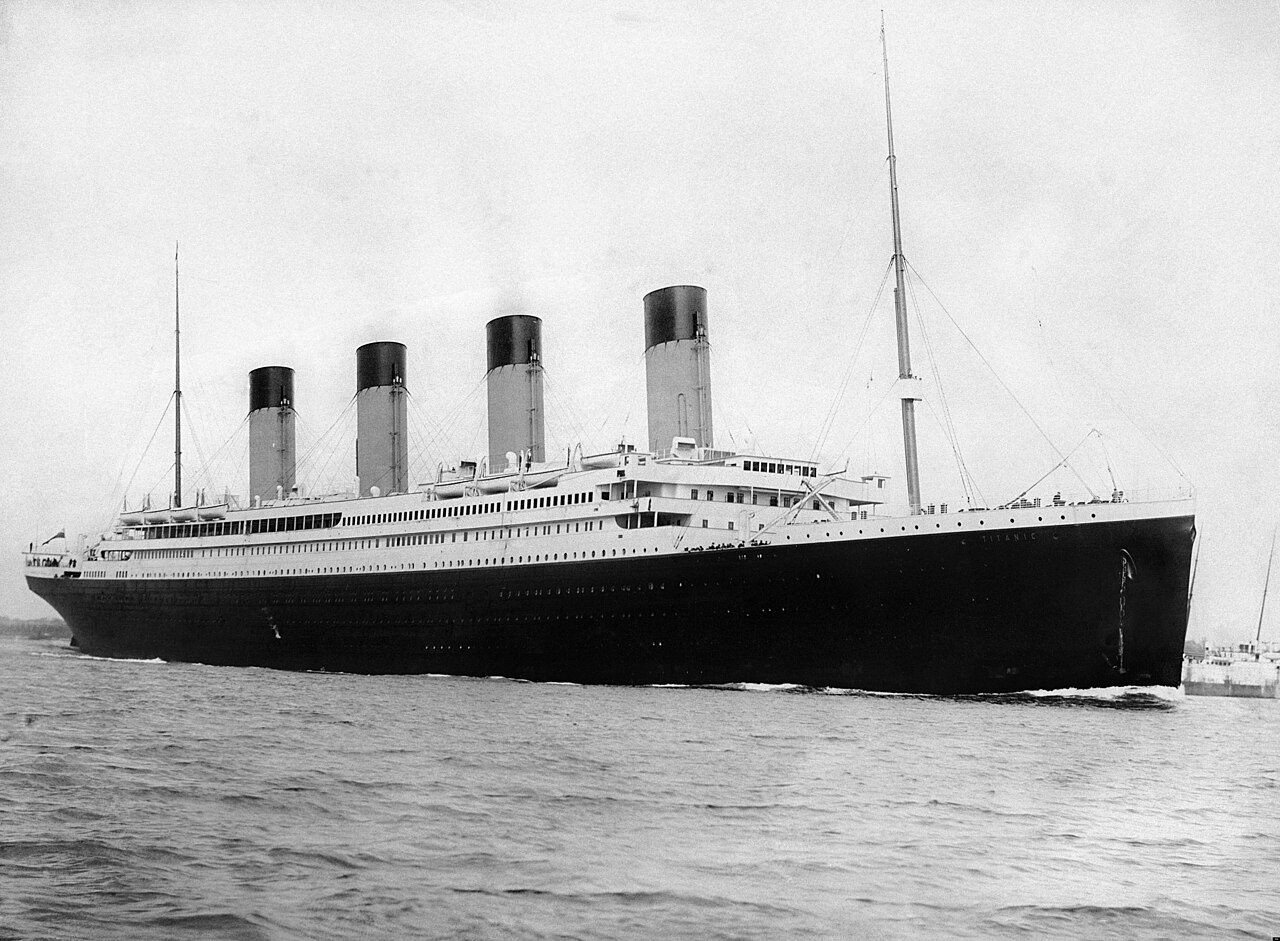
The film's fiction is a romance: in 1912, penniless artist Jack Dawson and unhappily engaged first-class passenger Rose DeWitt Bukater meet aboard the liner Titanic, framed by a modern-day search of the wreck for a lost diamond. Jack, Rose and the diamond are Cameron's inventions. The ship, its voyage and its sinking on the night of 14-15 April 1912 are documented history, and the film's makers pursued that history with unusual literalness, diving to the wreck and rebuilding the ship almost full-size. For the documented story of the vessel itself, see this site's page on the ship, linked below.
What followed is a matter of record. A production widely predicted in the press of 1997 to be a disaster on the scale of its subject instead produced the largest box-office success the industry had seen and a record-tying haul of Academy Awards.
Making the Film: Dives, a Replica and a Rising Budget
Cameron had been fascinated by shipwrecks and by Titanic since the wreck was located in 1985. Production formally began on 1 September 1995, when he filmed the actual wreck on the floor of the North Atlantic, diving to it repeatedly in Russian Mir submersibles; footage of the real wreck opens the film, intercut with its fictional treasure hunters. Britannica records that he designed an almost-to-scale replica of the ship for the production, and the replica was built at a purpose-built studio at Rosarito in Baja California, Mexico, in a vast seawater tank, so that the ship could be sunk, in stages, on camera. Principal photography ran from July 1996 to March 1997, using the Akademik Mstislav Keldysh, the Russian research vessel that had supported the wreck dives, for the modern scenes.
Costs rose throughout. The film was co-financed by Paramount Pictures, which handled North American distribution, and 20th Century Fox, which handled international distribution, precisely because no single studio wished to carry the risk alone. The release was postponed from the summer of 1997 to December. By completion the production budget stood at about $200 million - at the time, as Britannica states, the most expensive movie ever made - and trade-press expectation, widely reported, was that it could not earn its money back.
Release: Fifteen Weeks at Number One
Titanic premiered at the Tokyo International Film Festival on 1 November 1997 and opened in the United States on 19 December. Its opening weekend, about $28.6 million in North America, was solid rather than spectacular. What happened next was without precedent in the modern era: powered by repeat viewings - Britannica notes that ticket sales were aided by multiple viewings from moviegoers undeterred by a running time of more than three hours - the film held first place at the North American box office for fifteen consecutive weeks, a record, and simply did not fall away through the winter and spring of 1998.
On 1 March 1998 it became the first film to pass $1 billion in worldwide grosses. Box Office Mojo records $1,843,373,318 worldwide for the original release, of which $600,683,057 was domestic and $1,242,690,261 international - figures that more than doubled the previous worldwide record held by Jurassic Park. At the 70th Academy Awards the film converted fourteen nominations into eleven wins, including Best Picture and Best Director, tying Ben-Hur's record for wins and All About Eve's record for nominations, as Britannica records. Celine Dion's recording of My Heart Will Go On, from James Horner's score, became one of the best-selling singles of the era and carried the film into radio and music television far beyond the cinema.
Timeline
- 1985
The wreck of RMS Titanic is located on the North Atlantic floor, renewing public fascination with the ship.
- 1 September 1995
Production begins with Cameron filming the real wreck from Russian Mir submersibles.
- July 1996 - March 1997
Principal photography, centred on the near-full-scale replica at the Rosarito studio in Mexico.
- 1 November 1997
World premiere at the Tokyo International Film Festival.
- 19 December 1997
United States release; the film begins a fifteen-week run at number one in North America.
- 1 March 1998
Titanic becomes the first film to gross more than $1 billion worldwide.
- 23 March 1998
Eleven Academy Awards from fourteen nominations, tying the all-time records for both.
- 1998-2010
The film remains the highest-grossing release of all time for twelve years.
- 2010
Cameron's Avatar surpasses Titanic's worldwide gross, taking the all-time record.
- 4 April 2012
A 3D re-release for the centenary of the sinking adds about $343 million, taking the lifetime total past $2 billion.
- 2017
On its twentieth anniversary, the Library of Congress selects Titanic for the National Film Registry.
Significance
Titanic reset the industry's sense of scale twice: first by spending, then by earning. It demonstrated that a very long, period-set, effects-driven romance could out-gross every action film before it, largely on international receipts and repeat attendance, and its $1.84 billion original gross - Box Office Mojo's figure - stood as the all-time record for twelve years, until Cameron's own Avatar passed it in 2010. Later re-releases, including the 2012 3D edition and a 2023 edition, have taken the lifetime worldwide total to about $2.26 billion, keeping it among the highest-grossing films in history; rankings of that kind are unadjusted for inflation and change with each re-release, and this page attributes them to Box Office Mojo rather than stating them as absolutes.
The film also changed its subject's public history. Interest in the real Titanic - exhibitions, books and the wreck itself - surged after 1997 and never returned to its earlier level. Cameron returned to the wreck for documentaries, and in 2017 reviewed the film's accuracy for a National Geographic programme marking its twentieth anniversary.
Myths and disputes
Was the film expected to flop? The prediction was real and widely printed in 1997: a $200 million period romance, over schedule and over budget, was reported as a likely historic loss, and the Library of Congress's own National Film Registry essay notes that the cost led many to predict a historic box office disaster. The flop never happened, but the expectation is documented, not a myth invented afterwards.
How accurate is the film? Cameron researched the ship, its fittings and the sinking in exceptional detail, and the broad sequence of the disaster follows the historical record; the central love story, the diamond plot and several supporting characters are fiction, and should never be cited as history. One famous detail was corrected by Cameron himself: in the 2012 re-release he adjusted the star field in a dawn sky scene after astronomer Neil deGrasse Tyson pointed out that the stars shown did not match the sky over the Atlantic on that night in 1912 - a small, documented instance of the film's makers treating factual accuracy as a standard to be corrected against.
Finally, the box-office crown needs its qualifier. Titanic was the highest-grossing film of all time in unadjusted dollars from 1998 to 2010. Adjusted for ticket-price inflation, older films such as Gone with the Wind have sold more admissions, and Box Office Mojo's own inflation-adjusted North American chart places Titanic fifth. The record it genuinely holds - first past $1 billion, fifteen weeks at number one, twelve years at the top of the unadjusted chart - needs no exaggeration.
Legacy
In 2017 the Library of Congress selected Titanic for the National Film Registry as culturally, historically or aesthetically significant, describing it as a blockbuster that became a cultural touchstone of its era and made mega-stars of its two leads. Its sinking sequence remains a benchmark for large-scale practical effects combined with early digital work.
For the ship herself, the film completed a transformation: a 1912 disaster known mainly to historians became, after December 1997, the most famous shipwreck in the world. The film is fiction built on a documented catastrophe; its legacy is that millions now know there was a real ship, a real night and a real loss behind the love story - and many go looking for that history next.
Sources
- Encyclopaedia Britannica - Titanic
- Box Office Mojo - 1997 Worldwide Box Office
- Library of Congress, via Celluloid Junkie - The 2017 National Film Registry Is More Than a 'Field of Dreams'
- Cinefex - Back to Titanic (production account, Cinefex 72, December 1997)
The facts on this page were checked against these sources on 19 November 2026. The History Trail's permanent pages are researched and written for this site; the live profiles elsewhere on The History Trail are assembled automatically from Wikipedia and Wikidata.
About the Author
Researched and written by the The History Trail Editorial Team — the accountable editorial function behind this site's permanent story pages. The team works from the published sources cited on each page; it does not invent historians, reviewers or credentials, and it corrects errors openly.
Fact Check
Every load-bearing fact on this page traces to one of the sources listed above, and significant claims link to their source in the text. Our checking method is described on the methodology page; errors can be reported via the corrections page.
Sources & Citations
Cite this page as: The History Trail Editorial Team, The History Trail — this article's title, publication and update dates are shown beneath its headline. The full source list appears under Sources above; the site's source standards are on the sources page.