
Things
Coconut
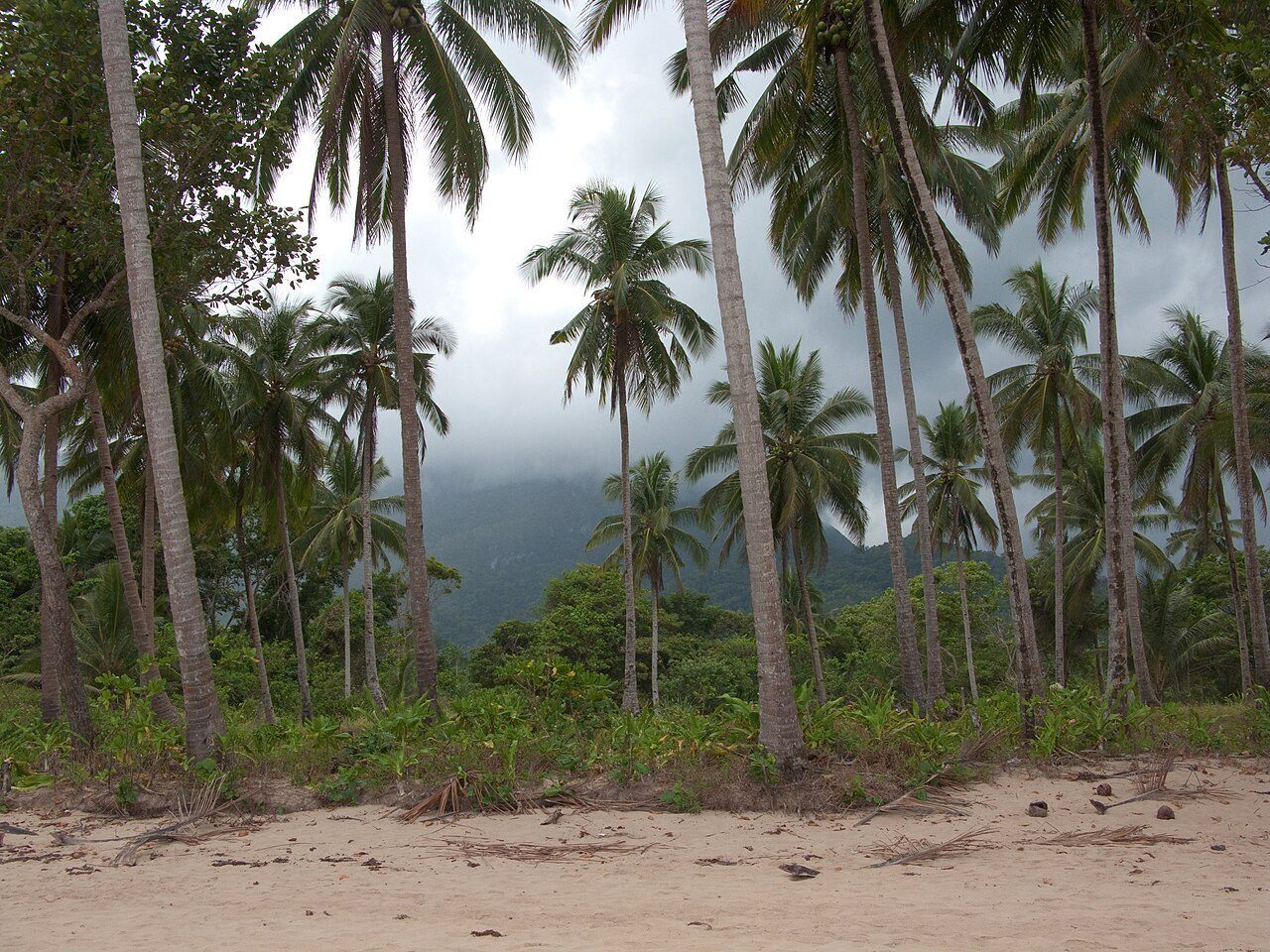
The coconut is the fruit of Cocos nucifera, a palm now growing on tropical coasts nearly worldwide. How it spread is a genuine scholarly puzzle. The fruit floats and can survive long voyages at sea, yet genetic research shows that its pantropical range is largely human work - above all Austronesian voyagers' - and that it was probably domesticated twice, independently, in the Pacific and the Indian Ocean world.
At a Glance
- Scientific name
- Cocos nucifera, of the palm family Arecaceae - the only living species of the genus Cocos, formally described by Linnaeus in 1753
- The tree
- A slender, leaning palm up to 25 metres tall (Britannica) that can live up to 100 years (Kew) - the 'tree of life' of the tropics
- The fruit
- Botanically a drupe, not a true nut: a thick fibrous husk around a hard shell holding meat and coconut water
- Probable origin
- The central Indo-Pacific: Britannica says probably Indo-Malaya; genetic studies point to the region between western Southeast Asia and Melanesia
- Two domestications
- Genetic research (Gunn et al., 2011) found two distinct populations, Pacific and Indo-Atlantic, suggesting cultivation began independently in island Southeast Asia and on the southern margins of the Indian subcontinent
- How it spread
- Its fruit floats and is adapted to sea dispersal, but its pantropical range was achieved mainly with human help - above all Austronesian voyagers
- Scale today
- Over 12 million hectares planted across 89 tropical countries (Gunn et al., 2011)
Introduction
Britannica describes the coconut palm as the most economically important palm species, cultivated extensively in the tropics for its edible fruit and found on tropical coasts nearly worldwide. Its slender, leaning, ringed trunk rises up to 25 metres from a swollen base, crowned with giant featherlike leaves. The mature fruit, 300 to 450 millimetres long, carries a thick fibrous husk around the hard shell, inside which lie the meat and the liquid - coconut water. Botanically, the coconut is a drupe, not a true nut. Britannica judges that the palm probably originated somewhere in Indo-Malaya.
Kew calls it a tree of life that can protect, heal and feed, and notes it can live up to 100 years. The list of uses explains the name. The flesh is eaten fresh or dried; the dried kernel, copra, yields coconut oil, a major vegetable oil, and the meat is grated into coconut milk. The husk yields coir, a salt-water-resistant fibre made into ropes, mats, baskets and brushes. The sap gives toddy, the young bud is eaten as palm cabbage, the leaves thatch and weave, and the trunk builds huts and is exported as a cabinet wood called porcupine wood. Indonesians claim, Britannica reports, that coconuts have as many uses as there are days in a year.
Two Coconuts: The Genetic Evidence
In 2011 a team led by Bee Fong Gunn published a genetic study of 1,322 coconuts sampled worldwide. It revealed two highly differentiated subpopulations, corresponding to the Pacific basin on one side and the Indo-Atlantic - the Indian and Atlantic Oceans - on the other. The authors argue this suggests independent origins of cultivation in the two regions: island Southeast Asia, and the southern margins of the Indian subcontinent.
The details map human history. The traits most clearly tied to selection under cultivation - the dwarf habit, self-pollination, and the rounded, liquid-rich niu vai fruit form - arose only in the Pacific. Coconuts showing admixture between the two groups occur primarily in the southwestern Indian Ocean, a pattern the authors read as consistent with Pacific coconuts carried along the ancient Austronesian trade route to Madagascar; admixture on the east African coast may also reflect later Arab trading. The same study records the palm's modern scale: over 12 million hectares planted across 89 tropical countries.
Drift or Canoe? How the Palm Spread
The case for the sea is real. The fruit is naturally adapted for dispersal by ocean currents, as Gunn and her colleagues note: the husk makes it buoyant and water-resistant, and the older niu kafa fruit form - oblong, triangular, thick-husked - has been interpreted as the ancestral shape, selected for ocean dispersal rather than for eating. In 1941 C.H. Edmondson claimed, on a very small sample, that coconuts could float 110 days, or some 5,000 kilometres, and still germinate - a claim later disputed. In 2014 Hugh Harries proposed that the palm originated and dispersed by island-hopping through the coral atoll ecosystem, populating new atolls without human help; wild coconuts, he argued, dispersed by floating long before people appeared.
The case for the canoe is stronger for the world we actually see. Drift models based on wind and ocean currents have shown that coconuts could not have drifted across the Pacific unaided. Thor Heyerdahl, who crossed the Pacific on a raft, reported that nuts kept dry survived, while those that became wet below deck were ruined, and nuts began to germinate after about 70 days. The geneticists' verdict is that while the fruit is adapted to the sea, its pantropical dissemination was achieved with the help of humans. Austronesian voyagers carried coconuts as they settled the Pacific, and most likely introduced Pacific coconuts to the Pacific coast of Latin America before Columbus, sailing from the Philippines. Europeans later carried Indo-Atlantic coconuts from India to Atlantic Africa, South America and the Caribbean.
Timeline
- From the Neolithic
Austronesian peoples spread the coconut through island Southeast Asia and across the Pacific, carrying it as a canoe plant on their voyages.
- c. 600-700 CE
Coconuts are present in the Tuamotu archipelago by roughly 1,300 years ago, on archaeological evidence cited by Harries - drifted or carried is the standing question.
- Colonial era
European sailors carry Indo-Atlantic coconuts from India to Atlantic Africa, South America and the Caribbean.
- 1753
Linnaeus formally describes the species as Cocos nucifera in Species Plantarum.
- 1941
C.H. Edmondson claims coconuts can float 110 days and 5,000 kilometres and still germinate - a much-cited claim later research disputes.
- August 1943
After PT-109 is sunk in the Solomon Islands, Lieutenant John F. Kennedy scratches a rescue message into a coconut husk; islander scouts carry it to an Allied coastwatcher, and his crew is rescued.
- 2011
Gunn and colleagues publish the genetics of 1,322 coconuts: two subpopulations, Pacific and Indo-Atlantic, pointing to two independent domestications.
- 2014
Hugh Harries proposes the coral atoll hypothesis: the coconut evolved and dispersed naturally among emerging coral atolls, before and without human help.
Significance
Gunn and her colleagues write that the coconut's impact on human dispersal in the humid tropics is unparalleled in the plant kingdom. As a portable source of food, water, fuel and building materials, it played a critical role in people's ability to voyage, establish trade routes and colonise lands across the Pacific and the Old World tropics. It also took root in culture: Kew records that in India it forms the basis of some Hindu rituals, offered in worship and displayed at weddings as a symbol of success, and it runs through Austronesian mythologies and oral traditions.
Its most famous single fruit is a wartime one. On the night of 1-2 August 1943, in the Solomon Islands, the patrol boat PT-109, commanded by Lieutenant John F. Kennedy, was rammed and sunk by a Japanese destroyer. The survivors subsisted on coconuts, and days later two islander scouts, Biuku Gasa and Eroni Kumana, showed Kennedy how to scratch a message into a green coconut husk: NAURO ISL... COMMANDER... NATIVE KNOWS POS'IT... HE CAN PILOT... 11 ALIVE... NEED SMALL BOAT... KENNEDY. The scouts carried it to an Australian coastwatcher; the crew was rescued on 8 August. Kennedy later had the shell encased as a paperweight that sat on his Oval Office desk; it is now held by the John F. Kennedy Presidential Library.
Myths and disputes
Is a coconut a nut? No - botanically it is a drupe, a fruit with a fleshy outer part around a hard stone, like a peach. The nut of commerce is the seed inside the stone.
Where is the coconut from? The argument is over a century old. Early in the twentieth century O.F. Cook argued for a South American origin, in the Andes valleys of Colombia, with the palm carried across the tropics entirely by human agency; botanists such as Beccari and Chiovenda placed its home in the Indian Archipelago or Pacific islands. Modern genetic studies have shifted the weight to the central Indo-Pacific - between western Southeast Asia and Melanesia, where the species shows its greatest genetic diversity - and Gunn's research puts the ancestral origin in Australasia. The exact homeland is still argued over.
Did coconuts conquer the tropics by drifting alone? The honest answer is: partly, and mostly not. The wild palm almost certainly spread by sea within its home waters, as Harries argues; but the cultivated palm's presence on nearly every tropical coast is, on the genetic evidence, a map of human voyaging. Where a claim cannot be settled - Edmondson's 110 days at sea is the famous example - this page says so.
Legacy
The coconut's legacy is double. Economically, it remains one of the predominant crops of the tropics: copra, oil and coir are global commodities, and the Philippines, India and Indonesia are major producers. Scientifically, it has become an unlikely archive of human migration: despite millennia of movement, its two genetic populations have kept their structure on a global scale, so a coconut's DNA still records which ocean world its ancestors travelled - and something of the voyages of the peoples who carried it there.
Sources
- Encyclopaedia Britannica — Coconut palm
- PLOS ONE (Gunn, Baudouin and Olsen) — Independent Origins of Cultivated Coconut (Cocos nucifera L.) in the Old World Tropics
- Annals of Botany (Hugh Harries) — Long-distance dispersal of the coconut palm by migration within the coral atoll ecosystem
- Royal Botanic Gardens, Kew — Coconut palm, Cocos nucifera
- John F. Kennedy Presidential Library — John F. Kennedy and PT-109
The facts on this page were checked against these sources on 19 November 2026. The History Trail's permanent pages are researched and written for this site; the live profiles elsewhere on The History Trail are assembled automatically from Wikipedia and Wikidata.
About the Author
Researched and written by the The History Trail Editorial Team — the accountable editorial function behind this site's permanent story pages. The team works from the published sources cited on each page; it does not invent historians, reviewers or credentials, and it corrects errors openly.
Fact Check
Every load-bearing fact on this page traces to one of the sources listed above, and significant claims link to their source in the text. Our checking method is described on the methodology page; errors can be reported via the corrections page.
Sources & Citations
Cite this page as: The History Trail Editorial Team, The History Trail — this article's title, publication and update dates are shown beneath its headline. The full source list appears under Sources above; the site's source standards are on the sources page.