
Things
Milky Way
The Milky Way is the only galaxy we will ever study from inside. Its pale band across a dark sky is our own disk seen edge-on; everything we know of its shape — the bar, the spiral arms, the black hole at the centre — has been deduced from within, like mapping a forest while standing among the trees.
At a Glance
- Type
- Barred spiral galaxy
- Diameter
- More than 100,000 light-years across the disk of stars
- Stars
- Probably 100 to 400 billion
- Our position
- In the Orion Arm (Orion Spur), about 26,000 light-years from the centre
- Galactic year
- The solar system takes about 240 million years to orbit the galaxy once
- Centre
- Sagittarius A*, a supermassive black hole of about four million solar masses
- Neighbourhood
- The Local Group — over 50 galaxies, dominated by the Milky Way and Andromeda
- Age
- Among the oldest galaxies; most galaxies formed between 10 and 13.6 billion years ago
Introduction
On a moonless night far from city lights, the Milky Way still does what it did for every human culture before ours: it arches across the sky as a river of pale light, too dense with stars to resolve and too vast to take in at once. That band is not a cloud or a nebula hanging near Earth. It is the galaxy itself — the flattened disk of our home system of stars, seen edge-on from a position inside it.
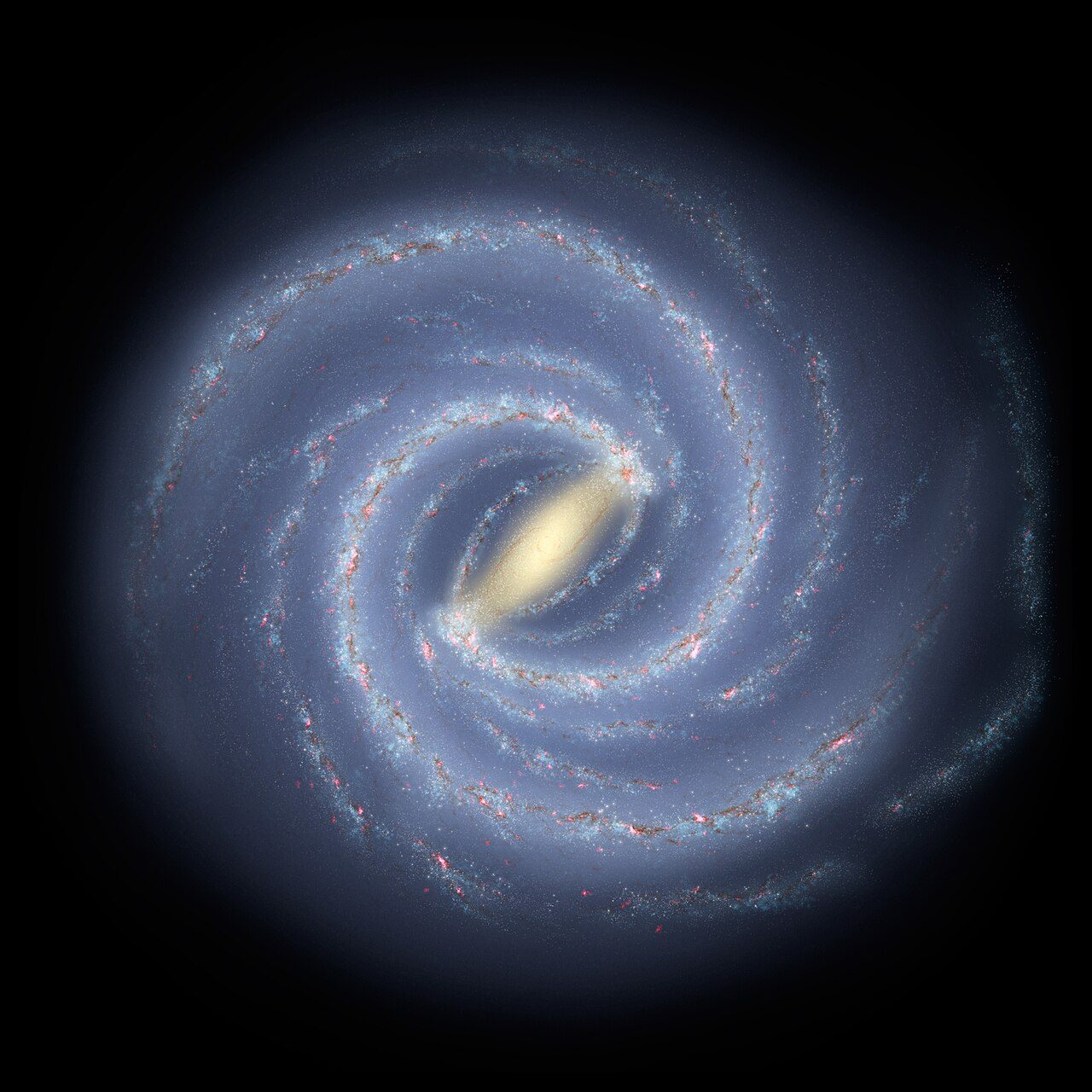
The galaxy is a barred spiral: a rotating disk more than 100,000 light-years across, holding probably 100 to 400 billion stars, with spiral arms trailing from a straight bar of older stars at its centre. The Sun is an unremarkable star in a minor arm, the Orion Spur, about 26,000 light-years out from the middle — roughly halfway to the edge — and it carries Earth around the galactic centre once every 240 million years or so.
Background
At the centre, about 27,000 light-years away in the direction of Sagittarius, sits Sagittarius A*: a supermassive black hole of some four million solar masses, quiet by the standards of galactic nuclei but massive enough to anchor the orbits of stars that whip around it at measurable fractions of the speed of light. Around the bright disk extends a sparse halo of ancient globular clusters and, dominating the galaxy's true mass, a far larger halo of dark matter whose gravity binds the whole structure together.
The Milky Way did not form in one piece. It grew over more than 13 billion years by gravity and by cannibalism, pulling in gas and swallowing smaller galaxies whose stars still stream through it today. It belongs to the Local Group, a gathering of over 50 galaxies whose two giants are the Milky Way and Andromeda, itself part of the Laniakea supercluster. Its future includes its neighbour: Andromeda is approaching, though recent analyses combining Hubble and Gaia data put the odds of an actual merger in the next ten billion years at only about fifty-fifty.
Timeline
- 1610
Galileo turns a telescope on the Milky Way and finds its glow resolves into innumerable faint stars — the band is made of stars too distant and crowded to separate by eye.
- 1785
William Herschel publishes the first map of the galaxy's shape, built by counting stars in hundreds of regions of the sky; his disk, with the Sun near the centre, stands for over a century.
- 1918
Harlow Shapley measures the globular clusters and shows their centre — the galaxy's true centre — lies far from the Sun. We are not at the middle of anything.
- 1920
Shapley and Heber Curtis stage the “Great Debate” in Washington on the scale of the universe and whether spiral nebulae are separate galaxies.
- 1924
Edwin Hubble finds Cepheid variable stars in the Andromeda nebula and measures its distance: far beyond the Milky Way. Our galaxy is one among many.
- 2008
Infrared images from NASA's Spitzer Space Telescope reveal the galaxy's central bar clearly and demote two of its four supposed major spiral arms to minor ones.
- 12 May 2022
The Event Horizon Telescope collaboration publishes the first image of Sagittarius A*, the black hole at the galaxy's heart — a glowing ring around a dark shadow 27,000 light-years away.
Significance
The Milky Way is astronomy's reference galaxy — the one system whose stars can be counted, dated and tracked individually, and therefore the yardstick against which the billions of galaxies seen only as smudges of light are interpreted. Almost every demotion in the history of science runs through it: Herschel put us at the centre, Shapley moved us to the suburbs, Hubble reduced the whole galaxy to one island among multitudes. Our address kept shrinking, and our universe kept growing.
It is also a time machine with the dials exposed. Because its stars are close, their ages, chemistry and motions can be read in detail, letting astronomers reconstruct how galaxies assemble — which stars were born here, which arrived in swallowed dwarfs, and how the disk settled into its present calm. The Gaia mission's census of well over a billion stars has turned that reconstruction from sketchwork into survey-grade history.
Legacy
The galaxy's study is mid-transformation. Star-by-star surveys are tracing its merger history in chemical fingerprints; the black hole at its centre has gone from inference to image within a working lifetime; and the question of its eventual meeting with Andromeda has been honestly reopened by better data. The Milky Way remains what it has been since 1610: the nearest place where the universe explains itself.
And the band still rises over dark countryside every clear night, unchanged to the eye — the disk of a barred spiral galaxy, carrying its four-million-solar-mass heart, its swallowed companions and one small solar system halfway out, around once more.
Sources
- NASA Science — Galaxies
- NASA Goddard Imagine the Universe! — The Milky Way Galaxy
- NASA Science — Our Milky Way Galaxy: How Big is Space?
- European Southern Observatory — Astronomers reveal first image of the black hole at the heart of our galaxy (eso2208)
The facts on this page were checked against these sources on 19 November 2026. The History Trail's permanent pages are researched and written for this site; the live profiles elsewhere on The History Trail are assembled automatically from Wikipedia and Wikidata.
About the Author
Researched and written by the The History Trail Editorial Team — the accountable editorial function behind this site's permanent story pages. The team works from the published sources cited on each page; it does not invent historians, reviewers or credentials, and it corrects errors openly.
Fact Check
Every load-bearing fact on this page traces to one of the sources listed above, and significant claims link to their source in the text. Our checking method is described on the methodology page; errors can be reported via the corrections page.
Sources & Citations
Cite this page as: The History Trail Editorial Team, The History Trail — this article's title, publication and update dates are shown beneath its headline. The full source list appears under Sources above; the site's source standards are on the sources page.