
Things
Swiss franc
The Swiss franc was not born strong. Created in 1850 as a near-copy of the French franc for a brand-new federal state, it spent fifty years as a satellite currency — then, under the Swiss National Bank, built the most durable reputation for stability of any money in the world.
At a Glance
- Introduced
- 1850, by the Federal Coinage Act
- Country
- Switzerland (and Liechtenstein)
- ISO code
- CHF — Confoederatio Helvetica franc
- Issued by
- Swiss National Bank (opened 1907)
- Subdivision
- 100 centimes (Rappen in German)
- Reputation
- The archetypal safe-haven currency
- Long-lived coin
- 10-centime coins minted in 1879 are still legal tender
Introduction
Switzerland invented its currency almost as an afterthought of inventing itself. When the loose confederation of cantons became a federal state in 1848, the right to mint coins passed to the Confederation — but money remained a chaos of cantonal and foreign pieces. The Federal Coinage Act of 1850 ended the disorder by creating the Swiss franc, modelled closely on the French franc, and the new unit established itself across the country with surprising speed and no great difficulty.
Nothing about the young franc promised greatness. The Swiss National Bank's own historian calls it, for its first fifty years, essentially a satellite of the French franc. Switzerland joined the Latin Monetary Union in 1865, tying its coinage to the shared gold-and-silver standard of France, Belgium and Italy. What the franc had, from the start, was a country that kept its finances in order — and in time, that proved to be the whole secret.
Background
The missing institution arrived late. Through the nineteenth century the franc circulated alongside notes issued competitively by dozens of independent cantonal and private banks, with no common discount policy and no lender of last resort. Only after a constitutional article in 1891 set the course did the Swiss National Bank finally open its doors in June 1907, taking over the note issue for the whole country and giving Switzerland, nearly sixty years after the franc, a central bank to defend it.
The National Bank applied the rules of the gold standard with unusual strictness, restoring the pre-war gold parity by 1924 after the First World War's inflation. Switzerland stayed in the shrinking Gold Bloc long after sterling (1931) and the dollar (1933) had devalued; only in 1936, following France, did the federal authorities reluctantly reduce the franc's gold parity. Under Bretton Woods the franc was pegged to the dollar, and when that system collapsed the National Bank took the decisive step of floating the franc in 1973.
Timeline
- 1848
Switzerland becomes a federal state; the right to mint coins passes to the Confederation.
- 1850
The Federal Coinage Act creates the Swiss franc, modelled on the French franc, as the national currency.
- 1865
Switzerland joins the Latin Monetary Union with France, Belgium and Italy, on a shared gold-and-silver standard.
- 1879
The 10-centime coin design of this year is struck; examples from 1879 still circulate as legal tender today.
- 20 June 1907
The Swiss National Bank opens, taking over note issuance for the whole country from dozens of competing banks.
- 1924
After First World War inflation, the National Bank restores the franc's pre-war gold parity, formally confirmed in 1926.
- 1936
Following France's devaluation, the Swiss federal authorities reduce the franc's gold parity — the franc's only devaluation of the era.
- 1973
As the Bretton Woods system collapses, the National Bank stops intervening and floats the Swiss franc.
- 1 January 2000
A revised constitution removes the last legal gold-backing requirement for the franc, completing its move to a pure fiat currency.
Significance
The franc's significance is a reputation that became a force of nature. Because Switzerland combined political neutrality, fiscal discipline and a central bank visibly willing to endure pain for price stability, the world's money began flowing into francs whenever trouble appeared — in the 1930s, in the 1970s, and in every crisis since. The National Bank's own centenary history records average inflation of about 2.5 per cent a year across its first century: not the lowest imaginable, but achieved while the franc appreciated relentlessly against almost everything else.
That safe-haven status cuts both ways, and managing it has defined modern Swiss policy: the stronger the world's fear, the stronger the franc, and the greater the pressure on Switzerland's exporters. The franc thus became a kind of global anxiety index — a currency whose exchange rate reads the world's mood. Its journey from French satellite to independent investment currency of the first rank, in the words of the National Bank's historian, tracks Switzerland's own rise to financial centrality.
Legacy
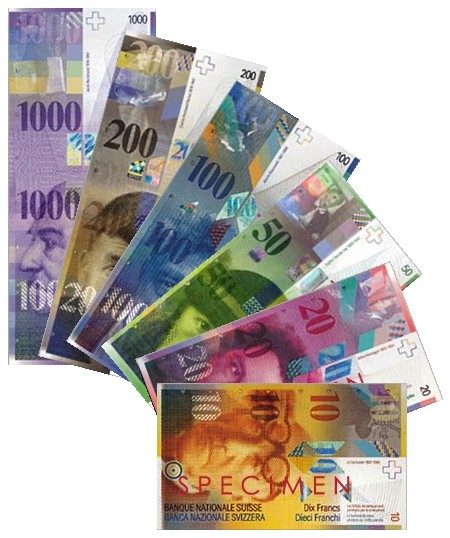
The franc today is the last of the great European national currencies outside the euro, kept deliberately by a country that has voted to stay apart — and one of the five or six currencies in which the world holds its reserves. Its banknotes are showcases of Swiss design, and its coins still include pieces whose designs predate the National Bank itself. The gold link that once defined it was finally written out of the constitution in 2000, and the franc did not blink.
Its legacy is the demonstration that a currency's strength is a social achievement, not a geological one. Switzerland has no resources that money requires; it has habits — balanced budgets, an independent central bank, a long memory for inflation. The franc of 1850 was a copy of France's. The franc of today is the original of which 'safe haven' is the copy, quoted everywhere money seeks shelter.
Sources
- Swiss National Bank — Why we should be interested in the history of currencies (Baltensperger, 2012)
- Swiss National Bank — Historical time series: 100 years of financial statements (2007)
- Swiss National Bank via BIS — 'A franc remains a franc': 100 years of National Bank policy (Roth, 2007)
- Swiss National Bank — Questions and answers on coins
- Swiss National Bank — A view on Switzerland in the run up to the demonetisation of gold (Roth, 1999)
The facts on this page were checked against these sources on 19 November 2026. The History Trail's permanent pages are researched and written for this site; the live profiles elsewhere on The History Trail are assembled automatically from Wikipedia and Wikidata.
About the Author
Researched and written by the The History Trail Editorial Team — the accountable editorial function behind this site's permanent story pages. The team works from the published sources cited on each page; it does not invent historians, reviewers or credentials, and it corrects errors openly.
Fact Check
Every load-bearing fact on this page traces to one of the sources listed above, and significant claims link to their source in the text. Our checking method is described on the methodology page; errors can be reported via the corrections page.
Sources & Citations
Cite this page as: The History Trail Editorial Team, The History Trail — this article's title, publication and update dates are shown beneath its headline. The full source list appears under Sources above; the site's source standards are on the sources page.