
Things
Japanese Tea Ceremony
The Japanese tea ceremony — chanoyu, 'hot water for tea' — is the choreographed preparation and sharing of whisked matcha in a hermit's-hut room. Shaped by Zen, perfected by Sen no Rikyū in the 16th century, it turned a drink into a discipline of attention.
At a Glance
- Japanese names
- Chanoyu ('hot water for tea'); sadō / chadō, 'the way of tea'
- Tea served
- Matcha — powdered green tea whisked in hot water
- Setting
- A chashitsu tearoom, often a small hut modelled on a hermit's dwelling, holding four or five people
- Four principles
- Harmony (wa), respect (kei), purity (sei), tranquillity (jaku)
- Aesthetic
- Wabi — deliberate simplicity, rusticity and absence of ornament
- Defining master
- Sen no Rikyū (1522–1591), who perfected the ceremony and raised it to an art
- Leading schools
- Omotesenke, Urasenke and Mushanokōjisenke, descended from Rikyū
Introduction
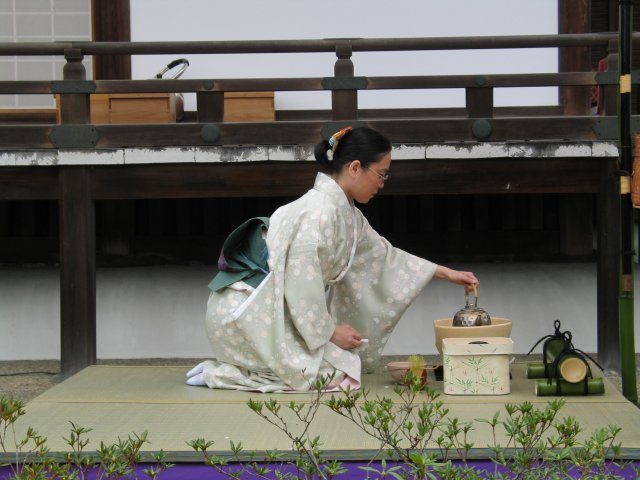
The Japanese tea ceremony is a ritualised practice in which a host prepares and serves matcha — powdered green tea whisked in hot water — to a small group of guests, following procedures codified over centuries. That is the direct answer; everything else about it follows from where it happens. The ceremony takes place in a tearoom, a chashitsu, ideally a small detached hut modelled on a hermit's dwelling and set in a garden, large enough for only four or five people. Practitioners call the practice chanoyu, literally 'hot water for tea', or sadō and chadō — 'the way of tea' — and mastering its choreographed art takes many years of study.
Inside that small room, the emphasis falls on the interaction between host, guests and utensils. The host chooses an assemblage of objects for that gathering alone — a scroll, flowers, a tea bowl, a caddy, a water jar — and prepares the tea before the guests, who are expected to notice: to reflect on the warmth of the bowl, and on the bright green of the matcha against the clay, before they drink. Tea is the medium of the ceremony. Attention — to the season, the objects and one another — is its real subject.
Origins
Ritual tea drinking originated in China, and tea reached Japan from China over several centuries, carried by monks and envoys. The decisive chapter is traditionally dated to 1191, when the monk Myōan Eisai, who had encountered tea as a medicine while studying in China, is believed to have introduced the practice to Japan; in 1211 he presented his treatise on the benefits of drinking tea to the shogun of the day. In the Kamakura period that followed, Zen monks drank tea to keep awake through long sessions of meditation, and the handling of tea acquired rules inside the monasteries — the root from which the ceremony grew.
In the 15th century the Zen monk Murata Jukō — also read Shukō (1423–1502), who had studied under the Zen master Ikkyū — is credited as the founder of the Japanese tea ceremony, turning tea drinking into a spiritual practice. Against the fashionable taste for precious Chinese objects, Jukō returned tea to utter simplicity and a small room of four and a half tatami mats. His successor in the line, Takeno Jōō (1502–1555), a merchant of Sakai, carried the ideal further and gave tea its enduring aesthetic keynote: wabi, the beauty of things rustic, plain and imperfect. Jōō taught the young Sen no Rikyū — and through Rikyū, the line became a school that Japan still follows.
Timeline
- 1191
The monk Myōan Eisai is believed to have introduced tea drinking to Japan from China, having encountered tea as a medicine; in 1211 he presents his treatise on curative tea-drinking to the shogun Minamoto no Sanetomo.
- Kamakura period (1192–1333)
Zen monks in Japan drink tea to keep awake during long sessions of meditation, and ritual tea drinking takes root in the monasteries.
- 15th century
Murata Jukō, a Zen monk, founds the Japanese tea ceremony as a spiritual practice, favouring simplicity and a tearoom of four and a half tatami mats.
- 1502–1555
Takeno Jōō develops wabi-cha, applying the ideal of wabi — rustic, quiet simplicity — to tea, and initiates his pupil Rikyū into the tradition.
- 1522
Sen no Rikyū is born in the port city of Sakai, into a wealthy merchant family.
- 1570
Rikyū first serves tea to the warlord Oda Nobunaga; he goes on to serve Nobunaga, and then Toyotomi Hideyoshi, as tea master, becoming the most influential figure in chanoyu.
- 1582
Rikyū designs the Tai-an tearoom at Myōki-an temple near Kyoto: just two tatami mats, entered through a tiny crawling-in door that obliges every guest to bow.
- 1587
Hideyoshi hosts the Grand Kitano Tea Ceremony at the Kitano shrine in Kyoto, an extravagant gathering open to guests of all social classes, with Rikyū officiating.
- 1591
Rikyū dies in Kyoto, ordered by Hideyoshi to take his own life; his teachings pass to his descendants.
- 17th century
Rikyū's descendants found the three Sen schools — Omotesenke, Urasenke and Mushanokōjisenke — dedicated to passing forward his teachings.
- Today
The ceremony that emerged in the 16th century is taught by the tea schools in Japan and around the world.
Significance
Rikyū and the other developers of the ceremony built it on four qualities, still taught as its principles: harmony (wa), between the guests and the implements used; respect (kei), not only among the participants but also for the utensils; purity (sei), or cleanliness, derived from Shintō practice and symbolised by washing the hands and rinsing the mouth before entering the tearoom; and tranquillity (jaku), imparted through the long and caring use of each article. Around those principles Rikyū codified the style called wabi-cha — simplicity, quietude and absence of ornament — redefining the ceremony in all its aspects: its rules of procedure, its utensils, its teahouse architecture and even its tea-garden landscaping.
The aesthetic had material consequences. Where earlier taste prized ancient Chinese treasures, the wabi masters, as the Metropolitan Museum of Art describes, began to incorporate rustic ceramic vessels from Korea and Japan, finding beauty in unrefined, natural or imperfect forms — farmers' unglazed stoneware jars from kilns such as Shigaraki and Bizen, elevated by the tea men's connoisseurship to the level of art, and hand-moulded Raku bowls, whose family of potters traces its lineage to Rikyū's time. The ceremony was also a social instrument: an elite pursuit in which rulers, the warrior elite and wealthy merchants forged and reinforced their ties — even as Rikyū's tiny door required every one of them, whatever his rank, to bow to enter.
Legacy
Rikyū's legacy is institutional as well as aesthetic. The three Sen schools descended from him — Omotesenke, Urasenke and Mushanokōjisenke — still transmit his way of tea, and the Raku family still produces the hand-moulded tea bowls first prized in his circle. The wabi sensibility he firmly established, joined to sabi, the appreciation of the old and faded, spread far beyond the tearoom to become one of the defining ideas of Japanese art: a sophisticated taste for artful poverty, for objects whose value lies in age, accident and restraint rather than in cost or finish.
The ceremony itself survives as a living discipline rather than a museum piece: practised in tearooms and taught by schools across Japan and around the world, still held in a small room modelled on a hermit's hut, still governed by harmony, respect, purity and tranquillity. Five centuries after Rikyū, a guest still bows through a small door, still notices the warmth of the bowl before drinking, and still joins a gathering that will never happen again. Few rituals have kept so much of their founder's intention intact.
Sources
- The Metropolitan Museum of Art (Heilbrunn Timeline) — The Japanese Tea Ceremony
- The Metropolitan Museum of Art (Heilbrunn Timeline) — Muromachi Period (1392–1573)
- Encyclopaedia Britannica — Tea ceremony
- Encyclopaedia Britannica — Sen Rikyū
- Wikipedia — Japanese tea ceremony
The facts on this page were checked against these sources on 19 November 2026. The History Trail's permanent pages are researched and written for this site; the live profiles elsewhere on The History Trail are assembled automatically from Wikipedia and Wikidata.
About the Author
Researched and written by the The History Trail Editorial Team — the accountable editorial function behind this site's permanent story pages. The team works from the published sources cited on each page; it does not invent historians, reviewers or credentials, and it corrects errors openly.
Fact Check
Every load-bearing fact on this page traces to one of the sources listed above, and significant claims link to their source in the text. Our checking method is described on the methodology page; errors can be reported via the corrections page.
Sources & Citations
Cite this page as: The History Trail Editorial Team, The History Trail — this article's title, publication and update dates are shown beneath its headline. The full source list appears under Sources above; the site's source standards are on the sources page.