
Things
Denarius
The denarius was Rome's standard silver coin for nearly five centuries: introduced during the Second Punic War, tariffed at ten bronze asses, and trusted across the Mediterranean. Its long, slow debasement — less silver, then less again — tracks the fortunes of the empire that minted it.
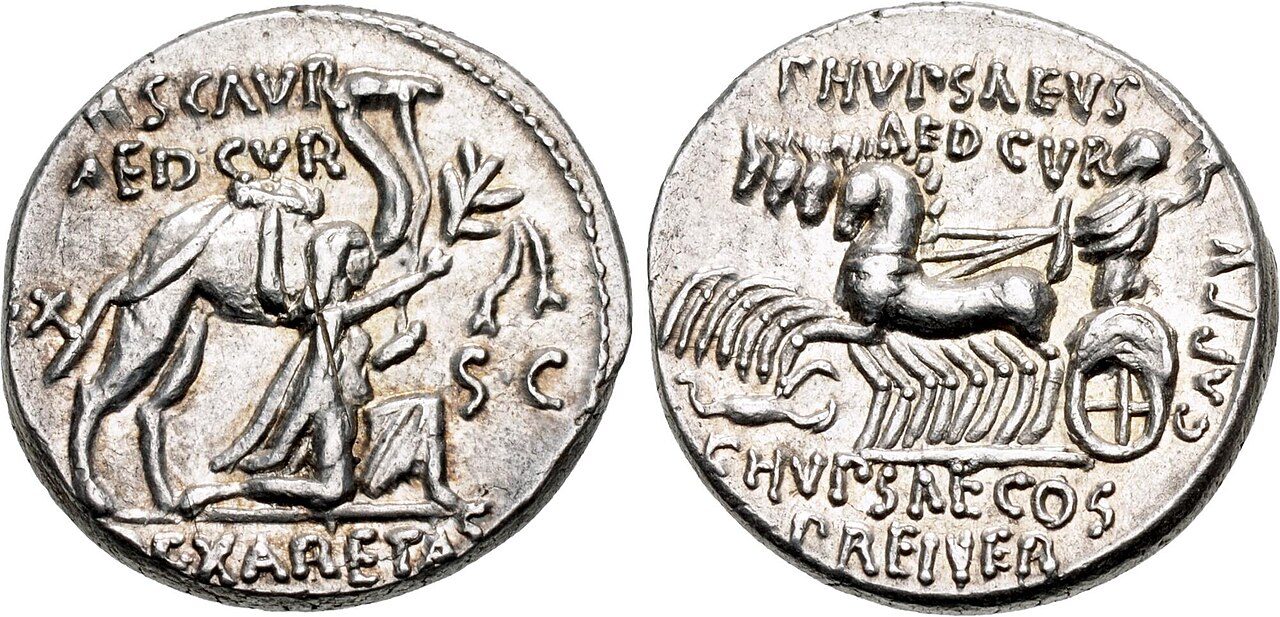
At a Glance
- Introduced
- About 211 BC, during the Second Punic War
- Name
- From Latin deni, 'containing ten' — originally worth 10 asses
- Original weight
- About 4.5 grams of silver (1/72 of a Roman pound)
- First types
- Head of Roma; the Dioscuri (Castor and Pollux) with ROMA
- Revalued
- About 141–133 BC, to 16 asses as the as shrank
- Under Augustus
- Weight settled at about 3.9 grams, nearly pure silver
- Superseded
- Gradually replaced by the antoninianus in the 3rd century AD
Introduction
The denarius was the principal silver coin of ancient Rome, and for centuries the backbone of its money. Rome introduced it about 211 BC, in the middle of the Second Punic War against Carthage, as part of an overhaul of a coinage strained by years of emergency issues. The new coin was marked X — ten — because it was tariffed at ten bronze asses; its very name, denarius, means 'containing ten'. It weighed about 4.5 grams, one seventy-second of a Roman pound, and was struck in high-purity silver.
The design announced the state, not a ruler: on one side the helmeted head of Roma, on the other the Dioscuri — the twin gods Castor and Pollux — galloping, with the word ROMA beneath. Production centred on the mint of Rome itself. Within a generation the denarius had established itself, in the Encyclopaedia Britannica's phrase, as the major currency of the central and western Mediterranean, the coin in which soldiers were paid, taxes assessed and trade across Rome's growing world conducted.
Background
The denarius was born of financial stress. Rome's earlier silver, the quadrigati, had been accompanied by a bronze coinage whose weight collapsed under wartime pressure, leaving the relationship between bronze and silver unsettled. The reform of about 211 BC fixed that relationship: the denarius at ten asses, with silver fractions beside it — the quinarius at five asses and the sestertius at two and a half. A lighter silver victoriatus circulated alongside, mainly, it seems, for use outside Italy, until about 150 BC.
The system then adjusted as bronze shrank. The as dwindled to a token coin of an ounce or less, and around 141 to 133 BC the denarius was revalued at sixteen asses instead of ten, while keeping its name and types. Under Augustus, at the end of the 1st century BC, the imperial denarius settled at about 3.9 grams — one eighty-fourth of a pound — in nearly pure silver, and the gold aureus was fixed at 25 denarii. That Augustan standard is the benchmark against which the coin's later decline is measured.
Timeline
- About 211 BC
Rome introduces the denarius during the Second Punic War: silver, about 4.5 grams, marked X and tariffed at ten asses, with Roma and the Dioscuri as its types.
- About 150 BC
The victoriatus, the lighter companion silver coin used mainly outside Italy, ceases production; the denarius stands alone as Rome's silver standard.
- About 141–133 BC
The denarius is revalued from ten to sixteen asses, reflecting the shrinking weight of the bronze as.
- 89 BC
Amid economic difficulty the denarius is temporarily debased, and serrated-edged denarii are issued to show they are solid, not plated.
- 27 BC – AD 14
Under Augustus the denarius settles at about 3.9 grams of nearly pure silver; 25 denarii equal one gold aureus.
- AD 64
Nero reduces the denarius to about 3.4 grams and lowers its fineness — the first of the imperial reductions that Britannica and later studies trace.
- AD 215
Caracalla introduces the antoninianus, tariffed at two denarii but containing far less than twice the silver, beginning the denarius's displacement.
- AD 238–244
Under Gordian III the denarius fades from regular production, gradually replaced by the antoninianus after nearly 450 years.
Significance
The denarius mattered because it was trusted at scale. A uniform, high-purity silver coin, produced mainly at one mint and accepted from Spain to Syria, let Rome pay armies, collect taxes and settle trade in a single medium — the monetary plumbing of empire. Its types also became a medium of communication: after the Republic, the coinage was controlled by the state, and imperial portraits and reverse types carried the emperor's image and messages to people who would never see Rome.
Its debasement is equally instructive. Beginning under Nero and accelerating in the 3rd century, emperors stretched the silver supply by reducing weight and fineness, until the antoninianus that replaced the denarius held only a fraction of the silver its face value implied. The coinage thus preserves, in metal, a record of fiscal pressure — civil wars, military costs and a state spending beyond its bullion. Hoards buried across the former empire, like those catalogued by the British Museum, still let historians read that record coin by coin.
Legacy
The denarius outlived itself in language and in money. The abbreviation 'd' for the British penny, used until decimalisation in 1971, descended from denarius; the dinar of several modern states carries the same name across two thousand years; and the Spanish word dinero — simply 'money' — is the denarius worn smooth by use. Few artefacts of Rome are still, in this sense, in circulation.
For historians, the coin remains a primary source in its own right: dated, official, mass-produced and found everywhere Rome ruled. Its portraits chart imperial succession, its reverses advertise victories and virtues, and its declining silver content graphs the empire's finances with a precision no chronicle matches. The denarius began as a wartime expedient in 211 BC; it ended as one of the longest-lived and most informative currencies ever struck.
Sources
- Encyclopaedia Britannica — Roman coins, republic and empire
- Encyclopaedia Britannica — Denarius
- British Museum — Collection record: silver denarius of Hadrian
- Wikipedia — Denarius
The facts on this page were checked against these sources on 19 November 2026. The History Trail's permanent pages are researched and written for this site; the live profiles elsewhere on The History Trail are assembled automatically from Wikipedia and Wikidata.
About the Author
Researched and written by the The History Trail Editorial Team — the accountable editorial function behind this site's permanent story pages. The team works from the published sources cited on each page; it does not invent historians, reviewers or credentials, and it corrects errors openly.
Fact Check
Every load-bearing fact on this page traces to one of the sources listed above, and significant claims link to their source in the text. Our checking method is described on the methodology page; errors can be reported via the corrections page.
Sources & Citations
Cite this page as: The History Trail Editorial Team, The History Trail — this article's title, publication and update dates are shown beneath its headline. The full source list appears under Sources above; the site's source standards are on the sources page.