
Things
Pasta
Pasta - dough of durum wheat flour and water, shaped and boiled - was already being made commercially in Sicily in 1154, over a century before Marco Polo left for China. The story that Polo brought pasta from China is a myth, popularised by an American trade magazine in 1929. Pasta's real history runs through Arab Sicily, Naples and Gragnano, a late-arriving tomato, and the emigrants who carried it around the world.
At a Glance
- What it is
- Unleavened dough, usually of durum wheat semolina and water (sometimes egg), shaped, often dried, and cooked in boiling water
- First clear record
- 1154: the geographer al-Idrisi describes itriyya, dried string pasta, made in quantity at Trabia in Sicily and exported by ship
- The Marco Polo story
- A myth. Polo returned in 1295, after pasta was already documented in Sicily (1154) and Genoa (1279); the tale was popularised by the Macaroni Journal in 1929
- Why durum wheat
- Durum's high gluten lets pasta hold its shape in manufacture and in boiling water, and lets dried pasta keep almost indefinitely
- Production centres
- Naples and nearby Gragnano, whose mills, sun and sea breezes made it the famous centre of dried pasta in the 19th century
- The tomato
- A New World food, brought to Europe in the 16th century; pasta in tomato sauce is documented from the late 18th century and became common in the 19th
- The American chapter
- Some 4 million Italians emigrated to the United States between 1880 and 1920; there they created spaghetti and meatballs, a dish Italy itself did not have
Introduction
Pasta looks simple: flour, water, a shape, a pot of boiling water. Yet few foods carry so much disputed history. Noodles are ancient in China, grain pastes are ancient around the Mediterranean, and the dried pasta the world now buys in packets is a specific invention - durum wheat dough, shaped and dried so it can be stored, shipped and boiled back to life months later. That invention belongs to the medieval Mediterranean, and its first clear record is Sicilian.
From Sicily, pasta spread up the Italian peninsula, became the street food and then the emblem of Naples, acquired a tomato sauce only in the age of steam, crossed the Atlantic with millions of emigrants, and returned as something new. Its history is also a warning about food legends: the best-known story about its origin is less than a hundred years old and was written to sell macaroni.
Ancient Pastes and Arab Sicily
The ancient Mediterranean knew grain doughs. Roman writers mention lagana, sheets of dough, and Greek and Roman medical writers knew semolina preparations. But sheets of fresh dough are not yet pasta secca, dried pasta. The crucial steps were durum wheat - a hard wheat, domesticated from emmer in the Fertile Crescent, whose high gluten holds a shape through drying and boiling - and the technique of drying shaped dough for storage and travel, which food historians associate with the Arab world.
Arabs conquered Sicily from 827, completing the conquest by 902, and the island became a meeting point of Arab, Greek and Norman cultures. In 1154 the Arab geographer Muhammad al-Idrisi, working at Palermo for the Norman king Roger II, described the town of Trabia, east of Palermo, where streams drove mills and estates made vast quantities of itriyya - dried string pasta - exported by the shipload to Calabria and to Muslim and Christian countries alike. It is the first clear account of pasta as a commercial, exportable product, and it predates Marco Polo's birth.
The record keeps accumulating before Polo. A Genoese notarial inventory of 1279 lists a basket of macaroni among the possessions of a soldier named Ponzio Bastone. Polo did not return from China until 1295 - and in his own account he compared Asian noodles to the vermicelli and lasagna he already knew from Italy, the opposite of introducing them.
Naples, Gragnano and the Age of Dried Pasta
Through the later Middle Ages and the centuries after, pasta production spread from Sicily to other dry, durum-growing coasts - Apulia, Sardinia and Campania. Naples became its capital of consumption: a huge, poor city whose people needed cheap, filling food, and whose macaroni sellers and vermicelli makers formed guilds. At first dried pasta was relatively costly, because the stiff durum dough had to be kneaded for a long time; presses and mechanised extrusion, developed from the 17th century onward, brought the price down and turned pasta into everyday food.
Just south of Naples, Gragnano became the production town par excellence. It had water mills in its valley, durum wheat from Apulia, and a daily pattern of sun and sea breeze ideal for slow outdoor drying, with strands hung on racks along its streets. In the 19th century Gragnano was famous across Europe as the city of macaroni - its white gold - supplying Naples, Italy and, increasingly, the emigrant ships. Naples gave pasta its public image, the macaroni-eating street crowds; Gragnano gave it scale.
The Tomato Arrives Late
For most of its history, pasta was eaten white - with cheese, butter, oil or broth. The red plate the world now pictures is recent, for a simple reason: the tomato is American. Tomatoes reached Europe from the New World in the 16th century and were long grown as curiosities and suspected as unhealthy. The first written tomato sauce recipe, Antonio Latini's Spanish-style sauce, appeared in Naples in 1692 - as a sauce for meat, not pasta.
The pairing came later. Leonardi's Roman cookbook L'Apicio Moderno gave a tomato sauce for pasta in 1790, and Neapolitan cookbooks of the 1830s and 1840s printed vermicelli with tomato sauce. Only in the 19th century, as tomatoes became a cheap southern crop and canning spread, did pasta al pomodoro become the ordinary dish - and eventually the symbol - it is today. Red pasta is younger than the railway age that carried it abroad.
Timeline
- 827-902
Arab forces conquer Sicily; durum wheat culture and dried-pasta techniques deepen on the island.
- 1154
Al-Idrisi describes itriyya made in quantity at Trabia, Sicily, and exported by ship - the first clear record of commercial dried pasta.
- 1279
A Genoese inventory lists a basket of macaroni in the estate of Ponzio Bastone, sixteen years before Marco Polo returns.
- 1295
Marco Polo returns from China; his account compares Asian noodles to Italian vermicelli and lasagna he already knew.
- 1692
Antonio Latini publishes the first written tomato sauce recipe in Naples - for meat, not yet for pasta.
- 1790
Francesco Leonardi's L'Apicio Moderno prints tomato sauce served with pasta.
- 19th century
Gragnano, near Naples, becomes Europe's famous dried-pasta town; pasta al pomodoro becomes a common dish.
- 1880-1920
About 4 million Italians emigrate to the United States, carrying pasta with them and creating Italian-American dishes.
- 1929
The Macaroni Journal, an American pasta trade magazine, prints the tale that popularises the Marco Polo origin story.
- 1958
Momofuku Ando launches Chikin Ramen in Japan - instant noodles, the pasta family's industrial, global cousin.
Significance
Pasta matters because it solved a permanent problem: how to turn a harvest into a food that keeps, travels and feeds people cheaply. Dried pasta is stored sunshine - durum wheat, water and air - and that is why it spread from Sicilian ports to every supermarket on earth. It also became, after Italian unification, a national symbol: a food of the poor south that the whole country, and then the whole world, adopted as Italy's signature.
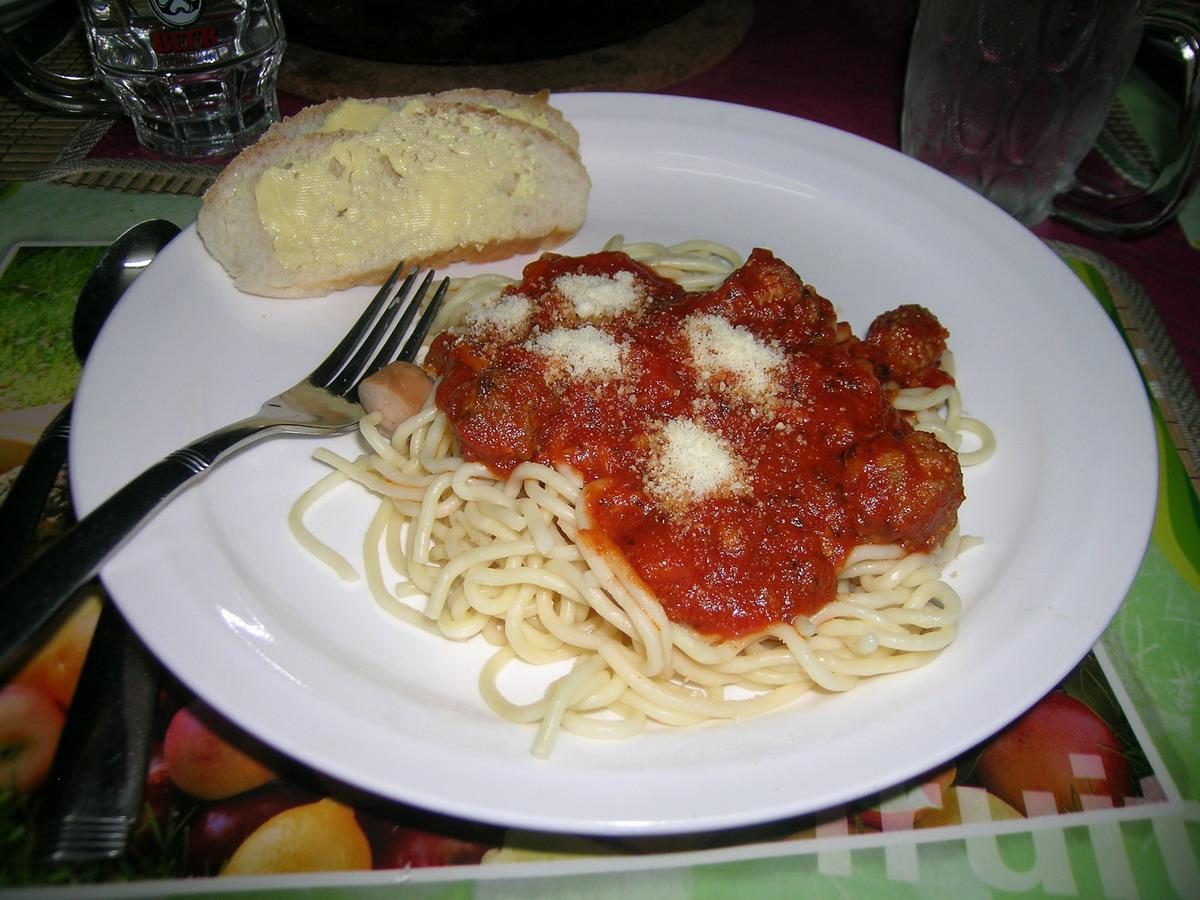
Emigration wrote its second act. In the United States, Italian immigrants found meat, once a rare luxury, suddenly affordable: Smithsonian Magazine records that they went from spending about 75 percent of their income on food in Italy to about 25 percent in America. Their small polpette, meatballs eaten alone or in soup in Italy, grew large, met canned tomato sauce and factory spaghetti, and became spaghetti and meatballs - 100 percent American, as Smithsonian puts it, and unknown as such in Italy.
Myths and disputes
Did Marco Polo bring pasta from China? No. The chronology alone disproves it: pasta is documented at Trabia in 1154 and in Genoa in 1279, while Polo left for China in 1271 and returned in 1295 - and never claimed to have brought noodles home. Scholars have traced the popular story to a tale printed in 1929 in the Macaroni Journal, the trade publication of North American pasta manufacturers, in which one of Polo's sailors supposedly discovers noodles in China. It was promotional storytelling that hardened into folklore. Chinese noodles are genuinely ancient and developed independently; no documented line runs from them to Italian pasta.
Did the Arabs invent pasta? That, too, is stronger than the evidence allows. Grain pastes existed in the ancient Mediterranean, and exactly who first dried shaped durum dough is not recorded. What the documents support is narrower and still remarkable: the earliest clear description of dried pasta made commercially, for export, comes from Arab-Norman Sicily in 1154, and the word al-Idrisi used, itriyya, is Arabic - its descendant, tria, survives in southern pasta names.
Legacy
Pasta's legacy is a world food built from a regional one. Industrial extrusion and drying, pioneered around Naples, made it a cheap staple on every continent; Italian restaurants carried it everywhere; and its instant cousin - Momofuku Ando's flash-fried Chikin Ramen of 1958 and the Cup Noodles that followed in 1971 - put a dried noodle meal in a packet or cup for more than a hundred billion servings a year. Few foods show so clearly how a technique, a wheat and a migration can feed the planet - or how a 1929 magazine story can outrun eight centuries of documents.
Sources
- Aramco World - Pasta's Winding Way West
- Smithsonian Magazine - Is Spaghetti and Meatballs Italian?
- Italy Magazine - Who Invented Macaroni?
- The Takeout - The Murky Origins of the Classic Pasta and Tomato Sauce Combo
- Government of Japan, Highlighting Japan - Ando Momofuku, the Inventor of Instant Noodles
The facts on this page were checked against these sources on 19 November 2026. The History Trail's permanent pages are researched and written for this site; the live profiles elsewhere on The History Trail are assembled automatically from Wikipedia and Wikidata.
About the Author
Researched and written by the The History Trail Editorial Team — the accountable editorial function behind this site's permanent story pages. The team works from the published sources cited on each page; it does not invent historians, reviewers or credentials, and it corrects errors openly.
Fact Check
Every load-bearing fact on this page traces to one of the sources listed above, and significant claims link to their source in the text. Our checking method is described on the methodology page; errors can be reported via the corrections page.
Sources & Citations
Cite this page as: The History Trail Editorial Team, The History Trail — this article's title, publication and update dates are shown beneath its headline. The full source list appears under Sources above; the site's source standards are on the sources page.