
Vehicles
The steam locomotive — power that moved the world
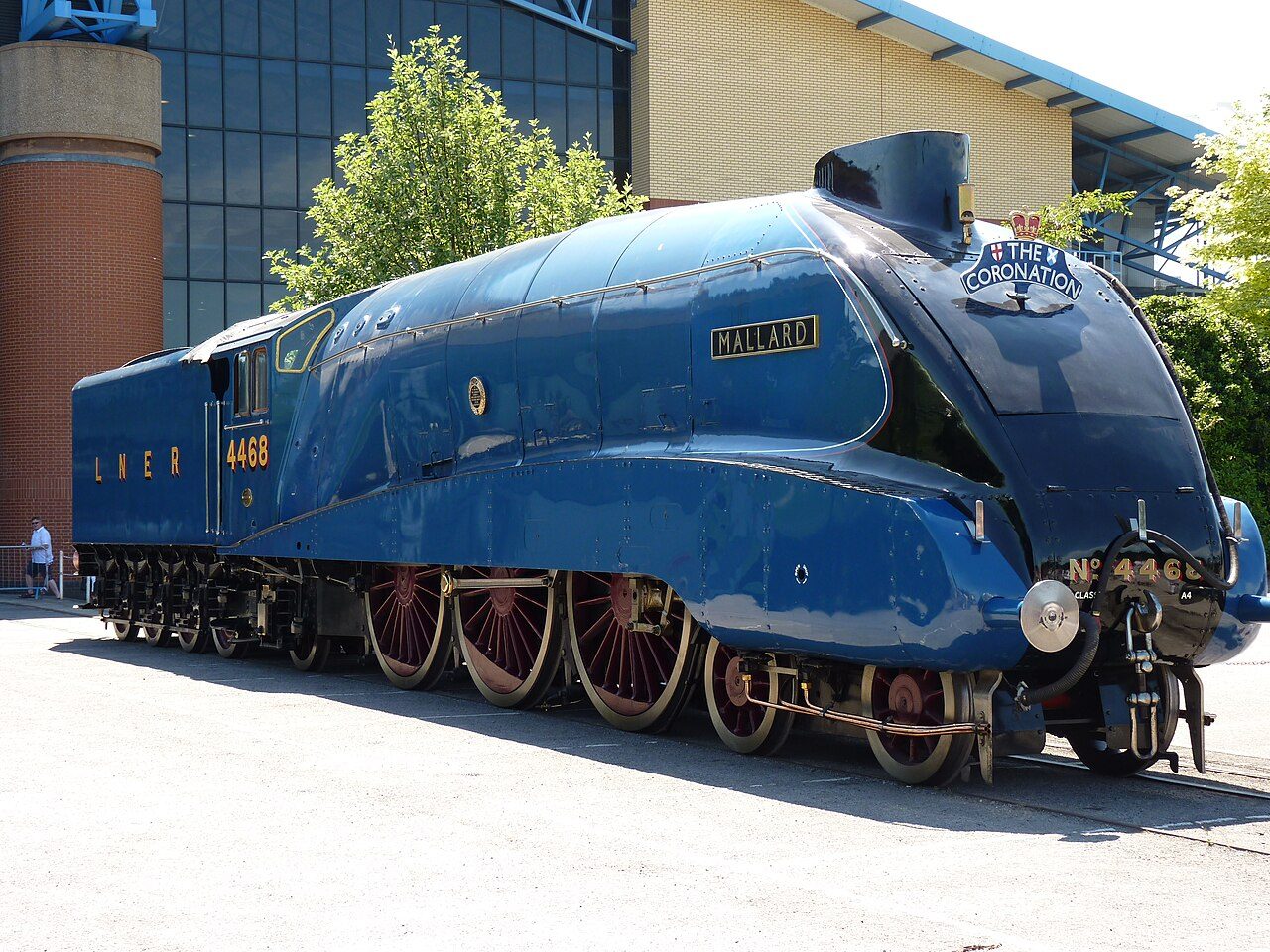
For roughly 150 years the steam locomotive was the fastest, strongest machine on land. It began with a Cornish engine hauling iron in Wales in 1804 and peaked with a streamlined giant at 126 mph in 1938.
At a Glance
- First railway run
- 21 February 1804 — Trevithick's Penydarren locomotive, South Wales
- Key pioneers
- Richard Trevithick; George and Robert Stephenson
- Template design
- Stephenson's Rocket, winner of the Rainhill Trials, October 1829
- First public passenger railway
- Stockton and Darlington Railway, opened 27 September 1825
- Speed record
- 126 mph (203 km/h) by Mallard, 3 July 1938 — still unbeaten for steam
- How it works
- Burning coal, oil or wood boils water; the steam drives pistons connected to the wheels
- Superseded by
- Diesel and electric traction, mainly after the Second World War
Land Travel Learns to Keep a Timetable
The steam locomotive did something no machine had done before: it made land travel fast, cheap and scheduled. Before it, the speed of a journey on land was the speed of a horse, and had been for thousands of years. Within a generation of the first practical locomotives, passengers were travelling at 30, 50, eventually more than 100 miles per hour, and whole economies reorganised themselves around the timetable.
A steam locomotive is a self-contained power station on wheels. It carries its own fuel — coal, oil or wood — and its own water supply. The fire boils water in the boiler, and the resulting steam pushes pistons that turn the driving wheels. Britannica notes that the type remained in almost universal use until about the Second World War, when more efficient diesel and electric traction finally displaced it.
This is the story of the type as a whole: the high-pressure experiments that started it, the Stephensons' design that standardised it, and the record-breakers that ended its reign at the very top of its powers.
Trevithick Dares to Use High-Pressure Steam
The breakthrough belonged to Richard Trevithick, a Cornish engineer who dared to use high-pressure steam where James Watt had feared it was too dangerous. High pressure meant a small, light engine — light enough, Trevithick reasoned, to carry itself. After a steam road carriage in 1801, he built the world's first steam railway locomotive in 1803 at the Penydarren Ironworks in South Wales, and on 21 February 1804 it hauled 10 tons of iron and 70 men along 10 miles of tramway to win a wager for the ironworks' owner.
The idea was right but the infrastructure was not: cast-iron rails kept breaking under his engines' weight, and Trevithick abandoned railways. Others persisted. George Stephenson, a colliery engineer in the north-east of England, built the Blucher to haul coal in 1814 and added the 'steam blast', sending exhaust steam up the chimney to draw the fire and make the locomotive truly practical. On 27 September 1825 his Locomotion hauled the first public passenger train on the Stockton and Darlington Railway, carrying 450 people at up to 15 mph.
Then came the design that fixed the pattern. For the Liverpool and Manchester Railway, a competition — the Rainhill Trials of October 1829 — was held to choose the locomotive. Rocket, built by George Stephenson with his son Robert, beat its rivals and reached 36 mph. Its multitube boiler and exhaust-steam blast, Britannica observes, remained basic features of the steam locomotive to the end of its career.
Timeline
- 1801
Richard Trevithick drives his first full-size steam carriage, the 'Puffing Devil', up a hill in Camborne, Cornwall.
- 21 February 1804
Trevithick's Penydarren locomotive hauls 10 tons of iron and 70 men for 10 miles in South Wales — the first recorded railway journey by locomotive.
- 1808
Trevithick demonstrates his locomotive Catch-me-who-can on a circular track in London, charging the public to watch and ride.
- 1814
George Stephenson's Blucher hauls eight loaded wagons of coal — 30 tons — at Killingworth colliery.
- 27 September 1825
The Stockton and Darlington Railway opens; Stephenson's Locomotion hauls the first public passenger train.
- October 1829
Rocket wins the Rainhill Trials, reaching 36 mph and settling the argument for steam over horses on the new Liverpool and Manchester line.
- 15 September 1830
The Liverpool and Manchester Railway opens — the first inter-city railway worked entirely by steam locomotives.
- 30 November 1934
Flying Scotsman becomes the first steam locomotive officially recorded at 100 mph.
- 3 July 1938
The streamlined A4 Pacific Mallard reaches 126 mph near Grantham — the world speed record for steam, still standing today.
- 25 April 1963
Mallard is withdrawn from service, as diesel and electric traction take over Britain's main lines.
Railway Time and the Reorganised Economy
The locomotive's significance is written into ordinary life. Railways demanded standard time — 'railway time' aligned town clocks to a single national standard — and they made fresh food, seaside holidays, suburban commuting, mass-circulation newspapers and national sporting fixtures practical. Coal, iron and manufactured goods moved at a fraction of their former cost, binding industrial regions into national economies and continents into single markets.
Technically, the locomotive was also a school of engineering. A century of incremental improvement — bigger boilers, compounding, superheating, streamlining, articulated giants such as the Union Pacific Big Boy, the largest type ever built — pushed metallurgy, thermodynamics and manufacturing forward, even though, as Britannica notes, the thermal efficiency of even the ultimate steam locomotives seldom exceeded about 6 percent. Simplicity and toughness kept steam working long after better technology existed.
Steam Retires, the Network Remains
Main-line steam ended at different moments in different countries — in Britain in the 1960s, later in parts of Asia and Africa — but it never entirely vanished. Heritage railways, museum giants such as the National Railway Museum in York, and a handful of main-line steam excursions keep the machines in motion and the skills to run them alive.
The deeper legacy is the network itself. The routes Stephenson surveyed still carry trains; the stations, cuttings, tunnels and standard gauge of the steam age remain the skeleton of modern rail travel. Diesel and electric trains inherited a world the steam locomotive built.
Sources
- Science Museum Group Collection — Richard Trevithick
- Encyclopaedia Britannica — Richard Trevithick
- Encyclopaedia Britannica — Rocket (locomotive)
- Encyclopaedia Britannica — Locomotive (steam locomotives)
- Wikipedia — Stephenson's Rocket (corroboration)
The facts on this page were checked against these sources on 18 November 2026. The History Trail's permanent pages are researched and written for this site; the live profiles elsewhere on The History Trail are assembled automatically from Wikipedia and Wikidata.
About the Author
Researched and written by the The History Trail Editorial Team — the accountable editorial function behind this site's permanent story pages. The team works from the published sources cited on each page; it does not invent historians, reviewers or credentials, and it corrects errors openly.
Fact Check
Every load-bearing fact on this page traces to one of the sources listed above, and significant claims link to their source in the text. Our checking method is described on the methodology page; errors can be reported via the corrections page.
Sources & Citations
Cite this page as: The History Trail Editorial Team, The History Trail — this article's title, publication and update dates are shown beneath its headline. The full source list appears under Sources above; the site's source standards are on the sources page.