
Things
Wheat
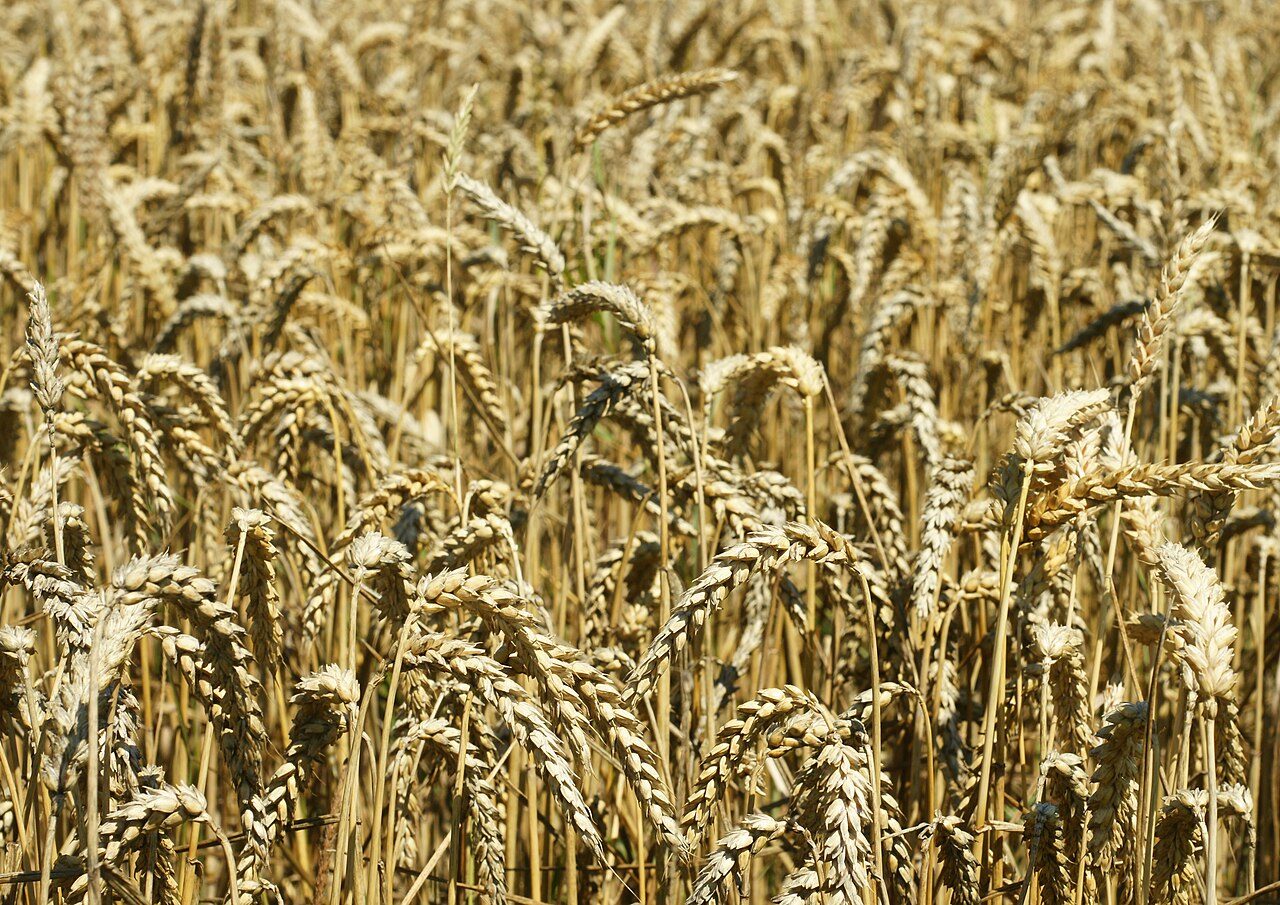
Wheat is a cereal grass of the genus Triticum, first domesticated in the Fertile Crescent around 10,000 years ago from the wild wheats einkorn and emmer. Bread wheat, the hexaploid Triticum aestivum, spread across the Old World, crossed the Atlantic with Spanish colonists, and was transformed in the twentieth century by the semi-dwarf varieties of the Green Revolution.
At a Glance
- What it is
- A cereal grass of the genus Triticum; common wheat, Triticum aestivum, is the world's main bread wheat, durum wheat the pasta wheat
- Domesticated
- In the Fertile Crescent of western Asia, around 9600-8800 BCE, from the founder wheats einkorn and emmer
- Its genetics
- Bread wheat is hexaploid: three genomes combined from three wild grasses, including the goatgrass Aegilops tauschii
- Spread
- Reached Greece by about 6500 BCE, China by about 2000 BCE, and the Americas with Spanish colonists in the early 1500s
- Green Revolution
- Norman Borlaug's semi-dwarf, rust-resistant wheats, bred in Mexico from the 1940s, raised yields across Mexico, India and Pakistan; he received the Nobel Peace Prize in 1970
- Today
- FAO recorded 808 million tonnes of wheat produced in 2022; maize, wheat and rice together account for 90 percent of world cereal production
- Its old enemy
- Stem rust fungus; the Ug99 strain, emerged in Uganda in 1998, overcame the resistance in most of the world's wheat varieties
Introduction
Wheat is a grass that humans remade. The wild wheats of western Asia drop their seeds as soon as they ripen - the ear shatters, scattering grain across the ground. The wheats farmers grow hold onto their grain until the harvester arrives. That single difference, selected grain by grain over thousands of years in the Fertile Crescent, is domestication, and it made wheat one of the founding crops of farming - one of the oldest and most important of the cereal crops, in Britannica's words.
The plant the world now eats is mostly one species, common or bread wheat, Triticum aestivum - a genetic triple hybrid, carrying three whole genomes from three different wild grasses. Its history runs from hunter-gatherers grinding wild grain more than ten thousand years ago, through the empires bread fed, across the Atlantic in Spanish ships, to a twentieth-century breeding programme in Mexico that tripled yields and won its leader the Nobel Peace Prize.
Domestication in the Fertile Crescent
Hunter-gatherers in West Asia harvested wild wheats for thousands of years before farming them; archaeologists have found wild grain gathered at sites such as Abu Hureyra in Syria from around 10,700 BCE. The first wheats to be domesticated, around 9600 to 8800 BCE on the evidence of charred grains from sites in southern Turkey such as Cayonu and Cafer Hoyuk, were einkorn and emmer - the two founder wheats. Einkorn is a simple diploid, with one genome. Emmer is a tetraploid, the product of an ancient cross between two wild grasses, carrying two genomes. In both, farmers - probably at first without intending it - favoured plants whose ears did not shatter and whose grains were larger, because those were the plants whose seed came home in the basket and got sown again.
Bread wheat itself came later, and by accident. Somewhere in the region, probably as cultivated emmer spread towards the Caspian, it crossed with a wild goatgrass, Aegilops tauschii, adding a third genome. The result, hexaploid Triticum aestivum, had larger grains and, in time, free-threshing forms whose grain separates easily from the husk - the qualities that make bread wheat the easiest of the wheats to mill and bake.
Empires, Bread and the Atlantic Crossing
For the next several thousand years wheat was the grain of cities and states. It stored well, travelled well, could be taxed in kind and milled into the bread that fed armies, builders and urban crowds from Egypt and Mesopotamia through Greece and Rome. Milling changed around it, from saddle querns to roller mills, but the plant itself changed only slowly, as farmers in each region kept seed from their best fields and produced the thousands of local landraces Britannica records.
Wheat was absent from the Americas, where maize held its place. It arrived as part of the Columbian exchange in reverse: the same Atlantic crossing that carried American potatoes, tomatoes and maize to the Old World carried Old World wheat to the New. Spanish colonists brought wheat to Mexico in the early 1500s, valuing it for the bread and communion wafers of their own diet, and it spread through the temperate zones of both continents - to the plains of North America and the pampas of Argentina, which became two of the world's great wheat lands. The crop that began in a crescent of hills in western Asia was now planted on every inhabited continent.
Timeline
- c. 9600 BCE
Wild emmer is cultivated in the southern Levant; domestication of the founder wheats, einkorn and emmer, is under way in the Fertile Crescent.
- c. 8800 BCE
Earliest archaeological evidence for domesticated einkorn, at sites in southern Turkey including Cayonu and Cafer Hoyuk.
- c. 6500 BCE
Emmer reaches Greece; wheat farming spreads through Europe, and into Egypt shortly after 6000 BCE.
- c. 2000 BCE
Wheat reaches China, completing its spread across the Old World landmass.
- Early 1500s
Spanish colonists introduce wheat to Mexico; the Columbian exchange carries the Old World grain to the Americas.
- 1930s
Japanese breeders develop Norin 10, a short-strawed wheat whose dwarfing genes later transform world breeding.
- 1944
Norman Borlaug arrives in Mexico with the Rockefeller Foundation programme to breed rust-resistant, higher-yielding wheat.
- 1956
Mexico becomes self-sufficient in wheat, on the Nobel Committee's account, using Borlaug's robust dwarf strains.
- 1970
Borlaug receives the Nobel Peace Prize for his contribution to the Green Revolution in food supply.
- 1998
A new stem rust strain, later named Ug99, emerges in Uganda, threatening the resistance bred into most of the world's wheat.
- 2022
FAO records world wheat production of 808 million tonnes; maize, wheat and rice together make up 90 percent of all cereal production.
Rust, Dwarfing and the Green Revolution
Wheat's ancient enemy is rust - fungal diseases, above all stem rust, that can blacken and destroy a crop in a season. When Borlaug, an American plant pathologist trained under the rust researcher Elvin Stakman, arrived in Mexico in 1944, Mexican wheat was being devastated by rust and the country imported most of its grain. His programme, run with Mexican colleagues under the Rockefeller Foundation and later the International Maize and Wheat Improvement Center (CIMMYT), attacked on two fronts: breeding for rust resistance, using shuttle breeding between two Mexican sites to get two generations a year, and crossing his resistant lines with Norin 10's Japanese dwarfing genes. The semi-dwarf plants that resulted put their growth into grain instead of straw, and stood upright under heavy fertiliser instead of lodging - falling flat - as tall wheats did. The effect, documented by the Nobel Committee's own account, was dramatic: Mexico was producing enough wheat to feed its population by 1956, and when the same strains reached India and Pakistan in the 1960s, production there rose sharply in the face of feared famine.
Borlaug received the Nobel Peace Prize in 1970, the Committee holding that more than any other single person of the age he had helped provide bread for a hungry world. Borlaug himself insisted he had worked as part of a team. The rust, meanwhile, did not retire: the Ug99 strain that emerged in Uganda in 1998 overcame the resistance gene most of the world's wheat relied on, and the Borlaug Global Rust Initiative, based at Cornell with CIMMYT and FAO partners, was launched in 2005 to breed the next defences.
Significance
Wheat's significance is foundational. Together with the other founder crops of the Fertile Crescent, it underwrote the first farming villages, then cities, then states: a storable, taxable surplus grain is one of the preconditions of civilisation as it developed in the Old World. It remains, on FAO's figures, one of the three cereals that dominate world production, and the staple bread grain of Europe, western and central Asia, North Africa and the Americas.
Myths and disputes
Two points in wheat's standard history are less settled than textbooks suggest, and this page flags both. The first is domestication itself. The older account has einkorn and emmer each domesticated once, in southeastern Anatolia. Recent genomic work on ancient grains argues for a slower, messier process - a multi-stage domestication spread across the region, with the key non-shattering mutations arising in separate wild populations and being united by hybridisation, possibly more than once. Where and how many times wheat was domesticated remains an open scientific question.
The second concerns the Green Revolution's famous number. Borlaug is often credited, in popular accounts, with saving a billion lives. The Nobel Committee's own 1970 wording was more measured - it honoured his contribution to increasing food supply and giving, in its citation phrase, a well-founded hope. The billion figure is a later, unverifiable estimate rather than a measured count, and the Revolution's costs - dependence on fertiliser, irrigation and a narrowing genetic base, the very vulnerability Ug99 exposed - are part of the documented record alongside its yield gains.
Legacy
Wheat's legacy is the landscape of the temperate world: the grain belts of Ukraine, Kansas, Punjab and New South Wales, and bread on tables in cities its first farmers could not have imagined. The plant selected ten thousand years ago still feeds more people than any other bread grain; the selection has never stopped.
Sources
- Encyclopaedia Britannica - Wheat
- NobelPrize.org - Norman Borlaug: Speed Read
- Cornell University, Borlaug Global Rust Initiative - Dr. Norman Borlaug
- Frontiers in Genetics - Domestication of Newly Evolved Hexaploid Wheat: A Journey of Wild Grass to Cultivated Wheat
- FAO - Agricultural Production Statistics 2000-2022 (FAOSTAT Analytical Brief 79)
The facts on this page were checked against these sources on 19 November 2026. The History Trail's permanent pages are researched and written for this site; the live profiles elsewhere on The History Trail are assembled automatically from Wikipedia and Wikidata.
About the Author
Researched and written by the The History Trail Editorial Team — the accountable editorial function behind this site's permanent story pages. The team works from the published sources cited on each page; it does not invent historians, reviewers or credentials, and it corrects errors openly.
Fact Check
Every load-bearing fact on this page traces to one of the sources listed above, and significant claims link to their source in the text. Our checking method is described on the methodology page; errors can be reported via the corrections page.
Sources & Citations
Cite this page as: The History Trail Editorial Team, The History Trail — this article's title, publication and update dates are shown beneath its headline. The full source list appears under Sources above; the site's source standards are on the sources page.