
Things
Venus flytrap
The Venus flytrap (Dionaea muscipula) is a carnivorous plant that grows wild only in the wetlands of the North and South Carolina coastal plain, within about 75 miles of Wilmington. Described to European science in 1759, named by John Ellis in 1768 to Linnaeus's astonished disbelief, and proved a true insect-eater by Charles Darwin in 1875, it is now a protected and poached emblem of its one small home.
At a Glance
- What it is
- Dionaea muscipula, a carnivorous plant of the sundew family (Droseraceae), the only species in its genus, which catches insects in hinged snap-traps to gain nitrogen its soil lacks
- Where it lives
- Wild only in wet longleaf pine savannas and bogs of the North and South Carolina coastal plain, within about 75 miles of Wilmington, North Carolina (NCpedia)
- First description
- Arthur Dobbs, royal governor of North Carolina, gave the first written European description in a letter to Peter Collinson dated 2 April 1759
- The name
- John Ellis proposed Venus's Flytrap and Dionaea muscipula in letters of September 1768; Linnaeus called the plant a miraculum naturae but doubted it ate insects
- Darwin
- In Insectivorous Plants (1875) Darwin proved its carnivory experimentally and called it one of the most wonderful plants in the world
- Conservation
- Classified Vulnerable by the IUCN; poaching wild plants has been a felony in North Carolina since 2014; the US Fish and Wildlife Service declined Endangered Species Act listing in 2023
Introduction
It is the most famous carnivorous plant in the world, and one of the most local. The Venus flytrap grows wild in one small district of the North and South Carolina coastal plain, in wet, fire-kept savannas within about 75 miles of Wilmington, North Carolina - and nowhere else on Earth. Yet within a decade of its first description reaching Europe in the 1760s, it had astonished Linnaeus, been given a name drawn from the goddess Venus, and begun a career as a scientific celebrity that culminated in Charles Darwin devoting part of his book Insectivorous Plants (1875) to it.
Its history is a study in contrasts: a plant known to Indigenous peoples of the Carolina coast long before any botanist saw it, celebrated in botanical gardens worldwide, sold in millions in cultivation - and, in its one wild home, poached, paved over and fought over in court, its survival now dependent on the law and on fire.
A Carolina Plant, Long Known at Home
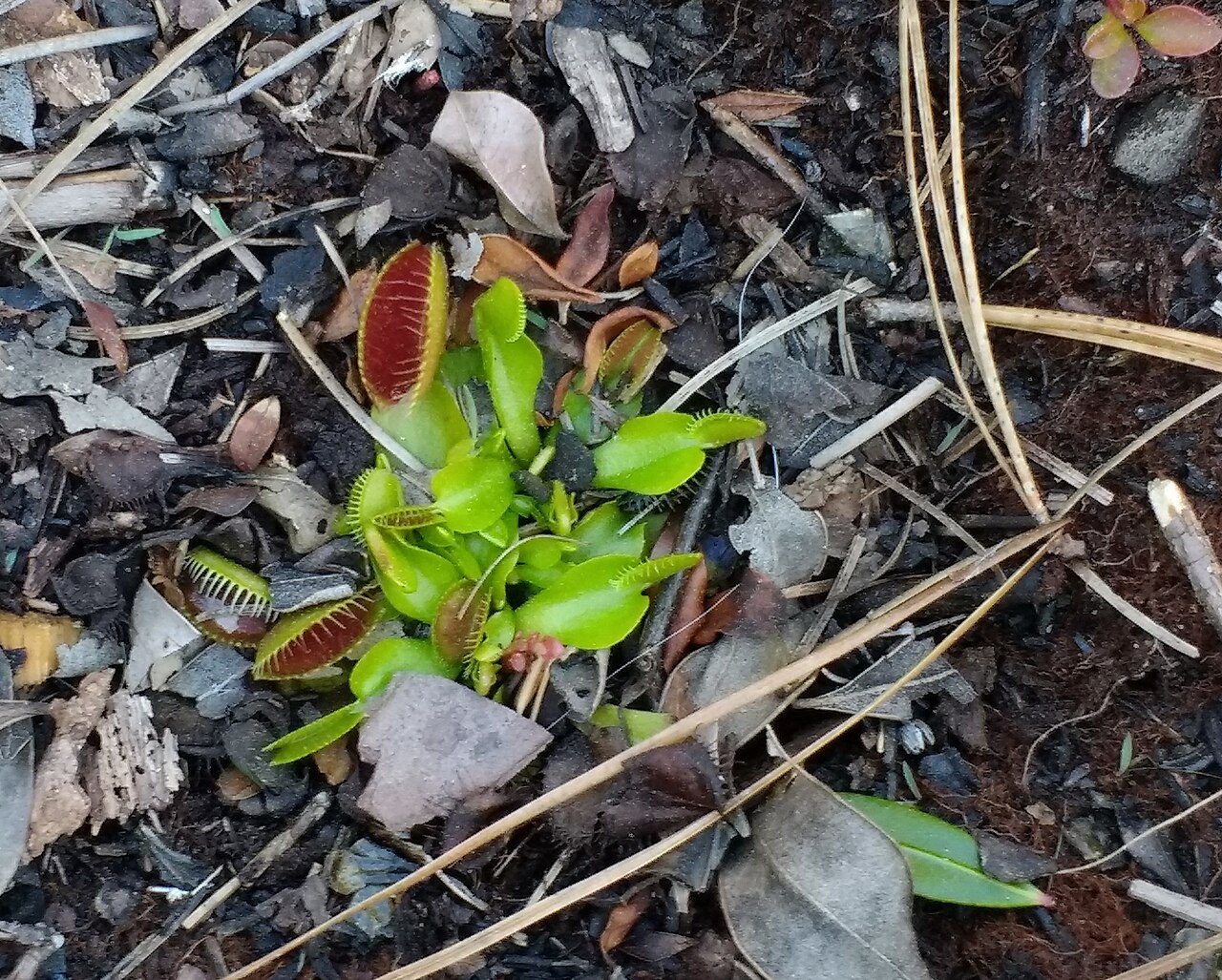
The flytrap lives where almost nothing else wants to: in the nutrient-starved, waterlogged soils of longleaf pine savannas and bog margins, where frequent fire keeps the ground open and sunny. Its carnivory is an answer to that poverty - the soil cannot supply nitrogen, so the plant takes it from insects, luring them onto the hinged lobes of its trap, where trigger hairs, touched twice, spring it shut. The North Carolina State Parks guide stresses that the trap's purpose is nutritional: this is a plant feeding, not a monster hunting.
Indigenous peoples of the region knew the plant and had a name for it. John Ellis, who later gave it its scientific name, recorded the Indigenous word as tippitywichit; the Handbook of American Indians derives the name from the Renape word titipiwitshik. The first written European description came not from a botanist but from a governor: Arthur Dobbs, royal governor of North Carolina, described the plant in a letter of 2 April 1759 to the English botanist Peter Collinson, calling it, in the phrase the letter made famous, a great wonder of the vegetable kingdom.
Ellis, Linnaeus and a Name from Venus
The plant's scientific debut was the work of John Ellis, a London naturalist and plant importer. On 1 September 1768 Ellis described it in The London Magazine, and on 23 September 1768 he wrote to Carl Linnaeus in Sweden with a drawing, a full description, and two proposed names: Venus's Flytrap in English, and Dionaea muscipula in Latin - Dionaea for Dione, mother of Venus, and muscipula, mousetrap. Ellis went further than description: he suggested, correctly, that the closed trap served the plant's nourishment, that nature might have given it the machine of its leaf to catch food.
Linnaeus was dazzled but unconvinced. He declared the plant a miraculum naturae - a miracle of nature - yet, as the 1911 Encyclopaedia Britannica summarised, he would only admit an extreme case of sensitiveness, supposing the insects were caught accidentally and afterwards released. The idea of a plant that ate animals offended the order of things. It took a century, and Darwin, to settle the argument Ellis had started.
Timeline
- Before 1759
Indigenous peoples of the Carolina coast know the plant; its recorded Indigenous name, tippitywichit, is later published by John Ellis.
- 2 April 1759
Arthur Dobbs, royal governor of North Carolina, sends the first written European description of the plant to botanist Peter Collinson.
- 1 September 1768
John Ellis describes the plant in The London Magazine, proposing the name Venus's Flytrap.
- 23 September 1768
Ellis writes to Linnaeus with a drawing and description, proposing the scientific name Dionaea muscipula; Linnaeus hails it as a miraculum naturae but doubts it eats insects.
- 1875
Charles Darwin publishes Insectivorous Plants, with his experimental account of the flytrap's trapping and digestion, proving the carnivory Ellis had proposed.
- 2005
North Carolina adopts the Venus flytrap as its official state carnivorous plant.
- 2014
North Carolina makes the unlawful taking of wild Venus flytraps a felony, punishable by up to 25 months in prison, aimed at commercial-scale poaching.
- 2019
A survey by the North Carolina Natural Heritage Program counts about 169,000 plants at known sites and estimates some 302,000 remaining in the wild.
- 2023
The US Fish and Wildlife Service declines to list the species under the Endangered Species Act - a decision conservation groups later move to challenge in court.
Significance
The flytrap's significance is out of all proportion to its size and range. Scientifically, it was a test case for the most unsettling idea in nineteenth-century botany: that the boundary between plant and animal behaviour is not where common sense puts it. Darwin's experiments on Dionaea - how the trap responds to touch, secretes digestive fluid and absorbs the products - helped found the modern study of plant movement and signalling. The species is the only member of its genus, and its snap-trap remains one of the fastest movements in the plant kingdom.
Culturally, it became the archetype of the carnivorous plant: the model for a century of fictional man-eating plants, and a fixture of windowsills worldwide through tissue-cultured plants sold by the million. Few species are at once so common in cultivation and so rare in the wild.
Questions readers ask
Did Darwin really call it the most wonderful plant in the world? Almost - and the exact words matter. In Insectivorous Plants (1875), Darwin wrote of Dionaea that it is one of the most wonderful plants in the world; modern scholars quoting the passage give that wording and page. The shorter, stronger form - the most wonderful plant in the world - was popularised as the title of F. Jones's 1923 Natural History article publishing Darwin's correspondence on the plant, and it is in that form, repeated by reference works such as NCpedia, that the quotation is usually given. Darwin's admiration is not in doubt: he wrote to Asa Gray that he cared more for these insect-eating plants than for almost anything in his work. But the famous sentence, as usually quoted, is a paraphrase that hardened into a quotation.
Was Linnaeus right about anything? Yes - about the wonder, if not the mechanism. His miraculum naturae and Ellis's rival claim pull in opposite directions, and the episode is a tidy lesson in how science proceeds: Ellis proposed the bolder, correct explanation in 1768, the greatest authority of the age declined to accept it, and experimental proof waited until 1875.
Is it endangered? It depends which list you read. The IUCN Red List classifies the species as Vulnerable. North Carolina lists it as a species of special concern and protects it under state plant law, and it is listed in CITES Appendix II, which controls international trade. But in 2023 the US Fish and Wildlife Service decided it did not warrant listing under the Endangered Species Act, reasoning in part that managed populations would persist - a decision the Center for Biological Diversity announced in 2026 it would challenge, arguing the plant has declined sharply through habitat loss, poaching, fire suppression and climate change.
Legacy
The flytrap's legacy is now a conservation argument conducted in its name. What remains in the wild survives in fragments - in Carolina Beach State Park, in the Nature Conservancy's Green Swamp Preserve, on military land and on private ground - and its habitat needs management: without frequent fire, the savanna closes over and the flytraps vanish into shade. North Carolina's felony poaching law of 2014, with prosecutions since for thefts of hundreds and thousands of plants, records how valuable a wild plant can be precisely because it is rare.
There is an irony Ellis would have appreciated. The plant he introduced to science as a miracle of nature is now propagated so easily in laboratories that no gardener needs a wild one - yet wild ones are still dug up, and the species' fate rests on protecting a few wet, burnable acres of Carolina pine savanna. The most famous plant in the world can be saved only in the one small place it has ever lived.
Sources
- NCpedia (Encyclopedia of North Carolina, UNC Press) - Venus Flytrap
- Encyclopaedia Britannica (1911) - Venus's Fly-Trap
- North Carolina State Parks - A plant that eats, and it only lives here
- Center for Biological Diversity - Lawsuit Launched to Protect the Carolinas' Venus Flytrap
- Molecular and Cellular Proteomics - The Protein Composition of the Digestive Fluid from the Venus Flytrap (citing Darwin, Insectivorous Plants, 1875)
The facts on this page were checked against these sources on 19 November 2026. The History Trail's permanent pages are researched and written for this site; the live profiles elsewhere on The History Trail are assembled automatically from Wikipedia and Wikidata.
About the Author
Researched and written by the The History Trail Editorial Team — the accountable editorial function behind this site's permanent story pages. The team works from the published sources cited on each page; it does not invent historians, reviewers or credentials, and it corrects errors openly.
Fact Check
Every load-bearing fact on this page traces to one of the sources listed above, and significant claims link to their source in the text. Our checking method is described on the methodology page; errors can be reported via the corrections page.
Sources & Citations
Cite this page as: The History Trail Editorial Team, The History Trail — this article's title, publication and update dates are shown beneath its headline. The full source list appears under Sources above; the site's source standards are on the sources page.