
Things
United States Declaration of Independence
The United States Declaration of Independence was adopted by the Continental Congress on 4 July 1776, announcing that the thirteen colonies were free and independent states. But the vote for independence itself came two days earlier, on 2 July, and the famous parchment was not signed by most delegates until 2 August - a document whose making is stranger, and more contested, than its legend.
At a Glance
- Independence voted
- 2 July 1776, when Congress adopted the independence section of the Lee Resolution
- Declaration adopted
- 4 July 1776, after Congress revised Jefferson's draft through 3 July and most of 4 July
- The drafters
- The Committee of Five: Jefferson, John Adams, Benjamin Franklin, Robert R. Livingston and Roger Sherman; Jefferson did the writing
- First printing
- The Dunlap broadsides, printed from 4-5 July, bearing only the names of John Hancock and Charles Thomson
- The signing
- Delegates began signing the engrossed parchment on 2 August 1776; 56 eventually signed, and some never did
- Where it is
- The engrossed copy is held by the US National Archives and displayed in its Rotunda in Washington, DC
Introduction
The Declaration did two jobs at once. It was a legal instrument, dissolving the colonies' allegiance to the British crown, and a piece of political philosophy, arguing that governments rest on the consent of the governed and may be altered when they destroy the rights they exist to protect. Its second sentence - that all men are created equal, endowed with unalienable rights including life, liberty and the pursuit of happiness - became the most quoted sentence in American history.
The Lee Resolution: Independence on 2 July
The decision preceded the document. Richard Henry Lee of Virginia had proposed that the colonies declare themselves free and independent states, and on 2 July 1776 Congress adopted the independence section of his resolution. John Adams wrote home that 2 July would be celebrated as the great anniversary festival - the day of deliverance. He was wrong by two days: posterity chose the date of the statement explaining the decision, not the decision itself.
Jefferson's Draft and Congress's Edits
Congress had appointed a Committee of Five in June - Jefferson, Adams, Franklin, Livingston and Sherman - and delegated the writing to Jefferson, who drafted the text between 11 and 28 June, with light changes from Adams and Franklin. The National Archives records that he presented the draft to Congress after the 2 July vote, and that congressional revision then occupied all of 3 July and most of 4 July before adoption that afternoon.
Congress made dozens of changes, cutting about a quarter of the draft. The most consequential deletion was Jefferson's longest grievance: a passage blaming George III for the slave trade, which he called a cruel war against human nature itself, accusing the king of keeping open a market where men should be bought and sold and of blocking colonial attempts to restrain the trade. Jefferson later wrote that the clause was struck in deference to South Carolina and Georgia, which wished to continue importing enslaved people - and he noted that northern delegates, whose people had been considerable carriers of enslaved Africans, were also uneasy. The passage condemned the trade, not slavery itself, and its author enslaved people at Monticello: the contradiction was present at the creation.
Broadsides, Parchment and the Signing Myth
What the public first read was print, not parchment. Under the committee's supervision the approved text was printed on the night of 4-5 July by John Dunlap; these Dunlap broadsides, bearing only Hancock's and Thomson's names, were sent to state assemblies, committees of safety and army commanders, and read aloud to troops and crowds.
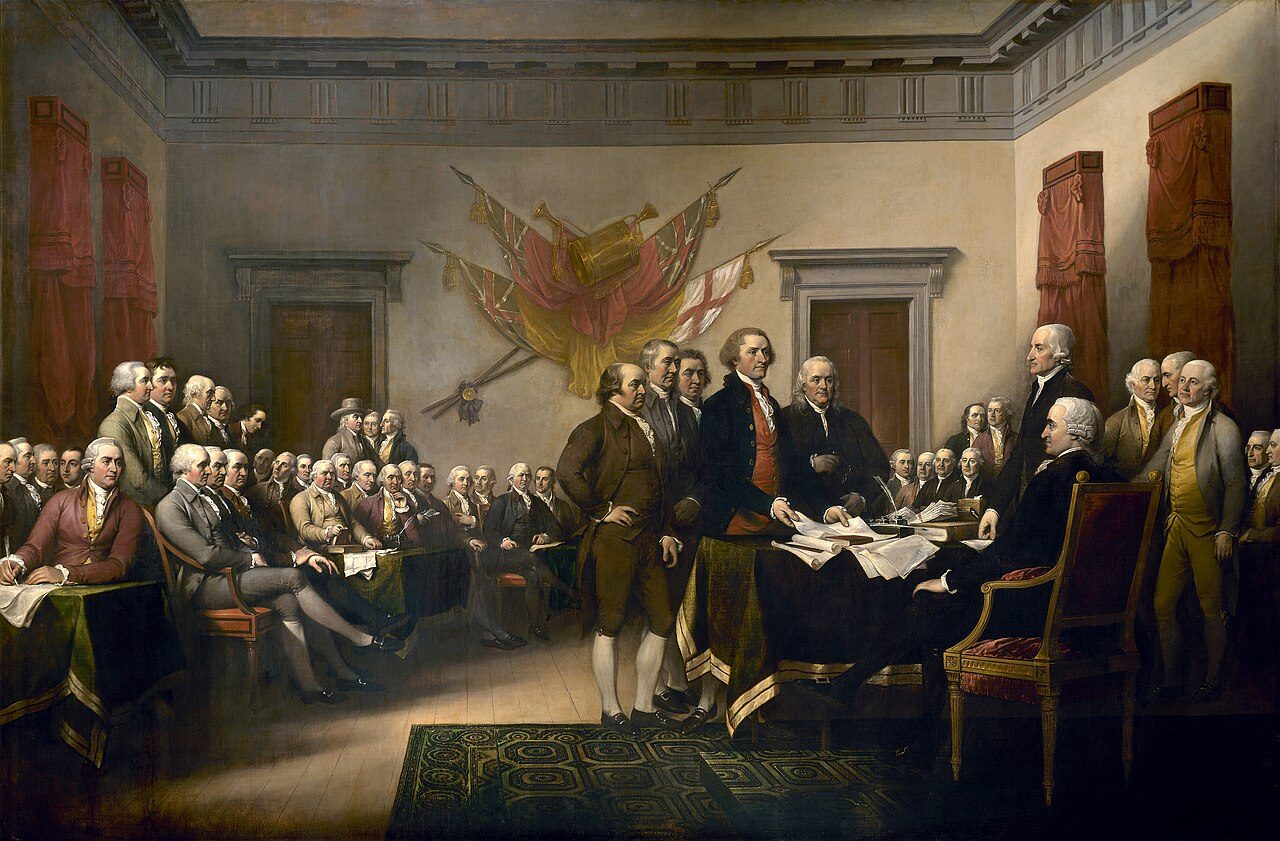
Only on 19 July did Congress order the Declaration engrossed - copied in a large formal hand, probably by Timothy Matlack - on parchment, under the new title 'the unanimous declaration of the thirteen united states of America', to be signed by every member. Signing began on 2 August, Hancock first, the rest arranged by state from New Hampshire to Georgia. Fifty-six delegates eventually signed; some, including committee member Robert R. Livingston, never did. The famous scene of all the founders signing together on 4 July never happened - Trumbull's celebrated painting, in any case, shows the committee presenting its draft, not a signing.
Timeline
- 7 June 1776
Richard Henry Lee proposes the resolution for independence in Congress.
- 11 June 1776
The Committee of Five is appointed; Jefferson is delegated to write the draft.
- 28 June 1776
The committee presents Jefferson's draft to Congress.
- 2 July 1776
Congress adopts the Lee Resolution: the colonies are declared independent.
- 4 July 1776
After two days of editing, Congress adopts the Declaration's text.
- 4-5 July 1776
John Dunlap prints the first broadsides of the Declaration.
- 19 July 1776
Congress orders the Declaration engrossed on parchment and signed by every member.
- 2 August 1776
Delegates begin signing the engrossed parchment; 56 eventually sign.
The Ideas
Jefferson drew on the English philosopher John Locke: natural rights that no government grants and none may rightfully take, and a right of the people to alter or abolish a government that becomes destructive of those rights. The Library of Congress, which holds Jefferson's rough draft, notes that he drew on many English, Scottish and American sources. The Declaration's long list of grievances against George III was the legal case; its preamble was the philosophy that outlived the case.
The ground had been prepared in print. In January 1776 Thomas Paine's pamphlet Common Sense had argued, in plain language that sold enormously, that an island should not rule a continent and that monarchy itself was the problem - turning independence from a remedy for grievances into a positive good. Britannica makes a further point readers often miss: the Declaration announced separation but did not accomplish it. Complete separation from Britain still had to be won by force, over seven more years of war, which is why the document's authors understood it as a pledge - of their lives, fortunes and sacred honour, in its closing words - rather than a result.
Significance
At the time, the Declaration's practical work was diplomatic: a united declaration made foreign alliance - above all with France - possible, and committed thirteen quarrelling colonies publicly to a war they could not now settle separately. Its authors expected it to be read as a state paper. Its transformation into something more came later.
Legacy
In the early republic the Declaration was one document among many; its elevation to a sacred text came in the nineteenth century, above all under Abraham Lincoln, who treated its proposition that all men are created equal as the nation's founding creed and dated the Union from 1776 at Gettysburg. Abolitionists, suffragists and civil-rights campaigners repeatedly held America to its words. Abroad, later declarations of independence and rights - from Haiti and Latin America to Vietnam in 1945, which quoted it directly - borrowed its language and logic. The engrossed parchment, faded but guarded, rests today in the National Archives in Washington, the physical centre of the nation's founding story.
Sources
- National Archives — Declaration of Independence (1776)
- Library of Congress — Jefferson's 'original Rough draught' of the Declaration of Independence
- Library of Congress — Declaration of Independence: Primary Documents in American History
- Encyclopaedia Britannica — Declaration of Independence
The facts on this page were checked against these sources on 19 November 2026. The History Trail's permanent pages are researched and written for this site; the live profiles elsewhere on The History Trail are assembled automatically from Wikipedia and Wikidata.
About the Author
Researched and written by the The History Trail Editorial Team — the accountable editorial function behind this site's permanent story pages. The team works from the published sources cited on each page; it does not invent historians, reviewers or credentials, and it corrects errors openly.
Fact Check
Every load-bearing fact on this page traces to one of the sources listed above, and significant claims link to their source in the text. Our checking method is described on the methodology page; errors can be reported via the corrections page.
Sources & Citations
Cite this page as: The History Trail Editorial Team, The History Trail — this article's title, publication and update dates are shown beneath its headline. The full source list appears under Sources above; the site's source standards are on the sources page.