
Things
Penicillin: The Mould That Opened the Antibiotic Age
A stray mould on a forgotten culture plate in 1928 revealed the first true antibiotic — but it took an Oxford team, American industry and a world war to turn Fleming's observation into a medicine that could be made by the ton.
At a Glance
- Discovered
- 1928, St Mary's Hospital, London
- Discoverer
- Alexander Fleming
- Source organism
- A Penicillium mould contaminating a culture plate
- Developed as a drug by
- Howard Florey, Ernst Chain, Norman Heatley and colleagues, University of Oxford
- First patient (as generally described)
- Albert Alexander, 12 February 1941, Oxford — improved within 24 hours, then relapsed when the supply ran out
- Mass production
- Peoria, Illinois, and US pharmaceutical industry, from 1941
- Nobel Prize
- Physiology or Medicine, 1945 — Fleming, Florey and Chain
The Contaminated Plate at St Mary's
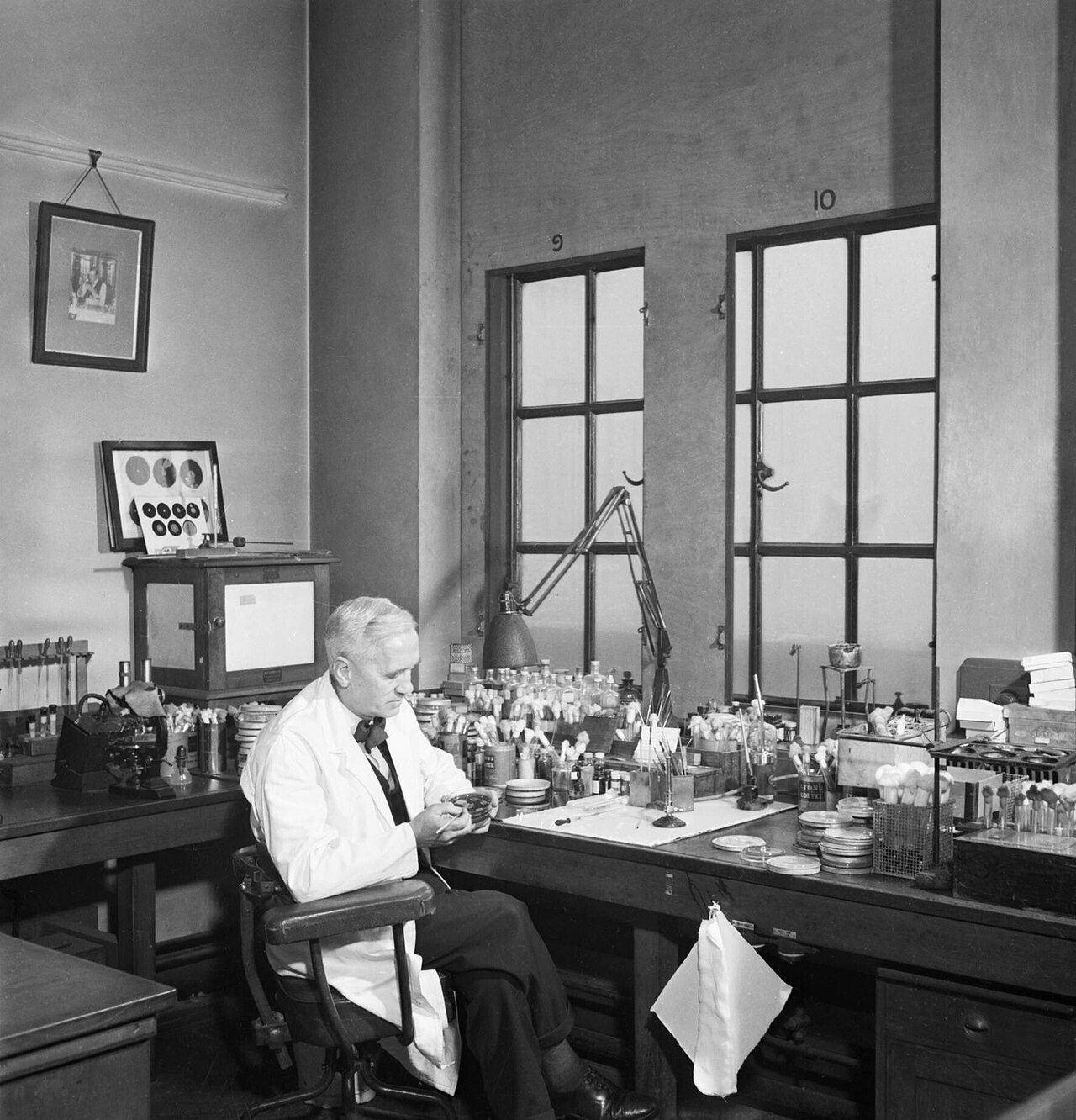
Penicillin began as an accident that most researchers would have thrown away. In September 1928 Alexander Fleming, a bacteriologist at St Mary's Hospital in London, noticed that a mould had contaminated one of his culture plates — and that the staphylococcal bacteria growing near the mould had been killed and dissolved, while colonies further away grew normally. Fleming isolated the mould, identified it as a member of the Penicillium genus, and named the antibacterial substance it produced penicillin.
What he had found was the first true antibiotic: a substance made by one micro-organism that could destroy others without, apparently, harming animal tissue. But a discovery in a dish is not a medicine. Penicillin was unstable, produced in tiny amounts, and almost impossible to purify with the tools Fleming had. It took a second team, a world war and an industrial effort spanning two continents to turn his observation into the drug that opened the antibiotic age.
Fleming, Lysozyme and a Paper Ignored for a Decade
Fleming was unusually well prepared to notice what the mould was doing. He had spent years studying substances that prevent bacterial growth, and in 1922 he had discovered lysozyme, a weak natural antibacterial found in tears and saliva. When the contaminated plate crossed his bench in 1928, he recognised the clear zone around the mould as a phenomenon worth chasing rather than a spoiled experiment. He published his findings in 1929 in the British Journal of Experimental Pathology.
The paper then sat largely idle for a decade. Fleming could not extract penicillin in a stable, usable form, and interest faded. The revival began at the University of Oxford in the late 1930s, where the pathologist Howard Florey and the biochemist Ernst Chain, working on antibacterial substances, returned to Fleming's paper and decided to investigate penicillin properly. With colleagues including Norman Heatley, they set out to grow the mould at scale, extract the active substance and test whether it could actually cure infection.
Timeline
- 1922
Fleming discovers lysozyme, a natural antibacterial enzyme — the work that trains his eye for what happens six years later.
- September 1928
At St Mary's Hospital, London, Fleming observes a Penicillium mould killing the staphylococci around it on a culture plate and names its active substance penicillin.
- 1929
Fleming publishes his discovery in the British Journal of Experimental Pathology; the scientific community shows little initial enthusiasm.
- 1939
Florey's team at the University of Oxford begins intensive work on penicillin, developing ways to grow, extract, purify and measure it.
- August 1940
The Oxford team reports in The Lancet that purified penicillin protects mice infected with otherwise lethal streptococci.
- 12 February 1941
Policeman Albert Alexander becomes the patient generally described as the first to be treated with penicillin for a serious infection, at the Radcliffe Infirmary in Oxford; he improves within 24 hours, but the supply runs out and he relapses.
- July 1941
With wartime Britain unable to produce enough, the Oxford effort is taken to the US Department of Agriculture laboratory at Peoria, Illinois, where fermentation work begins the day after the team arrives.
- 1 March 1944
Pfizer opens the first commercial plant for large-scale penicillin production by submerged fermentation in Brooklyn, New York.
- 15 March 1945
US restrictions are lifted and penicillin becomes available through ordinary pharmacies in the United States.
- 1945
Dorothy Hodgkin's X-ray work establishes penicillin's chemical structure, and Fleming, Florey and Chain share the Nobel Prize in Physiology or Medicine.
- 1 June 1946
Penicillin goes on sale to the general public in Britain as a prescription-only medicine.
The Antibiotic Age Begins
Before penicillin, a deep cut, a bout of pneumonia or an infected wound could kill a healthy young adult, and doctors could do little beyond support the patient and hope. Penicillin changed the odds fundamentally: many bacterial infections that had been death sentences — streptococcal, staphylococcal and gonococcal infections among them — became routinely treatable. Wartime production put the drug into military medicine in time for the D-Day landings in 1944, and civilian availability followed within a year of the war's end.
The scale of the industrial achievement matched the medical one. United States production rose from 21 billion units in 1943 to more than 6.8 trillion units in 1945, while the price of 100,000 units fell from twenty dollars in 1943 to under ten cents by 1949. Penicillin proved that a fragile product of a living mould could be manufactured like a chemical, and in doing so it created the template — and the industry — for every antibiotic that followed.
Resistance, the Nobel Prize and a Living Legacy
Fleming, Florey and Chain shared the 1945 Nobel Prize, cited for the discovery of penicillin and its curative effect in various infectious diseases, and the American Chemical Society and Royal Society of Chemistry later designated the work an International Historic Chemical Landmark. Penicillin itself remains in clinical use, and the search it started produced the whole antibiotic pharmacopoeia that modern surgery, chemotherapy and intensive care quietly depend on.
The shadow in the story was visible early. Bacteria exposed to too little penicillin can learn to resist it, and resistant strains are now counted among the greatest threats to public health; Oxford researchers work today on how prescribing can be restrained. Penicillin's legacy is therefore double: it taught medicine that infection could be beaten, and it taught microbiology that every victory over bacteria starts a clock.
Sources
- NobelPrize.org — The Nobel Prize in Physiology or Medicine 1945
- American Chemical Society — Discovery and Development of Penicillin (International Historic Chemical Landmark)
- University of Oxford — Penicillin: a historic first at the Radcliffe Infirmary
- USDA Agricultural Research Service — Penicillin: Opening the Era of Antibiotics
- Encyclopaedia Britannica — How was penicillin discovered?
- Emerging Infectious Diseases (CDC, via PubMed Central) — The Discovery of Penicillin: New Insights After More Than 75 Years
The facts on this page were checked against these sources on 18 November 2026. The History Trail's permanent pages are researched and written for this site; the live profiles elsewhere on The History Trail are assembled automatically from Wikipedia and Wikidata.
About the Author
Researched and written by the The History Trail Editorial Team — the accountable editorial function behind this site's permanent story pages. The team works from the published sources cited on each page; it does not invent historians, reviewers or credentials, and it corrects errors openly.
Fact Check
Every load-bearing fact on this page traces to one of the sources listed above, and significant claims link to their source in the text. Our checking method is described on the methodology page; errors can be reported via the corrections page.
Sources & Citations
Cite this page as: The History Trail Editorial Team, The History Trail — this article's title, publication and update dates are shown beneath its headline. The full source list appears under Sources above; the site's source standards are on the sources page.