
Things
Cholera
Cholera was likely known in antiquity along the Ganges, but in the nineteenth century it escaped India in wave after wave of pandemics. The fight against it produced one of medicine's founding stories — a London doctor, a water pump and a map — and, decades later, the bacterium itself.
At a Glance
- Cause
- Vibrio cholerae, a comma-shaped bacterium spread in contaminated water
- Homeland
- The Ganges delta, identified by Robert Koch
- Pandemics
- Seven major pandemics between 1800 and 1995
- First description of the organism
- Filippo Pacini, Florence, 1854 — ignored at the time
- Water transmission demonstrated
- John Snow, Broad Street outbreak, London, 1854
- Organism isolated and named
- Robert Koch, 1884
- Name corrected
- Vibrio cholerae Pacini 1854, by nomenclature ruling in 1965
Introduction
Cholera is a severe infection spread by water contaminated with human waste. Hippocrates and Galen described a compatible set of symptoms, and many sources point to a similar illness, always present and frequently epidemic, in the plains of the Ganges River. For most of history it stayed a regional scourge of South Asia. Modern knowledge of cholera dates from the beginning of the nineteenth century, when the disease began travelling the world's trade and troop routes in a series of great pandemics.
The disease kills by dehydration: after a short incubation of two or three days, severe diarrhoea and vomiting can drain a body with terrifying speed, leaving patients with the mummified appearance that struck early European observers. Seven major pandemics are counted between 1800 and 1995. Cholera thus became the classic epidemic disease of the industrialising century — and the test case for a new question: could a disease be defeated by finding how it travelled, before anyone knew what it was?
Background
In 1854 two men, working independently, found the two halves of the answer. In Florence, the anatomist Filippo Pacini examined the intestines of cholera victims under the microscope and described comma-shaped vibrios in enormous numbers in the mucus and shed cells. He concluded that the culprit was an organic living substance of parasitic nature which could reproduce itself and thereby produce a specific disease. His paper was published — and completely ignored by the scientific establishment of his day.
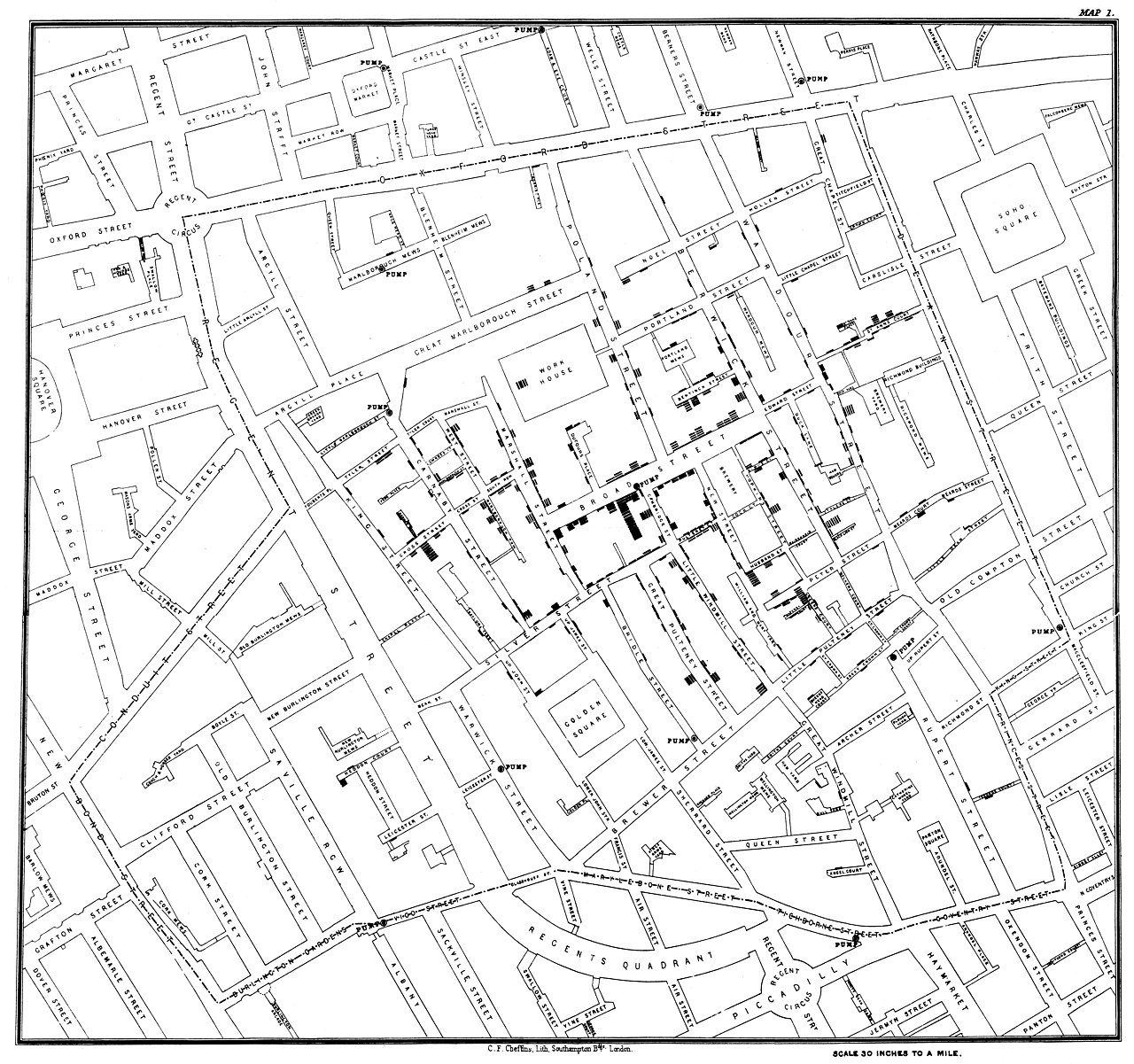
In London the same year, the physician John Snow demonstrated the role of water as the carrier of the disease during the Soho outbreak. By mapping and interviewing, he traced the cases to the Broad Street pump, and persuaded the local authorities to, reluctantly, remove its handle. Snow had no microscope proof and no organism; what he had was a method — counting cases, mapping them and reasoning about exposure — that became the template of epidemiology.
Timeline
- 1817
The first of the modern cholera pandemics spreads outward from the Ganges delta along trade and military routes.
- 1854
Filippo Pacini describes vibrios in the intestines of cholera victims in Florence and argues they cause the disease.
- 1854
John Snow links the Soho outbreak to the Broad Street pump; its handle is removed, demonstrating waterborne transmission.
- 1866
Achille-Adrien Proust cares for cholera patients in France and turns to prevention and international sanitation as the real defence.
- 1877
During the Bombay epidemic, quarantine — the elder Proust's cordon sanitaire idea — prevails over commercial objections.
- 1884
Working during the outbreak in Egypt, Robert Koch isolates the comma-shaped bacillus and names it Vibrio cholerae.
- 1961
The seventh cholera pandemic begins, spreading widely from Asia in the following decade.
- 1965
The international nomenclature committee rules the organism be known as Vibrio cholerae Pacini 1854, crediting its first describer.
- 2010
Cholera is confirmed in Haiti, where the bacterium meets a population and water infrastructure with no recent memory of it.
Significance
Cholera's deepest impact was on the idea of public health itself. Snow showed that a disease could be interrupted by acting on its route of transmission — clean water — without knowing its cause, and the great sanitary reforms of the industrial city followed from that logic. The elder Proust's career made the international version of the argument: that questions of hygiene reach beyond political borders, and that exclusion and quarantine, however unwelcome to trade, could be legitimate tools against a travelling disease.
The second impact was on treatment. Cholera's mechanism is fluid loss, and the historical record shows that with oral rehydration therapy few patients need die if clean water is available. A disease that once emptied neighbourhoods became, where water and rehydration reach in time, a survivable emergency. The gap between those two facts — a preventable, treatable disease that still erupts wherever sanitation breaks down — is cholera's continuing historical lesson, visible again in Haiti in 2010.
Legacy
Cholera left medicine with two inheritances. The first is methodological: Snow's pump-handle investigation is still taught as the founding act of epidemiology, and Koch's laboratory isolation of the bacillus as a model of germ-theory proof. The second is infrastructural: sewers, protected water supplies and international sanitary cooperation all carry cholera's fingerprints, built by generations who learned that the cheapest cure for a waterborne disease is water that does not carry it.
The disease itself has not retired. As the CDC's historians note, floods, disasters, conflict and mass travel keep compromising clean water, and cholera shows its head as soon as the opportunity arises. Its history is therefore unfinished in a specific way: the science was settled in the nineteenth century; the engineering and politics are still being negotiated. In 2017 the Global Task Force on Cholera Control, hosted by WHO, published a roadmap aiming to reduce cholera deaths by ninety percent by 2030 — the Snow programme, restated as a global target.
Sources
- CDC, Emerging Infectious Diseases — Persistence of Memory and the Comma Bacillus
- World Health Organization — Cholera fact sheet
- ScienceDirect Topics (reference overview) — Cholera, Historical
The facts on this page were checked against these sources on 19 November 2026. The History Trail's permanent pages are researched and written for this site; the live profiles elsewhere on The History Trail are assembled automatically from Wikipedia and Wikidata.
About the Author
Researched and written by the The History Trail Editorial Team — the accountable editorial function behind this site's permanent story pages. The team works from the published sources cited on each page; it does not invent historians, reviewers or credentials, and it corrects errors openly.
Fact Check
Every load-bearing fact on this page traces to one of the sources listed above, and significant claims link to their source in the text. Our checking method is described on the methodology page; errors can be reported via the corrections page.
Sources & Citations
Cite this page as: The History Trail Editorial Team, The History Trail — this article's title, publication and update dates are shown beneath its headline. The full source list appears under Sources above; the site's source standards are on the sources page.