
People
Charles Darwin
Charles Darwin sailed around the world at 22 as a ship's naturalist and came home with the raw material for the most consequential idea in biology. He then waited more than twenty years, gathering evidence barnacle by barnacle, before publishing On the Origin of Species in 1859.
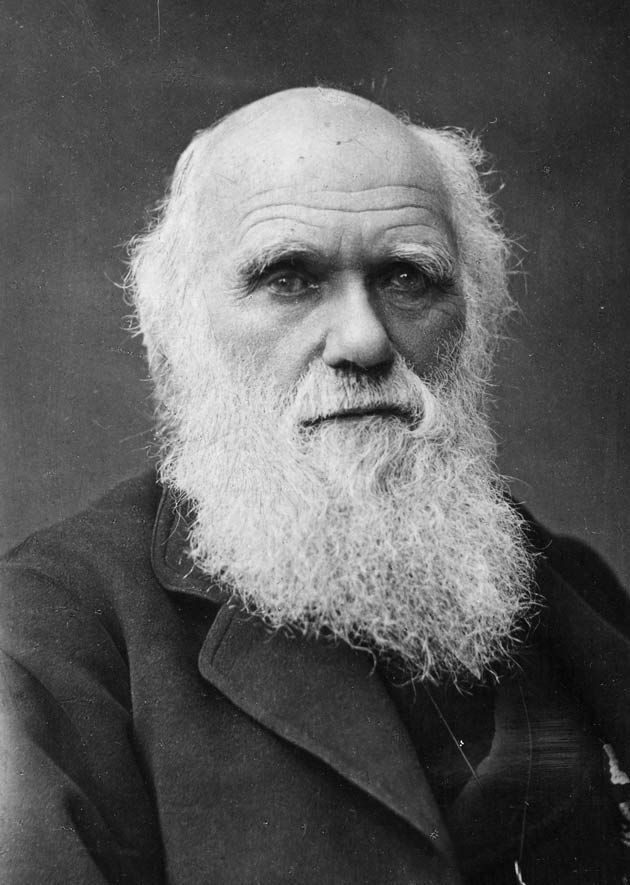
At a Glance
- Born
- 12 February 1809, Shrewsbury, Shropshire, England
- Died
- 19 April 1882, Downe, Kent, England
- The voyage
- Naturalist aboard HMS Beagle, 1831–36, a survey voyage around the world
- Key evidence
- Galápagos species including the giant tortoise and marine iguana; fossils and specimens now held at the Natural History Museum, London
- Theory
- Evolution by natural selection, formulated privately in 1837–39
- Key book
- On the Origin of Species, published 1859
Introduction
Charles Darwin was an English naturalist whose theory of evolution by natural selection became the foundation of modern evolutionary studies. His proposition was simple to state and radical in effect: all species have descended, with modification, from common ancestors, and the branching pattern of life results from natural selection — the survival of individuals whose slight variations suit them, however marginally, to their conditions of life.
Darwin did not rush the idea into print. He formulated his theory in private in 1837–39, after returning from a five-year voyage around the world aboard HMS Beagle, but gave it full public expression only two decades later, in On the Origin of Species in 1859. The delay was not idleness: it was spent amassing the evidence — from barnacles, coral reefs, fossils and pigeon breeding — that made the book so hard to argue with.
Background
Darwin was the son of Robert Waring Darwin, a physician, and he was not particularly successful in his early academic ventures. He gave up the study of medicine at the University of Edinburgh and moved to Cambridge to study for a general degree, where a lecturer, the Reverend John Stevens Henslow, inspired him to begin a career in natural history. When his studies ended, Henslow's suggestion put him aboard HMS Beagle as naturalist for a survey voyage to South America and beyond.
The Beagle sailed from England on 27 December 1831, and the circumnavigation was the making of the 22-year-old Darwin. Most famously he visited the Galápagos Islands, a volcanic archipelago off the coast of Ecuador, where he observed species such as the Galápagos giant tortoise and the marine iguana. Many of the specimens from the almost-five-year voyage are held at the Natural History Museum in London, and Darwin used the data from the voyage, together with his later studies, to formulate his theory. He spent only about eighteen months of the voyage actually aboard ship; the rest was spent ashore, collecting. By the last leg he had finished a 770-page diary, written some 1,750 pages of notes and drawn up twelve catalogues covering 5,436 skins, bones and other specimens — a lifetime's evidence, gathered before he was twenty-seven.
Timeline
- 12 February 1809
Born in Shrewsbury, England, son of the physician Robert Waring Darwin.
- 27 December 1831
HMS Beagle sails from England with Darwin aboard as naturalist, beginning a voyage of almost five years.
- 1835
The Beagle reaches the Galápagos Islands, where Darwin studies the tortoises, iguanas and other species found nowhere else.
- 2 October 1836
The Beagle returns to England; Darwin begins the private work, in 1837–39, that formulates his theory of natural selection.
- 1839
His journal of the voyage is published, making him famous as a popular author.
- 1858
Alfred Russel Wallace sends Darwin a paper setting out the same idea; their work is presented jointly to the Linnean Society that year.
- 1859
On the Origin of Species by Means of Natural Selection is published, setting out his theory with its evidence.
- 19 April 1882
Dies at Downe, Kent, aged 73; he is buried in Westminster Abbey.
Significance
The Origin did what earlier ideas about the transmutation of species had failed to do: it persuaded. Darwin's argument rested on a mechanism — as many more individuals of each species are born than can possibly survive, there is a recurring struggle for existence, and any being that varies slightly in a manner profitable to itself will have a better chance of surviving, and thus be naturally selected. Common descent plus natural selection explained, in one framework, fossils, island species, embryology and the geography of life.
The two-decade wait mattered to that persuasion. By 1859 Darwin could answer objections from a stock of evidence gathered across geology, zoology and breeding that no rival could match, and the joint presentation with Wallace in 1858 — after Wallace independently reached the same idea — showed the theory was in the evidence, not in one man's fancy. Within a generation, evolution by common descent was the working assumption of biology, even where natural selection itself was still argued over.
Legacy
Darwin was buried in Westminster Abbey, the ultimate British accolade for a man whose book had challenged the account of creation his countrymen grew up with. His specimens remain at the Natural History Museum, his vasculum — the collecting case he carried on the Beagle — at the Linnean Society, which also holds a first edition of the Origin presented to it. In June 2025 the documentary heritage of his life was recognised by UNESCO for its Memory of the World register. Modern biology still runs on his framework: genetics later supplied the mechanism of inheritance he lacked, but the pattern he saw in tortoises and iguanas in 1835 is the pattern every life scientist still works within.
Sources
- The Linnean Society of London — Charles Darwin (1809–82)
- Encyclopaedia Britannica — Charles Darwin
- Encyclopaedia Britannica — Beagle
The facts on this page were checked against these sources on 19 November 2026. The History Trail's permanent pages are researched and written for this site; the live profiles elsewhere on The History Trail are assembled automatically from Wikipedia and Wikidata.
About the Author
Researched and written by the The History Trail Editorial Team — the accountable editorial function behind this site's permanent story pages. The team works from the published sources cited on each page; it does not invent historians, reviewers or credentials, and it corrects errors openly.
Fact Check
Every load-bearing fact on this page traces to one of the sources listed above, and significant claims link to their source in the text. Our checking method is described on the methodology page; errors can be reported via the corrections page.
Sources & Citations
Cite this page as: The History Trail Editorial Team, The History Trail — this article's title, publication and update dates are shown beneath its headline. The full source list appears under Sources above; the site's source standards are on the sources page.