
Animals
Western Honey Bee
No insect works harder for human beings than the western honey bee. Kept on almost every continent, a single colony can hold 65,000 workers — and the crops that feed the world now depend on its daily commute between hive and flower.
At a Glance
- Scientific name
- Apis mellifera — Latin for 'honey-bearing bee'
- Native range
- Europe, northern Africa and the Middle East; now kept on almost every continent
- Colony
- One queen, about 10,000 to 65,000 female workers, and up to roughly 1,000 male drones
- Queen
- Can lay a thousand or more eggs a day; emerges as an adult in 16 days
- Development
- Workers emerge in about 21 days, drones in 24 days
- Pollination value
- Managed hives serve more than 90 commercial crops; US pollination alone is worth over $15 billion a year
- Chief threats
- The varroa mite, other parasites and diseases, and colony collapse disorder
Introduction
The western honey bee is the most familiar bee on Earth and, economically, the most important insect in the world. Native to Europe, northern Africa and the Middle East, it has been carried by beekeepers to almost every continent, prized for two products — honey and beeswax — and for a third service that dwarfs both: pollination. As it gathers nectar and pollen to provision its nest, the bee fertilises the flowers it visits, and much of modern agriculture is quietly built on that transaction.
A colony is less a crowd than a single organism divided into tens of thousands of bodies. At its centre is one queen, a fertile female laying a thousand or more eggs a day. Around her work the sterile female workers — building comb, nursing larvae, guarding the entrance, foraging miles for food — while a few hundred or thousand males, the drones, exist only to mate. Queens emerge as adults in 16 days, workers in about 21, drones in 24, and the whole society is coordinated by scent and by dance.
Background
Humans have kept this bee for millennia — beekeeping reaches back at least to ancient Egypt — but for most of that history the harvest was destructive: combs were fixed inside straw skeps and clay or wooden hives, and taking honey meant cutting the colony's home apart. The turning point came in 1851, when the American minister and beekeeper Lorenzo Langstroth worked out the principle of 'bee space' and built a hive of movable frames that could be lifted out, inspected and replaced without harming the bees.
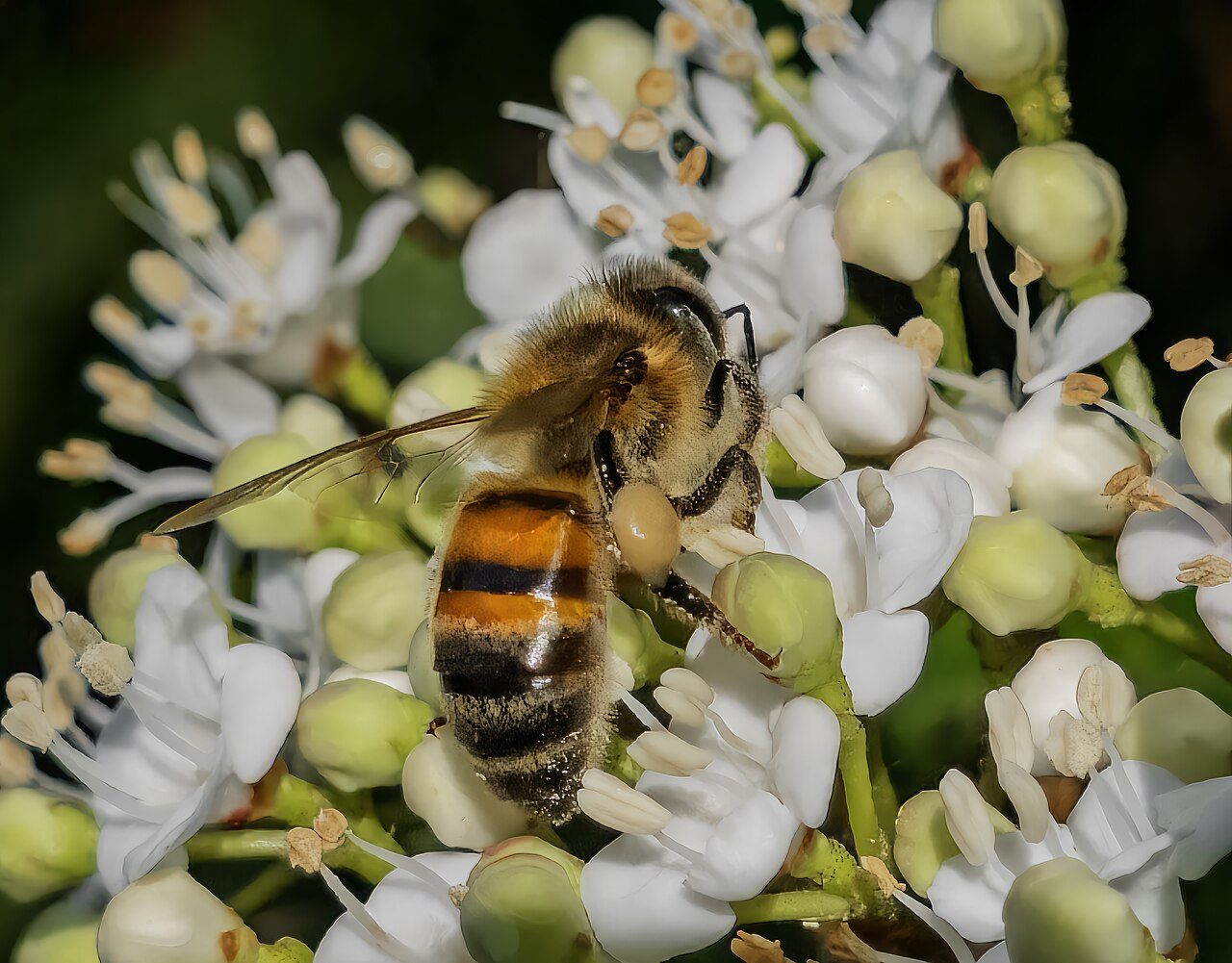
Inside the colony, communication is the marvel. Returning foragers perform dancelike movements that tell their sisters the location, distance, quantity and quality of a food source — the famous waggle dance. Workers carry pollen home in 'baskets' of stiff hairs on their hind legs, convert nectar that is half water into honey of only 16 to 18 percent water, and secrete the wax scales from which the geometric comb is built. A populous colony in a good site may haul in as much as 450 kilograms of nectar, water and pollen in a year.
Timeline
- Ancient Egypt
Beekeeping is already practised, with hives of straw and clay — the start of a partnership between humans and this species that has never ended.
- 1758
Carl Linnaeus formally names the species Apis mellifera, 'the honey-bearing bee'.
- 1700s
Swiss naturalist François Huber develops a movable-frame 'leaf hive' whose combs open like the pages of a book — a step towards the modern hive.
- 1851
Lorenzo Langstroth discovers 'bee space' and designs the movable-frame hive that revolutionises beekeeping.
- 1852
Langstroth patents his hive; imitators copy it widely despite his years of legal defence.
- 1853
Langstroth publishes Langstroth on the Hive and the Honey-Bee, the manual that spreads the new beekeeping.
- 1970s
With industrial agriculture, managed hives become nearly essential for the pollination of more than 90 commercially grown crops.
- 2006
Colony collapse disorder is first reported in the United States: workers leave the hive and never return, and whole colonies die.
Significance
The numbers explain why this bee matters. In the United States alone, beekeepers manage about 2.6 million colonies, trucking hives from crop to crop as blooms open across the country; the pollination those bees perform is estimated to contribute more than $15 billion in crops annually. California's almond industry, which supplies between half and four-fifths of the world's almonds, relies almost exclusively on billions of honey bees imported for a flowering season a few weeks long.
That dependence is also the vulnerability. Western honey bee colonies face the parasitic varroa mite and the mites and viruses that travel with it, other parasites, pesticides, habitat loss and the still-unexplained colony collapse disorder first reported in 2006, in which adult workers simply fail to come home. Because managed bees now stand in for wild pollinators across whole farming regions, the health of this one species has become a food-security question.
Legacy
The Langstroth hive is still the most common artificial hive in use, and its removable frames are now required by law in many places — the surest sign that a design has become the world standard. The bee inside it has become a scientific model organism as well as a farm animal, studied for its learning, memory, navigation and social organisation, and the waggle dance remains one of the most remarkable communication systems known in any insect.
The western honey bee's legacy is double-edged: it is both the pollinator modern farming cannot do without and a managed species whose struggles warn us about the wild pollinators we notice less. Protecting Apis mellifera has become inseparable from protecting the flowering world it works in.
Sources
- Encyclopaedia Britannica — Western honeybee
- Smithsonian Magazine — The Secret to the Modern Beehive is a One-Centimeter Air Gap
- Wikipedia — Western honey bee (corroboration)
The facts on this page were checked against these sources on 19 November 2026. The History Trail's permanent pages are researched and written for this site; the live profiles elsewhere on The History Trail are assembled automatically from Wikipedia and Wikidata.
About the Author
Researched and written by the The History Trail Editorial Team — the accountable editorial function behind this site's permanent story pages. The team works from the published sources cited on each page; it does not invent historians, reviewers or credentials, and it corrects errors openly.
Fact Check
Every load-bearing fact on this page traces to one of the sources listed above, and significant claims link to their source in the text. Our checking method is described on the methodology page; errors can be reported via the corrections page.
Sources & Citations
Cite this page as: The History Trail Editorial Team, The History Trail — this article's title, publication and update dates are shown beneath its headline. The full source list appears under Sources above; the site's source standards are on the sources page.