
Animals
Great white shark
It is the most famous fish in the world and one of the least known: a warm-bodied, ocean-crossing predator that may live past seventy, has never survived in captivity, and whose total numbers science still cannot reliably estimate.
At a Glance
- Scientific name
- Carcharodon carcharias
- Maximum size
- About 20 feet (600 cm); unconfirmed reports to 23 feet
- Family
- Lamnidae, the mackerel sharks — order Lamniformes
- Body temperature
- Endothermic: maintains a body temperature above the surrounding water
- Teeth
- Large, erect, triangular and serrated; broader in adults that hunt marine mammals
- Main prey
- Seals, sea lions, elephant seals, dolphins, other sharks, rays and fish
- Lifespan
- May live to 70 years or more (bomb-dating research)
- Conservation status
- Vulnerable (IUCN Red List); CITES Appendix II since 2002
Introduction
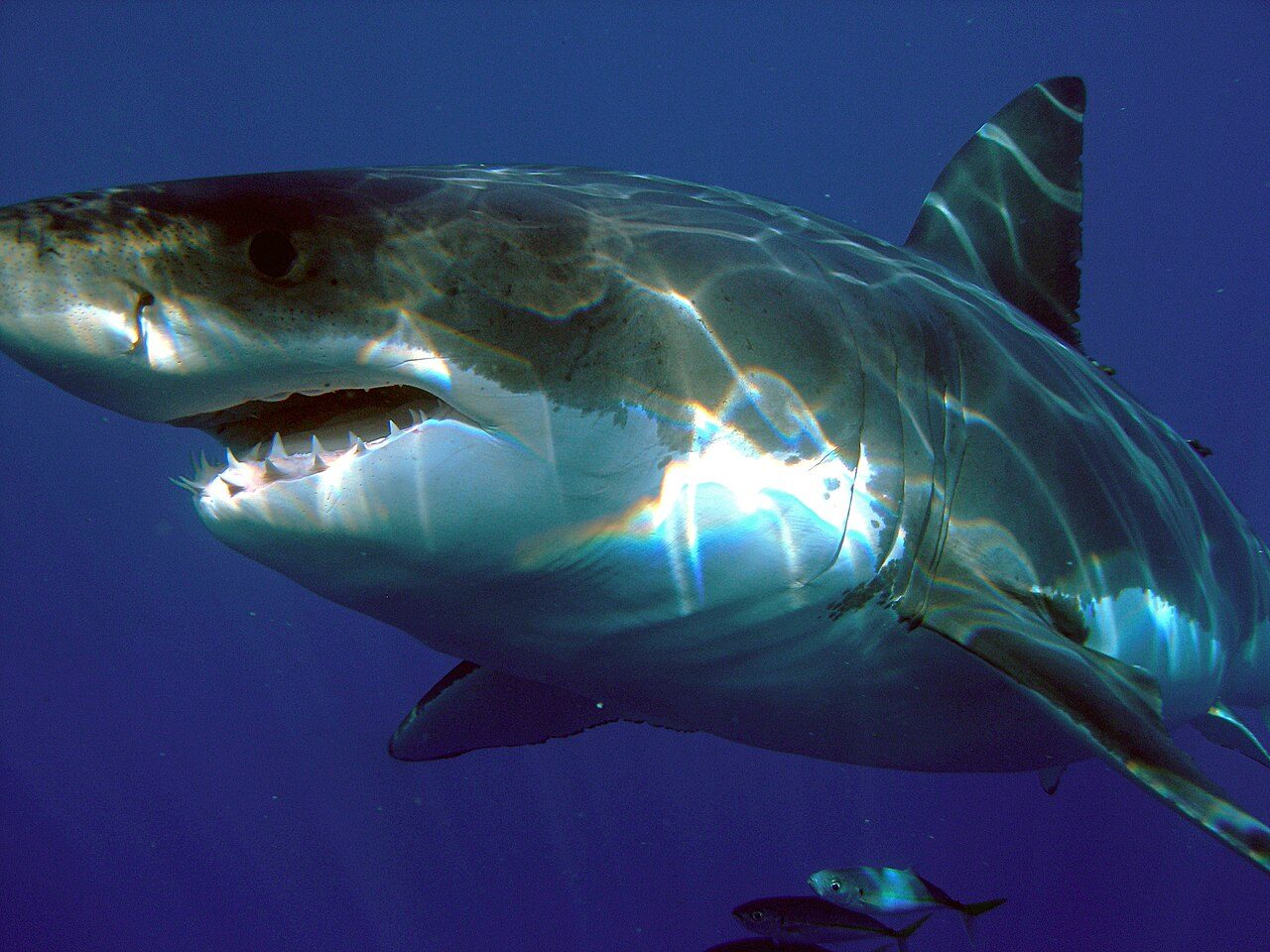
The white shark — Carcharodon carcharias, better known as the great white — is among the largest predatory fish on Earth. The Florida Museum puts its maximum size at about 20 feet, with unconfirmed reports of animals reaching 23 feet; females, which mature at about 14 to 16 feet, grow larger than males. Its colouring is a study in camouflage: greyish-black above, breaking abruptly to a pale, almost white underside, so that prey looking up sees sky and prey looking down sees deep water.
It is also, as the Florida Museum frankly notes, one of the best known sharks and yet one whose biology remains surprisingly little understood. White sharks have never been bred or raised in captivity, so almost everything known about them comes from observation, tagging and dissection in the wild — a predator studied at a distance, on its own terms.
Background
The white shark is cosmopolitan but is predominantly a creature of temperate seas, ranging in the western Atlantic from Newfoundland to Florida and Brazil to Argentina, in the eastern Atlantic from France to South Africa including the Mediterranean, and across the Indian and Pacific Oceans from the Red Sea and Siberia to New Zealand, Hawaii and Chile. It spends most of its time in the upper water column in nearshore waters — patrolling seal colonies, offshore reefs and rocky headlands — but it ranges from the surfline to the open ocean and down to depths of more than 1,300 metres, and larger individuals make intercontinental journeys.
Its equipment explains its reputation. The teeth are large, erect, triangular and serrated, broader in adults that tackle marine mammals. The white shark is endothermic — warm-bodied — holding its temperature above that of the surrounding water, which powers sustained swimming in cold seas. It is a daytime macropredator whose most important prey are marine mammals — seals, sea lions, elephant seals and dolphins — along with other sharks, rays and fish. Bomb-dating of its vertebrae suggests it may live to seventy years or more, far longer than once assumed.
Timeline
- About 56–34 million years ago
The Eocene Epoch: ancestors of the white shark may date back at least this far, according to the fossil record summarised by Britannica.
- About 18–12 million years ago
The middle Miocene: the modern species Carcharodon carcharias appears in the fossil record.
- 1758
Linnaeus first names the species Squalus carcharias; it will pass through a series of scientific names before settling as Carcharodon carcharias.
- 1975
The film Jaws fixes the white shark in the public imagination as a man-eater — an image scientists have spent fifty years qualifying.
- 1990s
Tag-and-release programmes in the United States, South Africa and Australia begin revealing the shark's true scale of movement, from local patrols to crossings of entire ocean basins.
- 2002
CITES places the white shark on its Appendix II, requiring permits and tighter regulation of international trade in its products.
- 2014
Bomb-dating research (Hamady and colleagues) overturns the assumed lifespan, showing white sharks may live to 70 years or more — with profound implications for how slowly the species can replace itself.
Significance
The white shark matters ecologically because it sits at the top of its food web. The Florida Museum notes that protection has been proposed precisely because of its position as an apex carnivore: a predator that regulates seal, sea lion and fish populations structures the behaviour of everything beneath it. Its hunting method is analytical as much as violent — experiments show sharks presented with a square target and a seal-shaped target choose the shape common in their natural environment, and researchers now believe many strikes on unfamiliar objects, including surfboards, are investigations: the shark tests with its mouth whether a strange object is food.
That same mouth made the species valuable dead. Jaws and teeth fetch thousands of dollars, and white sharks are taken in gill nets, longlines and a dozen other fisheries, their flesh eaten, skin made into leather, livers rendered for oil and fins sold for soup. Because the species is slow-growing and produces few young, it is highly vulnerable to overfishing — the reason it is listed as Vulnerable on the IUCN Red List and protected in the waters of South Africa, Australia and the United States, among others.
Legacy
No reliable global population estimate for the white shark exists, and regional estimates are unreliable — an extraordinary admission for so famous an animal, and the central problem of its conservation. Managers have been urged to act on the precautionary principle until better data on its breeding, growth and numbers arrive. Satellite tagging is steadily replacing ignorance with maps: seasonal movements, deep dives and ocean crossings that were invisible a generation ago.
The great white's legacy is therefore double-edged. It remains the shark credited with more fatal attacks on humans than any other species — a statistic the Florida Museum attributes to its size, power and feeding behaviour — yet the evidence of the last fifty years is of an animal far more threatened than threatening: slow to mature, slow to reproduce, and pursued for parts of its own body. Understanding it, rather than fearing it, has become the work.
Sources
- Florida Museum of Natural History — White Shark (Discover Fishes species profile)
- Encyclopaedia Britannica — Shark (white shark account)
- Encyclopaedia Britannica — 10 of the World's Most Dangerous Fish (great white shark)
The facts on this page were checked against these sources on 19 November 2026. The History Trail's permanent pages are researched and written for this site; the live profiles elsewhere on The History Trail are assembled automatically from Wikipedia and Wikidata.
About the Author
Researched and written by the The History Trail Editorial Team — the accountable editorial function behind this site's permanent story pages. The team works from the published sources cited on each page; it does not invent historians, reviewers or credentials, and it corrects errors openly.
Fact Check
Every load-bearing fact on this page traces to one of the sources listed above, and significant claims link to their source in the text. Our checking method is described on the methodology page; errors can be reported via the corrections page.
Sources & Citations
Cite this page as: The History Trail Editorial Team, The History Trail — this article's title, publication and update dates are shown beneath its headline. The full source list appears under Sources above; the site's source standards are on the sources page.