
Things
The Times Square Ball Drop
The Times Square ball drop began in 1907 because fireworks were banned: Adolph Ochs of The New York Times had sign-maker Jacob Starr build a 700-pound iron-and-wood ball, lit with 100 bulbs, and lower it from the Times Tower flagpole at midnight.
At a Glance
- The founder
- Adolph Ochs, owner of The New York Times, who moved the paper to the new Times Tower and renamed Longacre Square in 1904
- The first celebration
- December 31, 1904: an all-day festival for over 200,000 people, ending in fireworks from the tower
- Why a ball?
- The city banned the fireworks in 1907 for safety; a falling illuminated ball replaced the falling sparks
- The first ball
- Built by metalworker Jacob Starr of Artkraft Strauss: iron and wood, 5 feet across, 700 pounds, lit by one hundred 25-watt bulbs; first dropped December 31, 1907
- The missed years
- Only 1942 and 1943, for the wartime dimout — crowds still gathered for a minute of silence and chimes
- The modern ball
- A permanent year-round Big Ball from 2009: nearly six tons, 12 feet across, 2,688 Waterford crystal triangles lit by 32,256 LEDs
Introduction
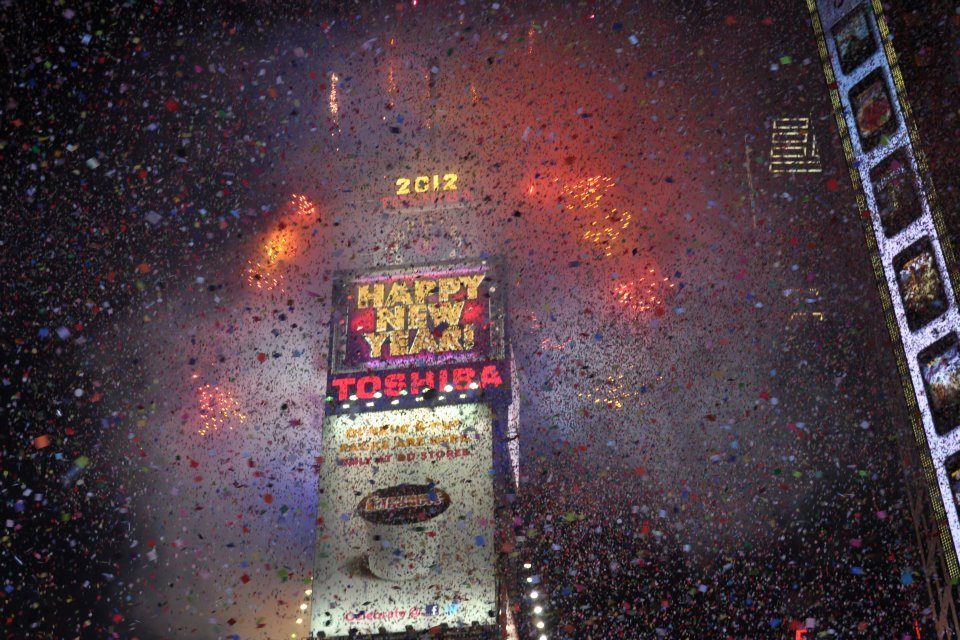
The Times Square ball drop — a glittering sphere lowered down a pole atop One Times Square in the last minute of December 31 — is the world's most watched new-year ritual, seen by an audience the Times Square Alliance estimates at over one billion people. It began as a substitute. When New York City banned the fireworks that had made the square's first celebrations famous, the New York Times and its sign-makers replaced falling sparks with a falling ball: 700 pounds of iron and wood, lit by 100 bulbs, lowered for the first time on December 31, 1907.
The ball has been redesigned again and again — wrought iron, aluminium, an apple, Waterford crystal, LEDs — and missed only two years, the wartime dimouts of 1942 and 1943. Its ancestors are not fireworks at all but the time balls of nineteenth-century observatories, dropped daily so ships could set their chronometers. Times Square simply made the signal annual, and aimed it at everyone.
Origins: Adolph Ochs Moves Uptown
The tradition starts with a newspaper's change of address. In 1904 The New York Times opened its new headquarters, the Times Tower, on the triangle where Broadway, Seventh Avenue and 42nd Street meet — and its owner, Adolph Ochs, had successfully lobbied the city to rename the surrounding district, Longacre Square, as Times Square in the paper's honour. To celebrate, Ochs staged an all-day street festival on December 31, 1904, ending in a fireworks display fired from the tower's base. More than 200,000 people attended, and Times Square instantly displaced Trinity Church downtown as New York's place to ring in the year.
The fireworks were the problem. They rained hot ash on the crowds, and in 1907 the city banned them. Ochs needed a climax that fell instead of exploded. The Times's chief electrician, Walter Palmer, is credited with proposing a time ball, and the job of building it went to Jacob Starr, a young immigrant metalworker whose sign company, Artkraft Strauss, would lower the ball for most of the twentieth century. Their first ball was five feet across, made of iron and wood, adorned with one hundred 25-watt light bulbs, and weighed 700 pounds.
The First Drop and the Ball's Many Lives
On December 31, 1907 the ball made its maiden descent from the flagpole atop the tower to signal the arrival of 1908 — waiters in the surrounding lobster palaces wore battery-powered top hats whose 1908 numerals lit up at the same moment. The ceremony has run every year since except 1942 and 1943, when wartime dimout rules suspended it; crowds gathered anyway and greeted the year with a minute of silence, followed by chimes from sound trucks at the tower's base.
The ball itself kept changing. A 400-pound wrought-iron ball replaced the original in 1920; a 150-pound aluminium ball succeeded it in 1955. From 1981 to 1988, red bulbs and a green stem turned the aluminium ball into an apple for the I Love New York campaign, after which the plain glowing white ball returned. A 1995 upgrade added rhinestones, strobes and computer controls before the aluminium era ended in 1998. For the millennium, Waterford Crystal and Philips Lighting built a completely new crystal ball, combining traditional material with modern lighting to greet the year 2000.
Timeline
- 1904
Adolph Ochs moves The New York Times uptown; Longacre Square becomes Times Square, and the first Times Square New Year's Eve festival ends in fireworks.
- 1907
The city bans the fireworks. Jacob Starr builds the first ball: iron and wood, 5 feet across, 700 pounds, 100 bulbs.
- 31 December 1907
The ball drops for the first time, signalling the arrival of 1908.
- 1920
A 400-pound wrought-iron ball replaces the original.
- 1942–43
The drop is suspended for the wartime dimout; crowds mark midnight with a minute of silence and chimes instead.
- 1955
An aluminium ball of just 150 pounds takes over.
- 1981–88
Red bulbs and a green stem turn the ball into an apple for the I Love New York campaign.
- 2000
A new Waterford Crystal ball, built with Philips Lighting, welcomes the millennium.
- 2007
For the tradition's centenary, a new LED crystal ball replaces incandescent and halogen lighting.
- 2009
A permanent, year-round Big Ball — nearly six tons, 12 feet across, 2,688 crystal triangles and 32,256 LEDs — becomes a fixture above Times Square.
Significance: From Time Signal to World Ritual
The drop's deeper ancestry is navigational. The first time ball was installed at the Royal Observatory at Greenwich in 1833, dropping at one o'clock each afternoon so captains on the Thames could set their chronometers precisely; about 150 public time balls followed around the world. Almost all have vanished, but the idea — a ball falling means an exact, shared moment — survived in Times Square, where the moment is midnight and the audience, by the Alliance's estimate, exceeds one billion. In 1914 the Times itself moved out to West 43rd Street; the ritual stayed, and outgrew its inventor.
The ceremony has also grown a participatory layer. At midnight, tonnes of confetti are released over the square, and much of it begins as wishes: throughout December, visitors write hopes for the coming year at the New Year's Eve Wishing Wall in Times Square or online, and those wishes are mixed into the confetti that falls on the crowd. A ritual invented to sell a newspaper district now literally showers strangers with one another's resolutions.
Questions readers ask
Has the ball really dropped every year since 1907? Almost: the only exceptions are 1942 and 1943, suspended for the wartime dimout — and even then the crowds came, keeping the gathering while losing the light. Britannica's account agrees on the 1907 debut, the ban that prompted it and the two missed years, though it quotes the Times's own announcement of 216 lamps for the first ball where the Alliance counts 100 bulbs of 25 watts; the Alliance's figure, from the ball's builder's tradition, is the one used here.
Is today's ball the original? No — the Alliance counts seven versions up to the centenary era, and a ninth, the Constellation Ball of 5,280 crystals, debuted in November 2025. The permanent Big Ball installed for 2009 stays above the square all year; the falling object has been replaced many times, but the descent, the pole and the minute have never changed.
Legacy
The ball drop solved a municipal safety problem so elegantly that it became the planet's default image of the new year arriving. A time signal for ships became a countdown for a billion people, and a banned firework became a falling star that returns on schedule. Whatever ball is current — iron, apple or crystal — the ritual's meaning is the one Palmer and Starr built in 1907: watch time itself descend, together, in public, and cheer when it lands.
Sources
- Times Square Alliance — NYE History & Times Square Ball
- Encyclopaedia Britannica — Why Do We Drop a Ball on New Year's Eve?
- HISTORY — New Year's: Eve, Day, Traditions & Resolutions
- Encyclopaedia Britannica — New Year festival
The facts on this page were checked against these sources on 19 November 2026. The History Trail's permanent pages are researched and written for this site; the live profiles elsewhere on The History Trail are assembled automatically from Wikipedia and Wikidata.
About the Author
Researched and written by the The History Trail Editorial Team — the accountable editorial function behind this site's permanent story pages. The team works from the published sources cited on each page; it does not invent historians, reviewers or credentials, and it corrects errors openly.
Fact Check
Every load-bearing fact on this page traces to one of the sources listed above, and significant claims link to their source in the text. Our checking method is described on the methodology page; errors can be reported via the corrections page.
Sources & Citations
Cite this page as: The History Trail Editorial Team, The History Trail — this article's title, publication and update dates are shown beneath its headline. The full source list appears under Sources above; the site's source standards are on the sources page.