
Things
Harvard University
Harvard University, in Cambridge, Massachusetts, is described by Britannica as the oldest institution of higher learning in the United States: it was founded in 1636 by a vote of the Massachusetts Bay Colony's legislature and named in 1639 for its first benefactor, the Puritan clergyman John Harvard. It grew from one master teaching in a single frame house into a research university whose graduate and professional schools helped shape American higher education.
At a Glance
- Founded
- 1636, when the Great and General Court of the Massachusetts Bay Colony approved 400 pounds for "a schoale or colledge"
- The name
- Ordered in 1639: the college was named Harvard College for John Harvard, its first benefactor, who had died the year before
- The bequest
- John Harvard left the college half his estate and his library - over 400 volumes, according to Harvard Library
- First steps
- Classes began in summer 1638; Henry Dunster became first president in 1640; the first commencement, with nine graduates, was held in 1642
- The charter
- The Charter of 1650 created the Harvard Corporation - president, five fellows and a treasurer - to manage the college in perpetual succession
- Became a university
- The Massachusetts Constitution of 1780 officially recognised Harvard as a university; its Medical School followed in 1782
- The transformation
- Under President Charles W. Eliot (1869-1909) Harvard gained national influence; graduate, law, medical and business schools grew around the undergraduate college
Introduction
Harvard's main campus lies along the Charles River in Cambridge, Massachusetts, a few miles west of downtown Boston. Britannica describes it as one of the eight Ivy League schools, widely regarded for high academic standards, selectivity in admissions and social prestige, with a total enrollment of about 25,000 in the early 21st century - about a third of them undergraduates in Harvard College, the rest in its graduate and professional schools.
The striking fact is the date. Harvard was voted into existence in 1636, sixteen years after the Pilgrims landed at Plymouth and almost a century and a half before the United States existed. For its first two centuries it was a small college, at first under church sponsorship, training a colony's ministers and magistrates. The university of world reputation is a later creation, built in layers on that foundation.
Origins: A Vote, a Town Renamed and a Dying Minister's Books
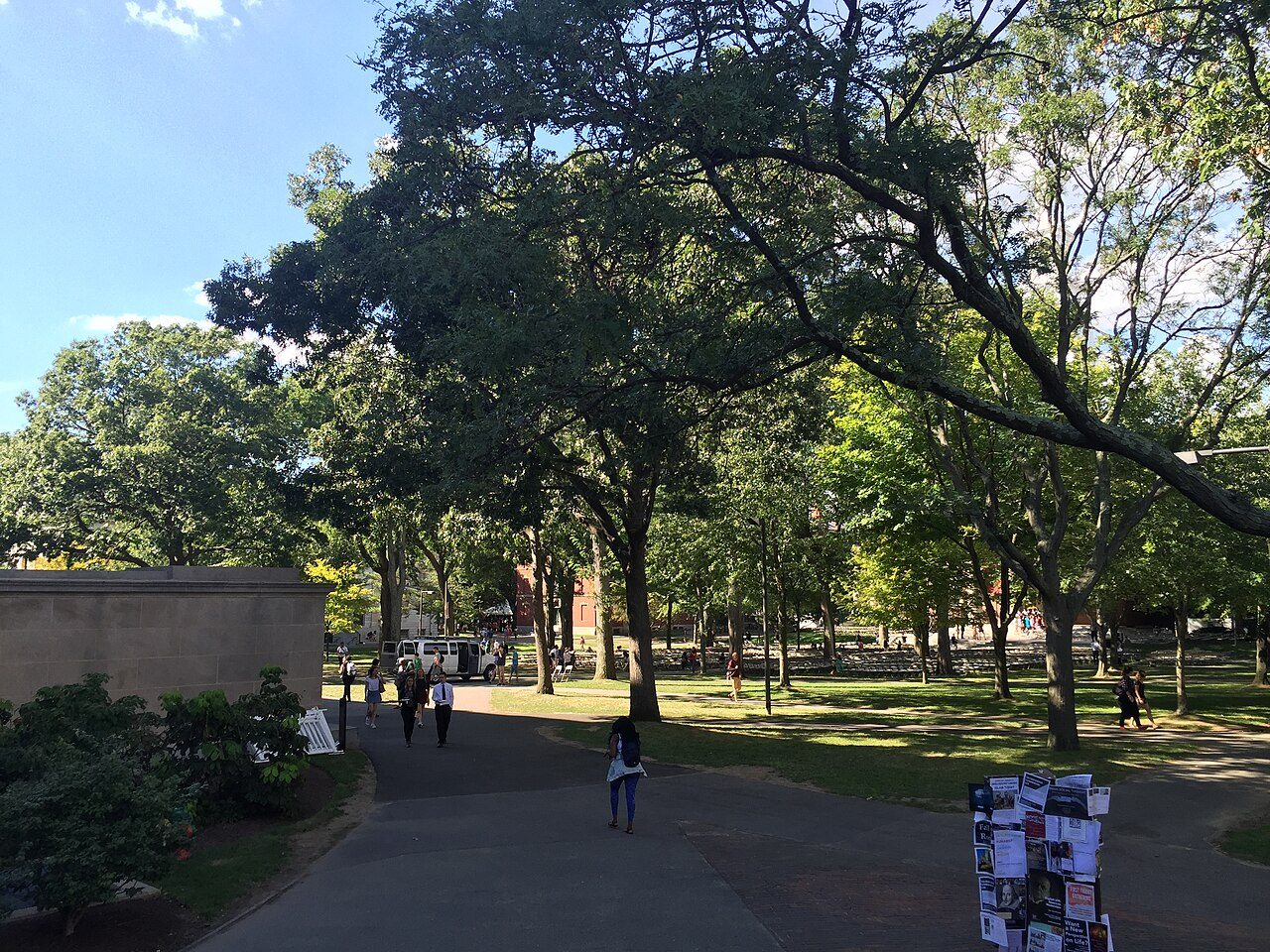
Harvard's own history timeline records the founding act precisely: in 1636 the Great and General Court of the Governor and Company of the Massachusetts Bay in New England approved 400 pounds for the establishment of "a schoale or colledge" later to be called Harvard. The next year the court ordered the college to be located at Newetowne, and the settlement was renamed Cambridge in 1638, Britannica explains, for the English university of some of the leading colonists. The college's first land - a house and an acre bought from Goodman Peyntree - became the nucleus of today's Harvard Yard.
Classes began in the summer of 1638, Britannica records, with one master in a single frame house and a college yard. That same year the college received the gift that gave it a name. John Harvard, a Puritan minister and a graduate of Emmanuel College, Cambridge, who had emigrated to the colony in 1637, died in September 1638 and left the young college his books and half his estate - a library Harvard Library puts at over 400 volumes. In March 1639 the General Court ordered that the college "shalbee called Harvard Colledge" in recognition of the bequest. Henry Dunster became its first president in 1640, the first commencement followed in 1642 with nine graduates, and the Charter of 1650 settled the college's government on a self-perpetuating corporation that, in amended form, still runs it.
From College to University: Professional Schools and the Eliot Era
For its first two centuries, Britannica notes, the college was gradually liberated first from clerical and later from political control, until in 1865 its alumni began electing members of the governing board. Its scope widened step by step. The Massachusetts Constitution of 1780 officially recognised Harvard as a university, and the founding of the Medical School in 1782, Harvard's timeline records, made it a university in fact as well as name. A Divinity School followed in 1816 and the Law School in 1817; the Lawrence Scientific School, founded in 1847 with a gift from the industrialist Abbott Lawrence, began the university's formal programmes in engineering and applied sciences.
The decisive transformation came under Charles W. Eliot, president from 1869 to 1909, who, in Britannica's summary, made Harvard into an institution with national influence. The Graduate School of Arts and Sciences was founded in 1872, during his tenure, and the pattern of a research university - an undergraduate college ringed by graduate and professional schools - took the form it still has. In 1908, near the end of Eliot's presidency, the Graduate School of Business Administration opened with 59 students as, Harvard records, the country's first business programme limited to college graduates.
Women's education arrived by a side door. In 1879 a group of Harvard faculty, the Harvard Annex, made a full course of study available to women, and the Annex was chartered as Radcliffe College in 1894. Radcliffe graduates were not granted Harvard degrees until 1963, and the two institutions formally merged only in 1999, when the Radcliffe Institute for Advanced Study was established.
Timeline
- 1636
The Great and General Court of the Massachusetts Bay Colony approves 400 pounds for "a schoale or colledge" - the founding vote.
- 1638
Classes begin in Newetowne, renamed Cambridge; John Harvard dies, leaving the college half his estate and his library.
- 1639
The General Court orders the college to be called Harvard College, in recognition of John Harvard's bequest.
- 1642
Harvard holds its first commencement, with nine graduates.
- 1650
The Charter of 1650 creates the Harvard Corporation to manage the college in perpetual succession.
- 1780-1782
The Massachusetts Constitution recognises Harvard as a university; the Medical School is founded in 1782.
- 1817
Harvard Law School is established, a year after the Divinity School.
- 1869
Charles W. Eliot is installed as president; his 40-year tenure remakes Harvard as a university of national influence.
- 1879-1894
The Harvard Annex opens higher education to women in 1879 and is chartered as Radcliffe College in 1894.
- 1908
The Graduate School of Business Administration opens with 59 students, limited to college graduates.
- 1999
Radcliffe and Harvard formally merge, creating the Radcliffe Institute for Advanced Study.
- 2007
Historian Drew Gilpin Faust becomes Harvard's first female president.
Significance
Harvard's significance is partly priority and partly example. As the first college founded in the American colonies - Harvard's own timeline calls it exactly that - it set the template other colonial colleges followed: a chartered corporation, a resident president, a yard of halls around which a town of learning grew. Its slow emancipation from church and state control between the 17th century and 1865 traced the path American higher education as a whole would take.
The Eliot era added the second template: the research university. By gathering professional schools and a graduate school of arts and sciences around the old college, Harvard helped define what an American university, as opposed to a college, was for. Its graduates carried the model outward: by the end of the first decade of the 21st century, Britannica records, Harvard had educated eight United States presidents, from John Adams to Barack Obama.
Myths and disputes
Was John Harvard the founder of Harvard? No - and Harvard itself says so. The college was founded by vote of the Massachusetts Bay Colony's legislature in 1636, before John Harvard had even arrived in New England; he was its first benefactor, not its founder, and he never attended it. The point is preserved in the university's favourite joke about itself. Daniel Chester French's 1884 statue in Harvard Yard is nicknamed, in Harvard Library's words, the "statue of three lies": its inscription reads "John Harvard, Founder, 1638," but Harvard did not found the college, the college was founded in 1636 not 1638, and the figure is not John Harvard at all - no likeness of him survived, so the sculptor's model was a student, Sherman Hoar.
The "oldest" claim also needs its exact wording, and this page keeps to it. Britannica calls Harvard the oldest institution of higher learning in the United States, and Harvard's own timeline calls it the first college in the American colonies. Both claims rest on the 1636 founding vote; teaching did not begin until 1638, and the name Harvard dates only from 1639. Stated that way - authorised in 1636, teaching from 1638, named in 1639 - the priority is a matter of record rather than slogan.
Legacy
Harvard's legacy is visible in the structure of American education itself: the liberal arts college at the centre, graduate and professional schools around it, alumni electing overseers, and a charter older than the republic still supplying the institution's legal frame. Harvard's timeline counts the chemist Theodore William Richards, Nobel laureate in Chemistry in 1914, as the first of 50 Harvard Nobel laureates - a measure of how completely the colonial college became a research institution.
The physical legacy matches. The Yard still grows around the house and acre bought in 1637, and visitors still rub the toe of a statue that depicts the wrong man, under the wrong title, with the wrong date - and still, somehow, honours the right thing: a young minister's gift of books, which turned a colony's vote into a college with a name.
Sources
- Harvard University - History timeline
- Harvard Library - Where is the John Harvard Statue?
- Harvard Gazette - Iconic John Harvard Statue is the star of the Yard
- Encyclopaedia Britannica - Harvard University
- Encyclopaedia Britannica - John Harvard
The facts on this page were checked against these sources on 19 November 2026. The History Trail's permanent pages are researched and written for this site; the live profiles elsewhere on The History Trail are assembled automatically from Wikipedia and Wikidata.
About the Author
Researched and written by the The History Trail Editorial Team — the accountable editorial function behind this site's permanent story pages. The team works from the published sources cited on each page; it does not invent historians, reviewers or credentials, and it corrects errors openly.
Fact Check
Every load-bearing fact on this page traces to one of the sources listed above, and significant claims link to their source in the text. Our checking method is described on the methodology page; errors can be reported via the corrections page.
Sources & Citations
Cite this page as: The History Trail Editorial Team, The History Trail — this article's title, publication and update dates are shown beneath its headline. The full source list appears under Sources above; the site's source standards are on the sources page.