
Things
Harry Potter and the Philosopher's Stone
Harry Potter and the Philosopher's Stone is a fantasy novel by J. K. Rowling, published by Bloomsbury in Britain on 26 June 1997. Rejected, by Rowling's own account, by twelve publishers before Bloomsbury accepted it, it appeared in a first hardback printing of only 500 copies, most of them for libraries - and then became the first volume of the best-selling book series in history.
At a Glance
- Author
- J. K. Rowling (born Joanne Rowling); the initials were adopted before publication at her publisher's suggestion of a gender-neutral pen name, the K standing for Kathleen, her grandmother's name
- First publication
- Bloomsbury, London, 26 June 1997; published in the United States by Scholastic in September 1998 as Harry Potter and the Sorcerer's Stone
- The first printing
- 500 hardback copies, of which 300 went to public libraries, alongside a larger paperback printing; publisher figures cited by auction houses put the whole first printing at 5,650 copies
- The road to publication
- Rowling and her agent Christopher Little have both given the number of publishers who rejected the manuscript before Bloomsbury as twelve
- The advance
- About 2,500 pounds, the figure Rowling has confirmed in interviews, plus an 8,000 pound grant from the Scottish Arts Council
- The fiction
- An orphan, Harry Potter, learns on his eleventh birthday that he is a wizard, and goes to Hogwarts School of Witchcraft and Wizardry, where he and his friends Ron Weasley and Hermione Granger protect the Philosopher's Stone from Lord Voldemort
- The series it began
- Seven novels, 1997 to 2007; Bloomsbury announced in February 2018 that the series had passed 500 million copies sold worldwide, in 80 languages
Introduction
This page is the documented history of a book, not of a wizard: Harry, Hogwarts and the Philosopher's Stone itself are fiction, invented by Rowling. What is real, and remarkable, is the book's own story. A manuscript written over about five years, much of it in Edinburgh cafes by a single mother living on state benefits, was turned down again and again, accepted for a small advance, and printed so modestly that most of its first hardbacks went straight onto library shelves. Within a few years it had changed children's publishing.
The novel's content, stated plainly as fiction, is this: Harry Potter, an orphan raised by his aunt and uncle, learns on his eleventh birthday that he is a wizard and has a place at Hogwarts School of Witchcraft and Wizardry. There he makes friends, Ron Weasley and Hermione Granger, and an enemy, Draco Malfoy, and helps to keep the Philosopher's Stone - in the story, an object that can turn metal into gold and grant immortality - out of the hands of Lord Voldemort. Britannica notes it was praised for its characters and imaginative world, and was an immediate success.
Writing the Book: Trains, Portugal and Edinburgh Cafes
Rowling has often told how the idea arrived in 1990, on a delayed train journey, and how she spent the following years building plots for seven books. The first novel was written between about June 1990 and 1995. In between came upheaval: her mother died in December 1990, she moved to Porto in Portugal to teach English, married, and had a daughter, and when the marriage ended she returned to Edinburgh in 1993, by her own account carrying the first chapters in her suitcase.
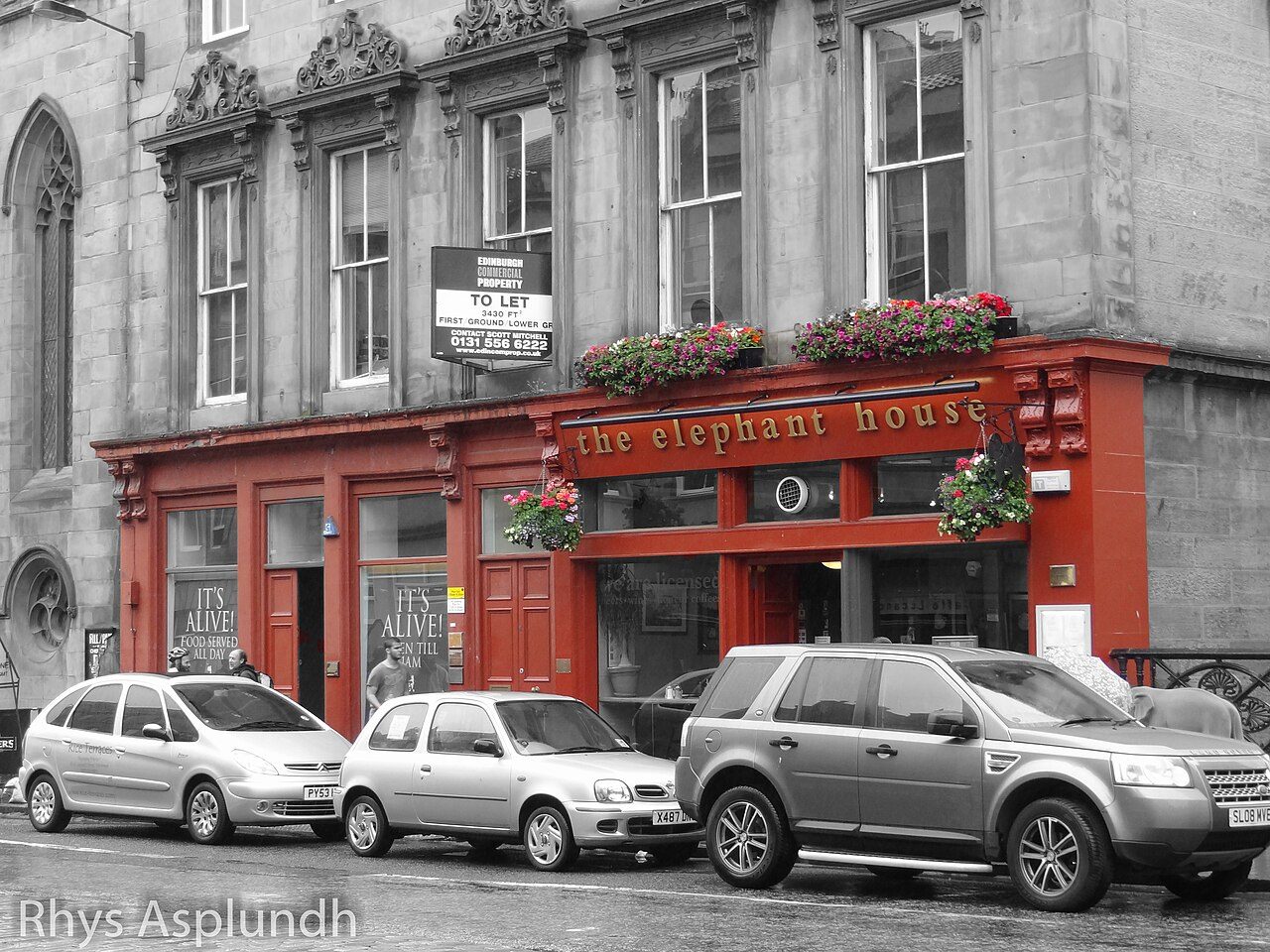
The Edinburgh years are the famous ones. Living on benefits with a baby daughter, Rowling wrote in cafes because, as she has explained, pushing the pram until her daughter slept and then writing in a warm cafe was the routine that worked. The cafe she has confirmed most clearly is Nicolson's, on Nicolson Street, part-owned by her brother-in-law: she has said she wrote there all the time, and once wrote an entire chapter there in one sitting. She also wrote in The Elephant House on George IV Bridge. She finished the manuscript in 1995, typing it herself because professional typing was beyond her budget, and received a grant of 8,000 pounds from the Scottish Arts Council after Bloomsbury accepted the book.
Twelve Rejections and the Bloomsbury Yes
Rowling sent the opening chapters to the Christopher Little Literary Agency, where, by the agency's account, an assistant, Bryony Evens, pulled them from the submissions pile and recommended them. Little took the book on and submitted it to publisher after publisher. The number Rowling and Little have both given for the rejections is twelve. The full list of the twelve houses has never been published, so this page gives the figure as what it is: the number consistently stated by author and agent, not a documented list.
The yes came from Bloomsbury, a London house then building a children's list under editor Barry Cunningham. Bloomsbury's founder Nigel Newton has recalled taking the sample chapters home, where his eight-year-old daughter Alice read them and demanded more - a verdict Newton has credited in his decision. Bloomsbury bought the book for an advance of about 2,500 pounds. Before publication, Joanne Rowling became J. K. Rowling: Britannica records that her publisher recommended a gender-neutral pen name, and that she added the middle initial K, for Kathleen, her paternal grandmother's name. Thomas Taylor, a young illustrator, painted the first edition's cover.
Timeline
- 1990
Rowling gets the idea for Harry Potter, by her account on a delayed train, and begins writing; her mother dies in December of the same year.
- 1993
After teaching in Porto and the end of her marriage, Rowling returns to Edinburgh with her baby daughter and, she has said, the first chapters in her suitcase.
- 1995
Rowling finishes the manuscript, typed by herself, and sends sample chapters to the Christopher Little Literary Agency.
- 1995-1996
The manuscript is rejected by twelve publishers, the number given by Rowling and her agent, before Bloomsbury accepts it.
- 26 June 1997
Bloomsbury publishes Philosopher's Stone in Britain: 500 hardback copies, 300 of them for libraries, in a total first printing put at 5,650 copies.
- 1997
The book wins a British Book Award and the gold medal in the 9-to-11 category of the Nestle Smarties Book Prize.
- September 1998
Scholastic publishes the book in the United States as Harry Potter and the Sorcerer's Stone.
- 1998-2007
Six sequels follow, ending with Deathly Hallows in 2007; the last four set successive fastest-selling records.
- 2001-2011
Warner Bros. releases eight film adaptations of the seven novels, carrying the story to a global cinema audience.
- February 2018
Bloomsbury announces that the Harry Potter series has passed 500 million copies sold worldwide, published in 80 languages.
- December 2021
A first-printing hardback sells at Heritage Auctions for 471,000 dollars.
Significance
The book's significance is first a publishing story. A children's novel that a dozen houses judged too long, too old-fashioned or too risky became, on Bloomsbury's own figures, the foundation of the best-selling book series in history. Bloomsbury reports that the series is published in 80 languages and that more than 500 million copies have been sold across the world, and that Deathly Hallows became the fastest-selling book ever in Britain, selling 2.65 million copies in its first 24 hours in the UK. Those are the publisher's figures, as Bloomsbury states them.
It is also a story about how books actually spread. The small first printing was a deliberate, ordinary caution for a first novel; what carried the book was recommendation - Cunningham's hope, reported at the time, that booksellers and librarians who read it would press it on children. The 300 library hardbacks, read and re-read, were not a failed launch. They were the launch.
Myths and disputes
Was The Elephant House the birthplace of Harry Potter? No, and the correction comes from Rowling herself. In 2020 she addressed the cafe claims directly: she had been writing Potter for several years before she ever set foot in The Elephant House, she said, so it is not the birthplace - though she did write there. She located the first putting of pen to paper in a flat in London, and gave Nicolson's, not The Elephant House, as the Edinburgh cafe where she wrote entire chapters. Cafe mythology should be read with that correction attached.
Two other famous numbers need the same care. The twelve rejections are real as a consistently repeated figure from Rowling and her agent, but no complete list of the twelve publishers exists in public, and retellings that name all twelve with confidence go beyond the record. And the 500 copies were 500 hardbacks, not 500 books in total: the same day's printing included more than five thousand paperbacks. The rarity, and the auction prices, belong to the hardback alone.
Legacy
The legacy of Philosopher's Stone is the series and the readership it created: seven novels a generation grew up with in real time, midnight publication parties that became a fixture of bookselling, and a permanent change in what publishers believed children's books could do. King's Cross station in London, where in the fiction students leave from the hidden Platform 9 and Three-Quarters, now keeps a permanent installation - a luggage trolley set into a wall beneath the platform sign - for the readers who still queue to be photographed at it.
The first edition tells the same story in miniature. A book printed in 500 hardbacks, most of them issued without dust jackets for library use, misprints and all - the word philosopher's missing a letter on the back cover, a wand listed twice in Harry's school equipment - is now among the most valuable modern books in the world. The phenomenon began, as the record shows, not with a marketing campaign but with a small printing, a child's verdict in a publisher's kitchen, and readers who would not stop recommending it.
Sources
- Encyclopaedia Britannica - Harry Potter and the Philosopher's Stone
- Smithsonian Magazine - Bought for 38 Cents, Rare Harry Potter Book Could Sell for Thousands
- Bloomsbury - J.K. Rowling, Harry Potter Books Author
- AGBI - 25 years of Harry Potter: From rejection to 500m global sales
- The Free Library - JK Rowling confirms where the first Harry Potter book was really written
The facts on this page were checked against these sources on 19 November 2026. The History Trail's permanent pages are researched and written for this site; the live profiles elsewhere on The History Trail are assembled automatically from Wikipedia and Wikidata.
About the Author
Researched and written by the The History Trail Editorial Team — the accountable editorial function behind this site's permanent story pages. The team works from the published sources cited on each page; it does not invent historians, reviewers or credentials, and it corrects errors openly.
Fact Check
Every load-bearing fact on this page traces to one of the sources listed above, and significant claims link to their source in the text. Our checking method is described on the methodology page; errors can be reported via the corrections page.
Sources & Citations
Cite this page as: The History Trail Editorial Team, The History Trail — this article's title, publication and update dates are shown beneath its headline. The full source list appears under Sources above; the site's source standards are on the sources page.