
Things
2011 Tōhoku Earthquake and Tsunami
On 11 March 2011 a megathrust earthquake off Japan's Tōhoku coast - listed by the US Geological Survey at magnitude 9.1, the most powerful ever recorded in Japan - sent a tsunami against the north-eastern coast of Honshu, flooding towns, ports and farmland and disabling the Fukushima Daiichi nuclear plant. Japan's National Police Agency figures, the Fukushima accident's documented sequence, and the reconstruction and warning reforms that followed are the subject of this page.
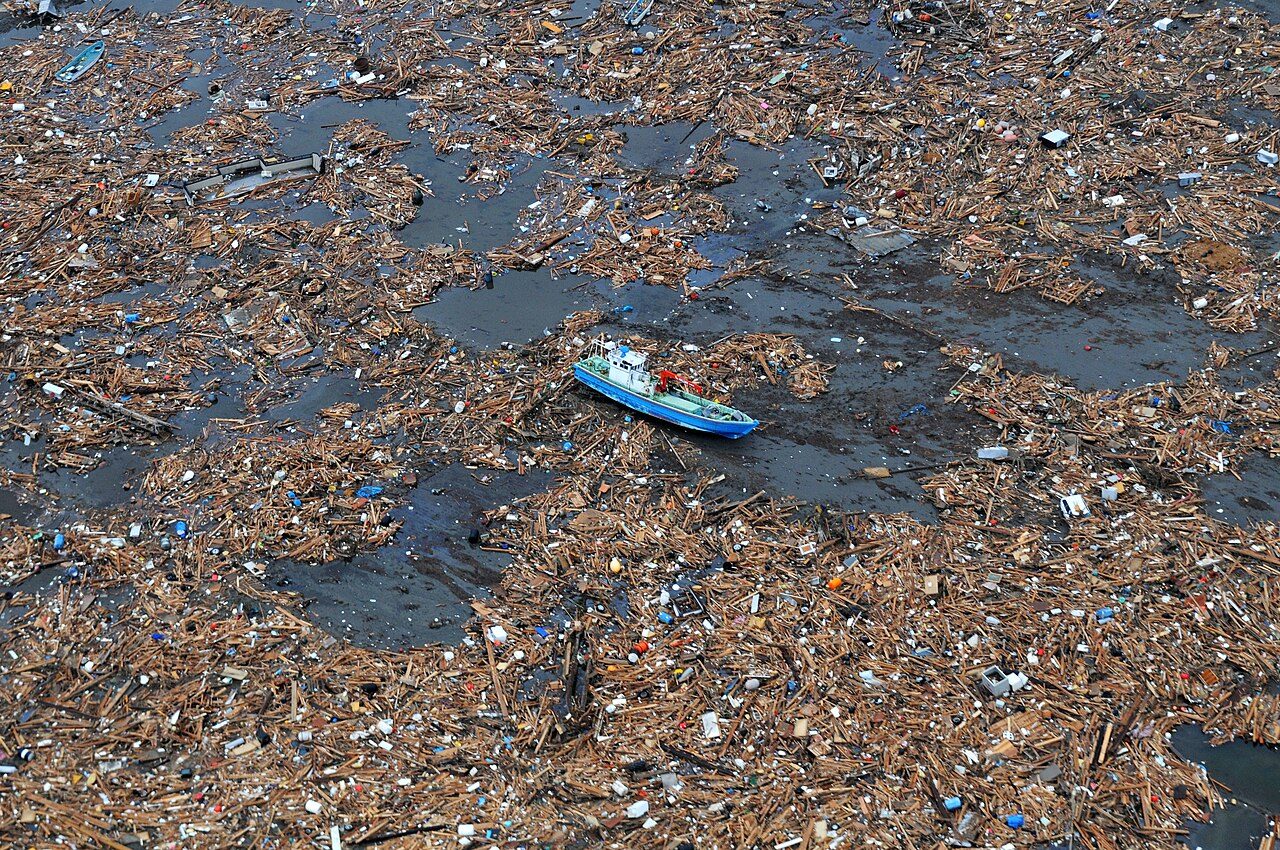
At a Glance
- Date and time
- 11 March 2011, 14:46 Japan Standard Time, off the Pacific coast of the Tōhoku region
- Magnitude
- Magnitude 9.1 in the US Geological Survey's current listing (revised upward in 2016); the Japan Meteorological Agency's published figure is 9.0
- Epicentre
- In the Pacific Ocean east of the Oshika Peninsula, at a depth of roughly 30 kilometres, on the Japan Trench subduction zone
- Tsunami
- NOAA's summary records a maximum surveyed runup of 38.9 metres in Iwate Prefecture; waves were observed across the whole Pacific basin
- Deaths
- Japan's National Police Agency reported 15,890 deaths and 2,590 people missing as of February 2015 (NOAA summary); Britannica gives the official total of confirmed dead or listed missing as about 18,500
- Fukushima Daiichi
- Japanese authorities rated the nuclear accident at Level 7, the highest, on the International Nuclear Event Scale on 12 April 2011
- Damage
- NOAA's summary put the damage in Japan at 220 billion US dollars
Introduction
The disaster is known in Japan as the Great East Japan Earthquake, and it was in fact three disasters in sequence. First came the earthquake itself: a rupture of the subduction zone where the Pacific Plate dives beneath northern Japan along the Japan Trench. The US Geological Survey's field teams describe a magnitude 9.1 great earthquake generating a Pacific-wide tsunami that was catastrophic along the coast of north-eastern Honshu. Then came the water, which did most of the killing and nearly all of the destruction along the coast. Finally, the tsunami's disabling of the Fukushima Daiichi nuclear power plant turned a natural disaster into a technological one, with evacuations that lasted for years.
Japan was, by wide agreement, the best-prepared country in the world for earthquakes and tsunamis, with seawalls, drills and an earthquake early-warning system. The documented lessons of 11 March are therefore not about an absence of preparation, but about its limits: the event was larger than the historical record the defences had been designed against.
The earthquake and the tsunami
The earthquake struck at 14:46 local time. Britannica records the epicentre some 130 kilometres east of the city of Sendai, Miyagi Prefecture, at a depth of about 30 kilometres, caused by the rupture of a stretch of the Japan Trench subduction zone. The sudden thrusting of the seafloor displaced the water above it and spawned the tsunami. Japan's early-warning system gave many people seconds of notice of the shaking and minutes to act on tsunami warnings, and warnings were issued around the Pacific basin.
Along the Sanriku coast of Iwate and in Miyagi and Fukushima prefectures, the waves overtopped seawalls built for smaller tsunamis. NOAA's event summary, drawing on field surveys, records a maximum runup - the height reached by the water above sea level - of 38.9 metres in Iwate Prefecture, with tide gauges around Japan registering between 1 and 9 metres and waves of about 2 metres reaching as far as Hawaii and the west coast of the United States. The US Geological Survey's survey teams, measuring damage in Natori, south of Sendai, found evidence of a flow depth of about 10 metres. Britannica notes that the great majority of those killed were drowning victims of the tsunami, and more than half were aged 65 or older.
Fukushima Daiichi: the documented sequence
The reactors at the three nuclear plants nearest the epicentre shut down automatically when the earthquake struck, Britannica records, but the quake cut main power to the plants and the tsunami then damaged the backup generators, most seriously at Fukushima Daiichi, on the coast about 100 kilometres south of Sendai. With power lost, cooling failed in three reactors over the following days; their cores overheated and partially melted, and explosions from built-up hydrogen gas damaged the outer buildings of reactors 1 and 3 on 12 and 14 March. Workers cooled the reactors with seawater, and an evacuation zone of 20 kilometres was set around the plant.
On 12 April 2011 Japanese authorities provisionally raised the accident's rating to Level 7 on the International Nuclear Event Scale, the scale's highest level, previously reached only at Chernobyl in 1986. The United Nations' report of the announcement adds the context Japanese officials gave at the time: the rating rested on the estimated total radioactivity released, which the Nuclear and Industrial Safety Agency put at roughly 10 percent of the Chernobyl release, and the reactors at Fukushima had shut down at the earthquake, unlike Chernobyl's. In December 2011 the Japanese prime minister declared the plant stable, with its reactors in cold shutdown.
Timeline
- 15 June 1896
The Meiji Sanriku earthquake and tsunami kill more than 27,000 people on the same coast, in NOAA's historical listing - the precedent Tōhoku's defences were built against.
- 11 March 2011, 14:46 JST
The megathrust earthquake strikes off the Oshika Peninsula; shaking is felt across Honshu and automatic shutdowns begin at coastal nuclear plants.
- 11 March 2011, afternoon
Tsunami waves strike Iwate, Miyagi and Fukushima prefectures, overtopping seawalls; warnings are issued across the Pacific.
- 12 March 2011
A hydrogen explosion damages the outer building of Fukushima Daiichi reactor 1; the evacuation zone around the plant is extended to 20 kilometres.
- 14 March 2011
A similar hydrogen explosion damages the building of reactor 3 at Fukushima Daiichi.
- 12 April 2011
Japanese authorities rate the Fukushima Daiichi accident at Level 7 on the International Nuclear Event Scale.
- September 2011 and after
Japan's Central Disaster Management Council adopts a two-level approach: defences designed against the more frequent class of tsunami, and survival of the largest class planned through evacuation and land use.
- December 2011
The Japanese government declares the Fukushima Daiichi reactors stable in cold shutdown.
- February 2015
NOAA's summary records the National Police Agency figures at that date: 15,890 deaths, 2,590 missing and 6,152 injured.
- Each 11 March
Japan marks the anniversary with ceremonies and a moment of silence at the time of the earthquake, in remembrance of the dead.
Significance
The human cost can only be stated with its sources attached, because the counts were compiled at different dates for different categories. NOAA's summary of the National Police Agency's reporting gives 15,890 deaths and 2,590 missing as of February 2015, with 6,152 injured; Britannica gives the official total of those confirmed dead or listed as missing as about 18,500, while noting other estimates of at least 20,000. What is not in dispute is the pattern: the deaths were concentrated in Iwate, Miyagi and Fukushima, Miyagi suffering the greatest losses, and the overwhelming cause was the tsunami rather than the shaking - in a country whose buildings are among the most earthquake-resistant in the world.
Questions readers ask
Was it magnitude 9.0 or 9.1? Both figures are official. The Japan Meteorological Agency's magnitude is 9.0; the US Geological Survey first published 9.0 and in July 2016 revised its listing to 9.1. Pages differ because they follow different agencies, not because either is wrong.
Did the earthquake or the tsunami do the damage? Along the coast, the tsunami: NOAA calls it the deadliest tsunami since the 2004 Indian Ocean event, and Britannica records that nearly all the deaths and much of the destruction were caused by the waves, though the earthquake damaged buildings, roads, rail and power systems across a wide inland area.
Is Fukushima the same as Chernobyl? They share the INES Level 7 rating, which is based on the scale of radioactive release. Japanese authorities and the IAEA stressed at the time that the accidents differed in cause and course: Fukushima's reactors had shut down when the earthquake struck, and the estimated atmospheric release was put at about a tenth of Chernobyl's.
Legacy
Reconstruction reshaped the Tōhoku coast. Japan adopted the two-level framework that still governs its tsunami policy: seawalls and coastal defences rebuilt and raised against the more frequent, smaller class of tsunami, and for the largest class - a 2011-scale event - an emphasis on evacuation routes, vertical evacuation buildings, land-use rules and warnings, with the walls' role being to slow the water and buy time. Towns were rebuilt in places on raised ground, and memorials and preserved ruins along the coast keep the day in public memory. Beyond Japan, the disaster changed nuclear regulation worldwide, prompting stress tests of reactors and reviews of flood defences at coastal plants, and it remains the reference event for tsunami science: the survey data gathered by teams such as the USGS's in 2011 still anchor models of how the largest tsunamis behave.
Sources
- US Geological Survey - USGS PCMSC Tsunami Observations, March 11, 2011
- NOAA National Centers for Environmental Information - March 11, 2011 Japan Earthquake and Tsunami
- UN News - Recent nuclear accident on par with Chernobyl, Japanese officials tell UN agency
- Encyclopaedia Britannica - Japan earthquake and tsunami of 2011: Aftermath of the disaster
- Encyclopaedia Britannica - Fukushima accident
The facts on this page were checked against these sources on 19 November 2026. The History Trail's permanent pages are researched and written for this site; the live profiles elsewhere on The History Trail are assembled automatically from Wikipedia and Wikidata.
About the Author
Researched and written by the The History Trail Editorial Team — the accountable editorial function behind this site's permanent story pages. The team works from the published sources cited on each page; it does not invent historians, reviewers or credentials, and it corrects errors openly.
Fact Check
Every load-bearing fact on this page traces to one of the sources listed above, and significant claims link to their source in the text. Our checking method is described on the methodology page; errors can be reported via the corrections page.
Sources & Citations
Cite this page as: The History Trail Editorial Team, The History Trail — this article's title, publication and update dates are shown beneath its headline. The full source list appears under Sources above; the site's source standards are on the sources page.