
On This Day
September 22 in History
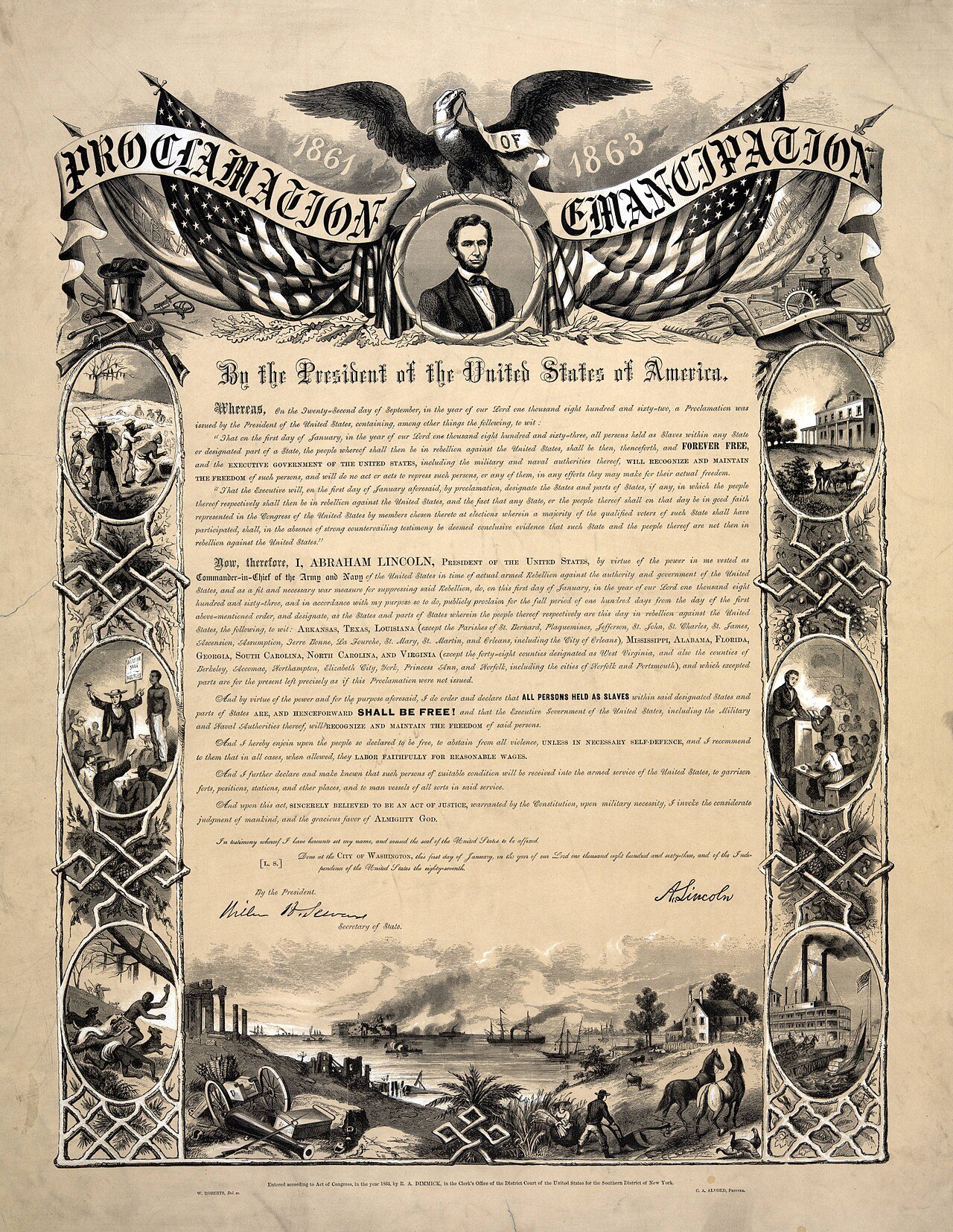
On 22 September 1862, five days after Antietam, President Abraham Lincoln issued the preliminary Emancipation Proclamation: unless the Confederate states returned to the Union within 100 days, the people they held in slavery would be declared 'thenceforward, and forever free' on 1 January 1863. September 22 is also the day Nathan Hale was hanged, Iraq invaded Iran, and Solidarity was founded in Poland.
Choose another date: open the On This Day calendar to browse events, births and deaths for any day of the year.
At a Glance
- The announcement
- 22 September 1862 — Lincoln issues the preliminary Emancipation Proclamation, five days after the Battle of Antietam
- The deadline
- Confederate states had 100 days, until 1 January 1863, to rejoin the Union; none did
- Who it covered
- More than three million enslaved people in the states still in rebellion
- Who it did not cover
- The loyal slaveholding border states — Delaware, Maryland, Kentucky and Missouri
- The result
- On 1 January 1863 Lincoln signed the final Emancipation Proclamation, recasting the Civil War as a war against slavery
- Completed by
- The Thirteenth Amendment of 1865, which abolished slavery throughout the United States
Events on this day
- 1692The last of the Salem witch trials' victims are hanged in Massachusetts — eight people executed on a single day.
- 1761George III is crowned king of Great Britain and Ireland at Westminster Abbey.
- 1792The French First Republic is proclaimed in Paris, one day after the National Convention abolished the monarchy.
- 1862Lincoln issues the preliminary Emancipation Proclamation, setting a date for freedom for enslaved people in the rebel states — the featured story above.
- 1888The first issue of National Geographic Magazine is published in Washington, D.C.
- 1914The German cruiser SMS Emden shells Madras (now Chennai) in India, bringing the First World War to the Indian coast.
- 1966Only 413 paying fans watch the New York Yankees play the Chicago White Sox at Yankee Stadium — the stadium's smallest recorded crowd.
- 1975Sara Jane Moore fires at President Gerald Ford outside a San Francisco hotel; she is seized before a second shot and Ford is unharmed.
- 1980Iraq invades Iran, beginning the Iran–Iraq War, which lasts nearly eight years.
- 1980Delegates of Poland's striking unions unite to found Solidarity, the first independent trade union in the Soviet bloc, under Lech Wałęsa.
- 1991The Huntington Library announces that the Dead Sea Scrolls will be made freely available to scholars, ending a decades-long monopoly.
Born on this day
- 1515Anne of Cleves — fourth wife of Henry VIII of England, whose brief marriage was annulled within months.
- 1791Michael Faraday — English scientist who discovered electromagnetic induction and laid the foundations of electric power.
- 1885Erich von Stroheim — Austrian-born film director and actor of Greed and Grand Illusion.
- 1902John Houseman — Romanian-born American actor and producer, co-founder of the Mercury Theatre.
- 1958Andrea Bocelli — Italian tenor who became one of the world's best-selling classical singers.
- 1976Ronaldo — Brazilian footballer, twice a World Cup winner and three times FIFA World Player of the Year.
Died on this day
- 1539Guru Nanak — founder of Sikhism and the first of its ten Gurus, who preached equality and honest labour.
- 1776Nathan Hale — American officer hanged by the British as a spy, remembered for regretting that he had but one life to lose for his country.
- 1989Irving Berlin — Russian-born American songwriter of 'White Christmas' and 'God Bless America', dead at 101.
- 2015Yogi Berra — American baseball catcher and folk philosopher of the New York Yankees.
The featured story: Lincoln issues the preliminary Emancipation Proclamation, 22 September 1862
Abraham Lincoln had the document in his desk all summer. He had read a draft emancipation proclamation to his cabinet on 22 July 1862, and Secretary of State William Seward had persuaded him to wait for a Union military success, lest the order look like an act of desperation. The success — narrow, bloody and incomplete — came on 17 September at Antietam in Maryland, where the Army of the Potomac halted Robert E. Lee's invasion of the North. Five days later, on 22 September 1862, Lincoln called the cabinet again and issued the preliminary Emancipation Proclamation.
It was framed as an ultimatum. The proclamation declared that on 1 January 1863, one hundred days later, all persons held as slaves in any state or part of a state still in rebellion against the United States 'shall be then, thenceforward, and forever free.' States that returned to the Union and sent representatives to Congress before the deadline could keep their enslaved labourers a little longer; states that fought on would lose them by presidential order, enforced by the Union army. Lincoln presented it as a war measure — a way to strip the Confederacy of the labour force that fed and dug for its armies.
Its limits were deliberate and stark. Because Lincoln claimed only his war powers as commander-in-chief, the order reached only enemy territory: slavery in the loyal border states of Delaware, Maryland, Kentucky and Missouri was untouched, and nothing in it freed anyone the day it was issued. Critics on both sides saw the paradox — freedom proclaimed precisely where the Union could not yet enforce it, and denied where it could. Lincoln's answer was practical: the proclamation would become real street by street as Union armies advanced, and enslaved people themselves, fleeing to Union lines, would make it so.
No Confederate state returned. On 1 January 1863 Lincoln signed the final proclamation, and the war's meaning changed in law as it already had in fact: the Union army became an army of liberation, some 180,000 Black men eventually served in its ranks, and Britain and France, whose publics hated slavery, could no longer seriously consider intervening for the Confederacy. Because a wartime order might lapse with the war, Lincoln drove the Thirteenth Amendment through Congress in 1865 — but the road to it began with the hundred-day warning of 22 September 1862.
Why this date matters
September 22 is a day of deadlines and declarations. Lincoln gives the Confederacy a hundred days in 1862; France proclaims its republic in 1792; Iraq crosses into Iran in 1980 while Polish workers found the union that would outlast an empire. Its quieter entries point the same way — a magazine's first issue in 1888, scrolls locked away for decades finally opened in 1991. Again and again the date is when something long prepared is finally announced, and the clock starts running.
Sources
- Encyclopaedia Britannica — On This Day: September 22
- HISTORY — This Day in History: September 22
- Wikimedia — On This Day feed: September 22
- HISTORY — Lincoln issues preliminary Emancipation Proclamation
- National Archives — Emancipation Proclamation (1863)
The facts on this page were checked against these sources on 19 November 2026. The History Trail's permanent pages are researched and written for this site; the live profiles elsewhere on The History Trail are assembled automatically from Wikipedia and Wikidata.
About the Author
Researched and written by the The History Trail Editorial Team — the accountable editorial function behind this site's permanent story pages. The team works from the published sources cited on each page; it does not invent historians, reviewers or credentials, and it corrects errors openly.
Fact Check
Every load-bearing fact on this page traces to one of the sources listed above, and significant claims link to their source in the text. Our checking method is described on the methodology page; errors can be reported via the corrections page.
Sources & Citations
Cite this page as: The History Trail Editorial Team, The History Trail — this article's title, publication and update dates are shown beneath its headline. The full source list appears under Sources above; the site's source standards are on the sources page.