
On This Day
November 14 in History
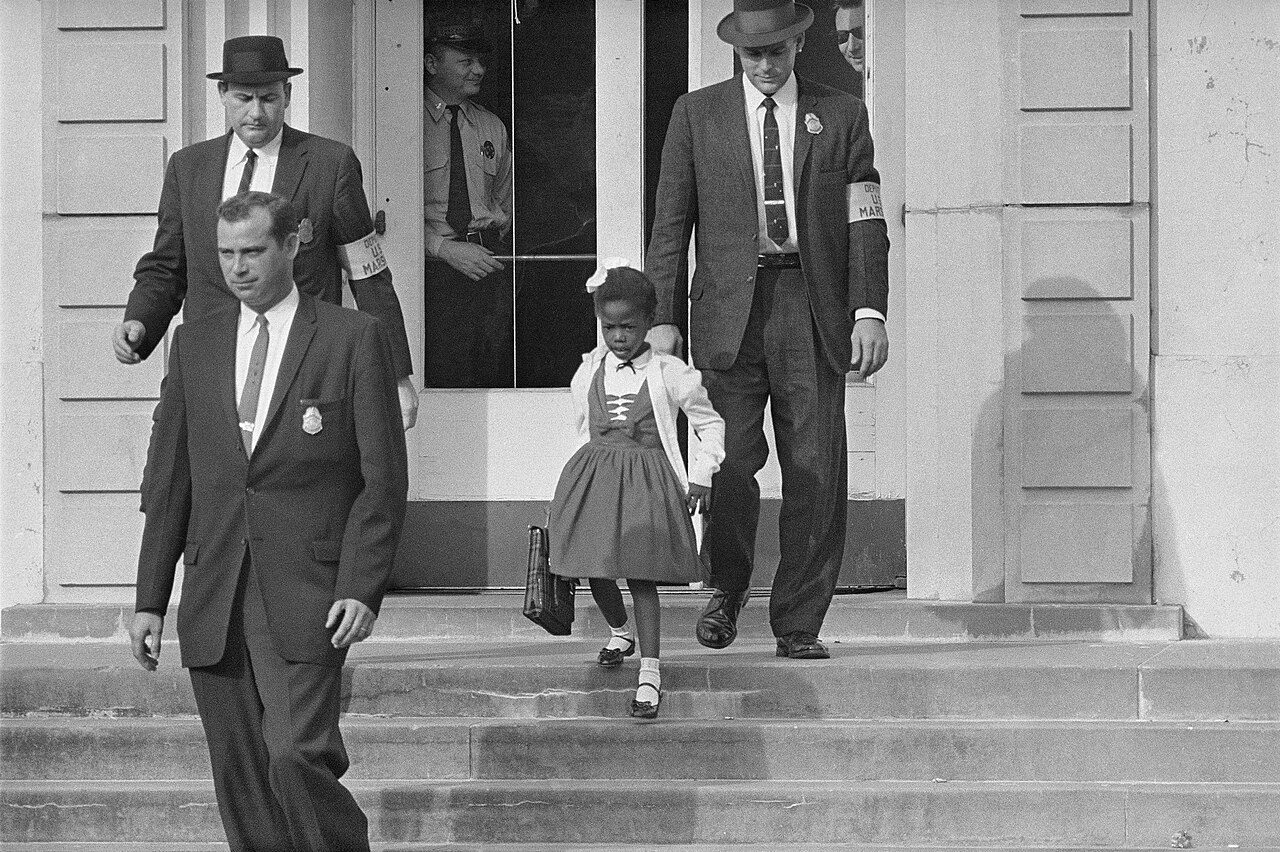
On 14 November 1960 a six-year-old girl in a new dress walked up the steps of William Frantz Elementary School in New Orleans, flanked by federal marshals, past crowds screaming abuse. Ruby Bridges was the first Black child to attend that school, and her small walk became one of the defining images of the American civil rights movement. November 14 is also the day Moby-Dick was published, Apollo 12 lifted off and Monet was born.
Choose another date: open the On This Day calendar to browse events, births and deaths for any day of the year.
At a Glance
- The child
- Ruby Bridges, aged six, the only Black pupil assigned to William Frantz Elementary that day
- The escort
- Four U.S. marshals, sent because a federal court had ordered New Orleans schools to desegregate
- The law
- Six years after Brown v. Board of Education (1954) declared school segregation unconstitutional
- The boycott
- White parents withdrew their children; for a year Ruby was taught alone by one teacher, Barbara Henry
- The image
- Norman Rockwell's 1964 painting The Problem We All Live With fixed the scene in American memory
- The others
- Three Black girls — the McDonogh Three — desegregated McDonogh 19 school across the city the same morning
Events on this day
- 1680Astronomer Gottfried Kirch discovers the Great Comet of 1680, the first comet found with a telescope.
- 1832New York's first horse-drawn streetcar makes its debut, the city's first mass transit.
- 1851Herman Melville's Moby-Dick is published in the United States; it sells poorly and is recognised as a masterpiece only after his death.
- 1889Journalist Nellie Bly sets out from New York to travel around the world in under 80 days; she does it in 72.
- 1910Eugene Ely makes the first aeroplane take-off from a ship, flying off a platform on USS Birmingham.
- 1941The British aircraft carrier Ark Royal, torpedoed the day before, sinks under tow near Gibraltar.
- 1960Six-year-old Ruby Bridges walks into William Frantz Elementary School in New Orleans — the featured story above.
- 1965The Battle of Ia Drang begins, the first major battle between regular U.S. and North Vietnamese forces.
- 1969Apollo 12 lifts off for the second crewed landing on the Moon, crewed by Conrad, Gordon and Bean.
- 1970A chartered plane carrying the Marshall University football team crashes in West Virginia, killing all 75 people aboard.
- 1990Producer Frank Farian admits that Milli Vanilli did not sing on their own hit album.
- 2003Astronomers discover Sedna, a distant trans-Neptunian object, one of the most remote bodies then known in the solar system.
- 2010Sebastian Vettel wins the Formula One championship, at 23 the youngest champion in the sport's history.
Born on this day
- 1840Claude Monet — French painter whose Impression, Sunrise gave Impressionism its name.
- 1889Jawaharlal Nehru — first prime minister of independent India.
- 1891Frederick Banting — Canadian co-discoverer of insulin; World Diabetes Day is kept on his birthday.
- 1900Aaron Copland — American composer of Appalachian Spring and Fanfare for the Common Man.
- 1922Boutros Boutros-Ghali — Egyptian diplomat who became the UN's first African secretary-general.
- 1948Charles III — king of the United Kingdom, the longest-serving heir apparent in British history.
- 1954Condoleezza Rice — American political scientist who became U.S. secretary of state.
Died on this day
- 1716Gottfried Wilhelm Leibniz — German philosopher and mathematician who developed calculus independently of Newton.
- 1831Georg Wilhelm Friedrich Hegel — German philosopher of history and dialectic.
- 1915Booker T. Washington — American educator and founder of Tuskegee Institute.
- 1946Manuel de Falla — Spanish composer of The Three-Cornered Hat.
- 2016Gwen Ifill — American journalist who moderated vice-presidential debates and anchored PBS NewsHour.
The featured story: Ruby Bridges's first day of school, 14 November 1960
Six years after the Supreme Court ruled in Brown v. Board of Education that segregated schools were unconstitutional, New Orleans had still not moved. A federal judge finally ordered the city to begin desegregation on 14 November 1960, and the school board, forced to pick children, administered tests designed to be nearly impossible — then assigned the handful of Black six-year-olds who passed to two schools. Ruby Bridges, the only child sent to William Frantz Elementary in the Ninth Ward, was to go alone. Her father feared for her life and at first refused; her mother, Lucille, argued that the step had to be taken, for Ruby and for every child after her.
What waited at the school is recorded in the accounts of the marshals and of Ruby herself. A crowd of white protesters, many of them mothers, screamed racial abuse; someone held up a Black doll in a coffin. Four deputy U.S. marshals — federal officers, because the city police could not be trusted to enforce the court's order — walked her in. Britannica calls her the youngest of the group of Black students who integrated Southern schools that day; across the city, three other girls, the McDonogh Three, entered McDonogh 19 under the same protection. Inside Frantz, white parents pulled their children out classroom by classroom, and teachers resigned rather than teach her. One did not: Barbara Henry, newly arrived from Boston, who taught Ruby alone, in an empty school, for the entire year.
Ruby ate lunch alone, played alone, and was allowed out only under escort; a woman in the crowd threatened daily to poison her, so she could eat only food sent from home. Yet the child at the centre of it later remembered praying for the crowd on her way in — 'Please be good to them, because they don't know what they're doing' — and the psychiatrist Robert Coles, who counselled her that year, built a classic study of children's moral courage around her composure. The boycott slowly collapsed; a few white children returned, and the following year more Black children enrolled without marshals. The photograph of the small girl in white between towering marshals, and Norman Rockwell's painting of it four years later, made the scene the civil rights movement's most concentrated image: the entire weight of a nation's argument carried up a flight of steps by a six-year-old.
Ruby Bridges still lives in New Orleans, where she founded a foundation in her name to promote tolerance through education, and Frantz Elementary — later badly damaged by Hurricane Katrina — now houses a charter school named for Akili Academy with a statue of her in its courtyard. The marshals' escort is re-enacted each year by children walking the same route. Of all the dates in the long legal war over American schooling, 14 November is the one with a face.
Why this date matters
November 14 is a day of first steps and long journeys. A six-year-old takes the most consequential short walk in American education; Nellie Bly sets off around the world; a pilot takes off from a ship for the first time; Apollo 12 leaves for the Moon. Its births are builders — Monet remaking painting, Nehru building a state, Banting co-discovering insulin — and even its quieter entries, a streetcar's debut and a comet sighted through a new telescope, are beginnings. The date's character is departure: things, and people, setting out.
Sources
- Encyclopaedia Britannica — On This Day: November 14
- HISTORY — What Happened on November 14
- HISTORY — Ruby Bridges desegregates her school (November 14, 1960)
- Wikimedia — On This Day feed: November 14
The facts on this page were checked against these sources on 19 November 2026. The History Trail's permanent pages are researched and written for this site; the live profiles elsewhere on The History Trail are assembled automatically from Wikipedia and Wikidata.
About the Author
Researched and written by the The History Trail Editorial Team — the accountable editorial function behind this site's permanent story pages. The team works from the published sources cited on each page; it does not invent historians, reviewers or credentials, and it corrects errors openly.
Fact Check
Every load-bearing fact on this page traces to one of the sources listed above, and significant claims link to their source in the text. Our checking method is described on the methodology page; errors can be reported via the corrections page.
Sources & Citations
Cite this page as: The History Trail Editorial Team, The History Trail — this article's title, publication and update dates are shown beneath its headline. The full source list appears under Sources above; the site's source standards are on the sources page.