
On This Day
May 28 in History
May 28 carries one of the darkest signatures in American law. On this day in 1830 President Andrew Jackson signed the Indian Removal Act, empowering the federal government to force the Native nations of the Southeast from their ancestral lands to territory west of the Mississippi. The removals that followed, remembered above all in the Cherokee Trail of Tears, displaced some 60,000 people and killed thousands. The date also saw the eclipse that stopped a battle in 585 BC, the sailing of the Spanish Armada in 1588 and Pakistan's nuclear tests in 1998.
Choose another date: open the On This Day calendar to browse events, births and deaths for any day of the year.
At a Glance
- Date signed
- 28 May 1830
- Signed by
- President Andrew Jackson
- What it authorised
- Exchange of Native lands in the east for land west of the Mississippi River
- Nations most affected
- Cherokee, Choctaw, Chickasaw, Muscogee (Creek) and Seminole
- Scale of removal
- An estimated 60,000 people removed between 1829 and 1837
- The Cherokee march
- 1838-39, remembered as the Trail of Tears
Events on this day
- 585 BCA solar eclipse, said to have been predicted by the philosopher Thales, interrupts a battle between the Lydians and the Medes, who make peace.
- 1533Archbishop Thomas Cranmer declares the marriage of Henry VIII and Anne Boleyn valid, defying the pope.
- 1588The Spanish Armada sets sail from Lisbon, bound for the invasion of England.
- 1754Virginia militia under the 22-year-old George Washington clash with French troops at Jumonville Glen, an opening shot of the French and Indian War.
- 1830President Andrew Jackson signs the Indian Removal Act, authorising the forced removal of Native nations westward — the featured story above.
- 1863The 54th Massachusetts, one of the first Black regiments in the Union Army, parades through Boston and leaves for the Civil War.
- 1892John Muir founds the Sierra Club in San Francisco to protect America's wilderness.
- 1905The Battle of Tsushima ends with Japan's destruction of the Russian Baltic Fleet, a turning point of the Russo-Japanese War.
- 1918American troops fight their first major battle of the First World War at Cantigny in France.
- 1934The Dionne quintuplets are born near Corbeil, Ontario, the first quintuplets known to survive infancy.
- 1961Amnesty International is founded in London to campaign for prisoners of conscience.
- 1998Pakistan conducts underground nuclear tests, becoming the seventh country to possess nuclear weapons.
Born on this day
- 1759William Pitt the Younger — British prime minister at 24, the youngest in the country's history, who led Britain through much of the French Revolutionary Wars.
- 1908Ian Fleming — English writer who created James Bond and wrote the Chitty-Chitty-Bang-Bang story
- 1934The Dionne quintuplets — Yvonne, Annette, Cecile, Emilie and Marie, the first quintuplets known to survive infancy
- 1968Kylie Minogue — Australian singer and actress who became one of the world's best-selling female recording artists.
Died on this day
- 1849Anne Brontë — English novelist and poet, the youngest Brontë sister, author of The Tenant of Wildfell Hall.
- 2010Gary Coleman — American actor who became a child star as Arnold Jackson in Diff'rent Strokes
- 2014Maya Angelou — American poet and memoirist, author of I Know Why the Caged Bird Sings and a leading voice of the civil rights era
The featured story: The Indian Removal Act, 28 May 1830
Andrew Jackson built his presidency on expansion, and the land he wanted most lay in the American Southeast, where the Cherokee, Choctaw, Chickasaw, Muscogee (Creek) and Seminole nations held millions of acres guaranteed to them by treaty. Settlers coveted the land for cotton, the state of Georgia extended its laws over Cherokee territory, and gold had been found on Cherokee land. Jackson pressed Congress for a general removal law that would move the eastern nations across the Mississippi River, framing expulsion as benevolence toward peoples he claimed could not survive beside white settlement.
On 28 May 1830 Jackson signed the Indian Removal Act. The law authorised the president to grant Native nations land in the west in exchange for their homelands within the existing states, and provided money to negotiate removal treaties and to pay for the journeys. It did not, in its own words, order anyone to march. In practice the treaties that followed were extracted under pressure, fraud and the threat of force, and the removals of the 1830s became one of the great forced migrations of the nineteenth century.
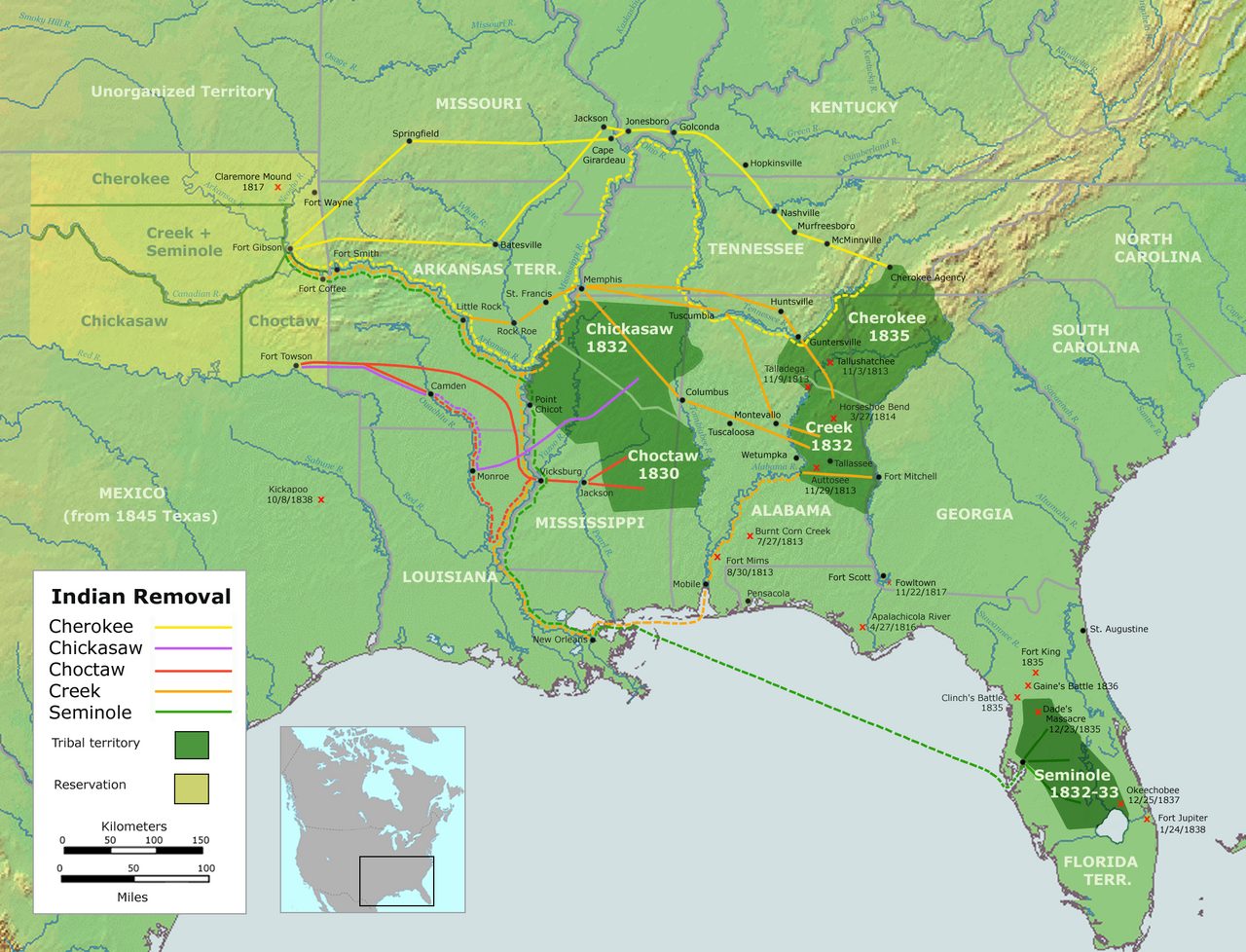
The Cherokee resisted by law, winning recognition of their sovereignty from the Supreme Court in Worcester v. Georgia in 1832, a judgment Georgia and the president declined to enforce. A small, unauthorised Cherokee faction signed the Treaty of New Echota in 1835, ceding the nation's land, and in 1838 federal troops rounded up some 16,000 Cherokee and marched them west in detachments through a brutal winter. Cherokee authorities later estimated that about 6,000 people died on the 1,200-mile journey, which the Cherokee called the trail where they cried, the Trail of Tears. The Cherokee were the last of the five great southeastern nations to be sent west. The Choctaw had gone first, followed by the Muscogee (Creek), the Chickasaw and the Seminole, whose resistance in Florida produced years of guerrilla war. The Cherokee, who had adopted a written constitution, a newspaper and plantation farming in the settlers' own style, were removed anyway, proof that assimilation offered no protection once the land itself was wanted.
Between 1829 and 1837 an estimated 60,000 Native people from 18 tribes were removed from the Southeast, opening tens of millions of acres to settlement and slavery-based agriculture. The Indian Removal Act remains among the most condemned statutes in American history. The routes of the removals are now preserved and interpreted as the Trail of Tears National Historic Trail, and the nations removed rebuilt their governments in what is now Oklahoma, where their descendants remain.
Why this date matters
May 28 is a date of peoples on the move, by choice, by law and by force. An armada sails to invade England; a young George Washington fires some of the first shots of a world war in a Pennsylvania glen; Black soldiers march out of Boston to fight for a Union that has not yet freed them; and, at the centre of the date, a president's signature sets in motion the forced migration of whole nations. Against that weight the day sets small, stubborn counterweights: five baby girls in Ontario who refuse to die, and an organisation founded in London to speak for prisoners of conscience everywhere. The date's signature, set down in 1830, is the one against which all its other departures are measured, a reminder that the century's great migrations were as often decreed as chosen.
Sources
- Encyclopaedia Britannica — On This Day: May 28
- HISTORY — This Day in History: May 28
- Parks Canada — The Dionne Quintuplets National Historic Event
- Wikimedia Commons — Trails of Tears map file page

The facts on this page were checked against these sources on 19 November 2026. The History Trail's permanent pages are researched and written for this site; the live profiles elsewhere on The History Trail are assembled automatically from Wikipedia and Wikidata.
About the Author
Researched and written by the The History Trail Editorial Team — the accountable editorial function behind this site's permanent story pages. The team works from the published sources cited on each page; it does not invent historians, reviewers or credentials, and it corrects errors openly.
Fact Check
Every load-bearing fact on this page traces to one of the sources listed above, and significant claims link to their source in the text. Our checking method is described on the methodology page; errors can be reported via the corrections page.
Sources & Citations
Cite this page as: The History Trail Editorial Team, The History Trail — this article's title, publication and update dates are shown beneath its headline. The full source list appears under Sources above; the site's source standards are on the sources page.