
On This Day
May 14 in History
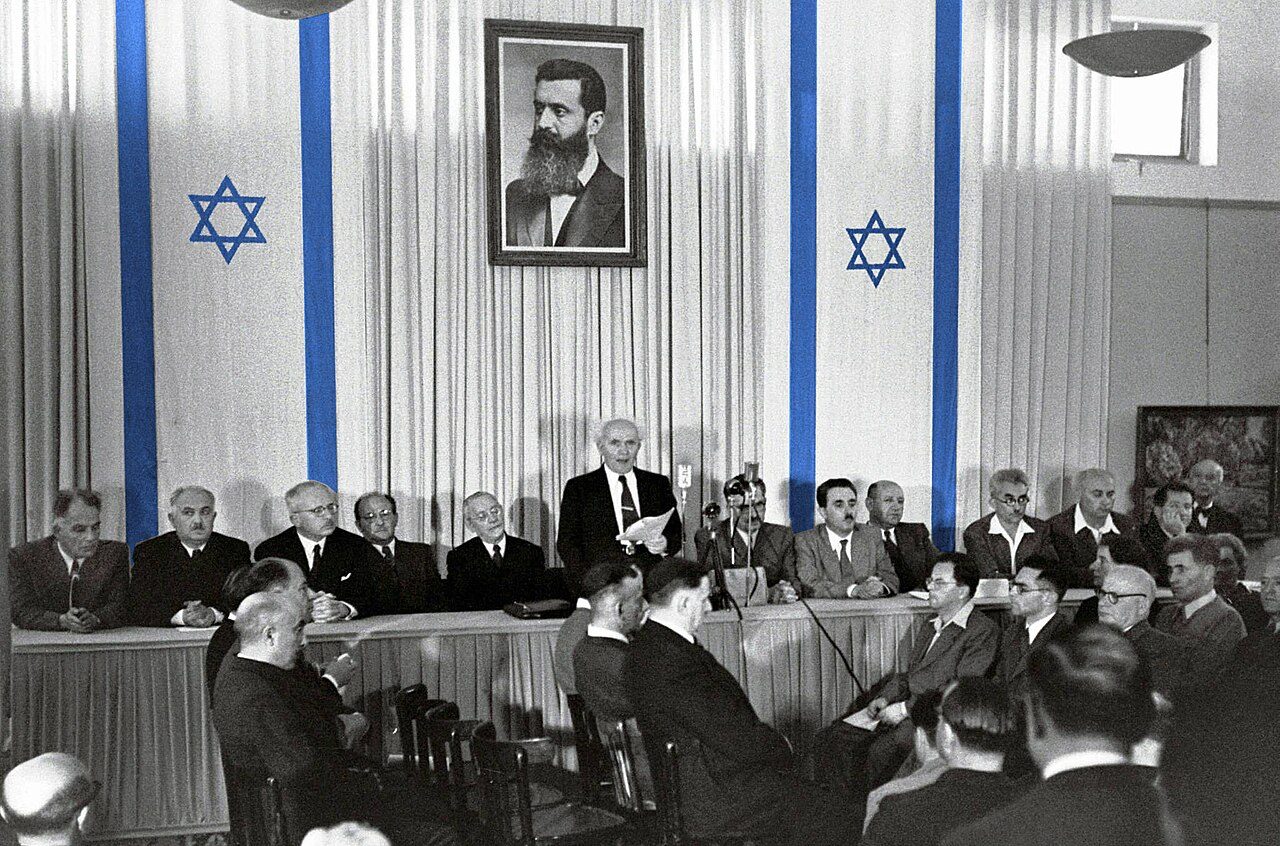
On 14 May 1948, hours before the British Mandate for Palestine expired, David Ben-Gurion proclaimed the establishment of the State of Israel at a hurried ceremony in Tel Aviv. The United States recognised the new state within minutes; the neighbouring Arab states invaded the next day. May 14 is also the day of Jenner's first vaccination, the founding of Jamestown, and the start of the Lewis and Clark expedition.
Choose another date: open the On This Day calendar to browse events, births and deaths for any day of the year.
At a Glance
- The proclamation
- 14 May 1948, 4 p.m., Tel Aviv Museum — Ben-Gurion reads the Declaration of the Establishment of the State of Israel
- The legal basis claimed
- The UN partition resolution of November 1947 and the Jewish people's historic connection to the land
- The timing
- Effective at midnight, the moment the British Mandate for Palestine terminated
- The recognition
- The United States grants de facto recognition eleven minutes after midnight; the USSR follows within days
- The war
- Egypt, Transjordan, Syria, Lebanon and Iraq invade on 15 May; the war runs into 1949
- The other memory
- More than 700,000 Palestinian Arabs fled or were expelled — the Nakba, commemorated on 15 May
Events on this day
- 1607English colonists establish Jamestown in Virginia, the first permanent English settlement in North America.
- 1643Louis XIV becomes king of France at the age of four, beginning a reign of seventy-two years, the longest of any European monarch.
- 1796Edward Jenner inoculates eight-year-old James Phipps with cowpox matter, performing the first vaccination against smallpox.
- 1804Lewis and Clark set out from St Louis on their expedition to explore the Louisiana Purchase and find a route to the Pacific.
- 1948David Ben-Gurion proclaims the establishment of the State of Israel in Tel Aviv — the featured story above.
- 1955The Warsaw Pact is signed in Warsaw, formally allying the Soviet Union and its Eastern European satellites against NATO.
- 1973Skylab, the first American space station, is launched — though damage in ascent will require a repair mission by its first crew.
- 1998The final episode of Seinfeld airs in the United States, ending the 'show about nothing' that defined 1990s television comedy.
- 2018The United States opens its embassy to Israel in Jerusalem, and the U.S. Supreme Court strikes down the federal ban on state sports betting.
Born on this day
- 1553Margaret of Valois — queen of France whose memoirs give an insider's account of the Valois court and the wars of religion.
- 1771Robert Owen — Welsh manufacturer and utopian socialist who built the model mill community at New Lanark.
- 1944George Lucas — American filmmaker who created Star Wars and Indiana Jones and reshaped popular cinema.
- 1952David Byrne — Scottish-born American musician, frontman of Talking Heads.
- 1969Cate Blanchett — Australian actress, winner of two Academy Awards.
- 1984Mark Zuckerberg — American entrepreneur who co-founded Facebook while a student at Harvard.
Died on this day
- 1919Henry J. Heinz — American businessman who built the H. J. Heinz food company and its '57 Varieties'.
- 1940Emma Goldman — Lithuanian-born anarchist writer and campaigner, deported from the United States in 1919.
- 1998Frank Sinatra — American singer and actor, 'Ol' Blue Eyes', dead at 82 in Los Angeles.
- 2015B.B. King — American blues guitarist and singer, dead at 89, his guitar Lucille silenced.
The featured story: Israel declares independence, 14 May 1948
At four o'clock on the afternoon of 14 May 1948, in the Tel Aviv Museum on Rothschild Boulevard, David Ben-Gurion stood beneath a portrait of Theodor Herzl and read out the Declaration of the Establishment of the State of Israel. The ceremony had been arranged in haste and in near-secrecy, for fear the departing British authorities might stop it. Some 250 guests heard Ben-Gurion proclaim a Jewish state in the land, effective at midnight, when the British Mandate for Palestine would expire. The audience sang Hatikvah, and the first Jewish state in nearly two thousand years existed — on paper, and under arms.
The declaration rested on the United Nations partition plan of November 1947, which had proposed dividing Palestine into Jewish and Arab states. The Jewish leadership accepted the plan; the Arab leadership and the neighbouring Arab states rejected it, and civil war had raged between the communities ever since the vote. Ben-Gurion's text reached for both audiences: it grounded the state in the Jewish people's historic connection to the land and in the UN resolution, promised equality to all its inhabitants regardless of religion or race, and appealed to the Arab states for peace even as their armies massed on the borders.
Recognition came with extraordinary speed. The United States extended de facto recognition eleven minutes after the declaration took effect at midnight — President Truman overruling a State Department that had argued for delay. The Soviet Union followed with full recognition days later, a rare moment of superpower agreement. But at midnight the Mandate ended, and on 15 May the armies of Egypt, Transjordan, Syria, Lebanon and Iraq invaded. The war that followed lasted into 1949: Israel survived and expanded beyond the partition lines, while more than 700,000 Palestinian Arabs fled or were expelled from their homes — the catastrophe Palestinians call the Nakba, commemorated each year on the day after Israel's independence.
No date in the modern Middle East carries more consequence, or more contested meaning, than 14 May 1948. For Israelis it is the fulfilment of the Zionist project and a refuge secured after the Holocaust destroyed a third of the world's Jews. For Palestinians it begins a dispossession whose questions — borders, refugees, Jerusalem — remain unresolved three-quarters of a century later. The armistice lines of 1949, the wars of 1967 and 1973, and every negotiation since have all been arguments about what was proclaimed in that half-hour ceremony in Tel Aviv.
Why this date matters
May 14 is a day of foundings with long shadows. A four-year-old becomes king of France on it in 1643 and reigns for seventy-two years; a colony is planted at Jamestown on it in 1607 that grows into a nation's origin story; a state is proclaimed in Tel Aviv on it in 1948 whose founding argument has never closed. Even its quieter entries found things: Jenner's vaccination founds immunology on it in 1796, and Lewis and Clark set out on it in 1804 to found an American geography. May 14 starts things that take centuries to finish — if they finish at all.
Sources
- Encyclopaedia Britannica — On This Day: May 14
- HISTORY — What Happened on May 14
- Encyclopaedia Britannica — Israel
- U.S. Department of State — Creation of Israel, 1948
The facts on this page were checked against these sources on 19 November 2026. The History Trail's permanent pages are researched and written for this site; the live profiles elsewhere on The History Trail are assembled automatically from Wikipedia and Wikidata.
About the Author
Researched and written by the The History Trail Editorial Team — the accountable editorial function behind this site's permanent story pages. The team works from the published sources cited on each page; it does not invent historians, reviewers or credentials, and it corrects errors openly.
Fact Check
Every load-bearing fact on this page traces to one of the sources listed above, and significant claims link to their source in the text. Our checking method is described on the methodology page; errors can be reported via the corrections page.
Sources & Citations
Cite this page as: The History Trail Editorial Team, The History Trail — this article's title, publication and update dates are shown beneath its headline. The full source list appears under Sources above; the site's source standards are on the sources page.