
On This Day
March 9 in History
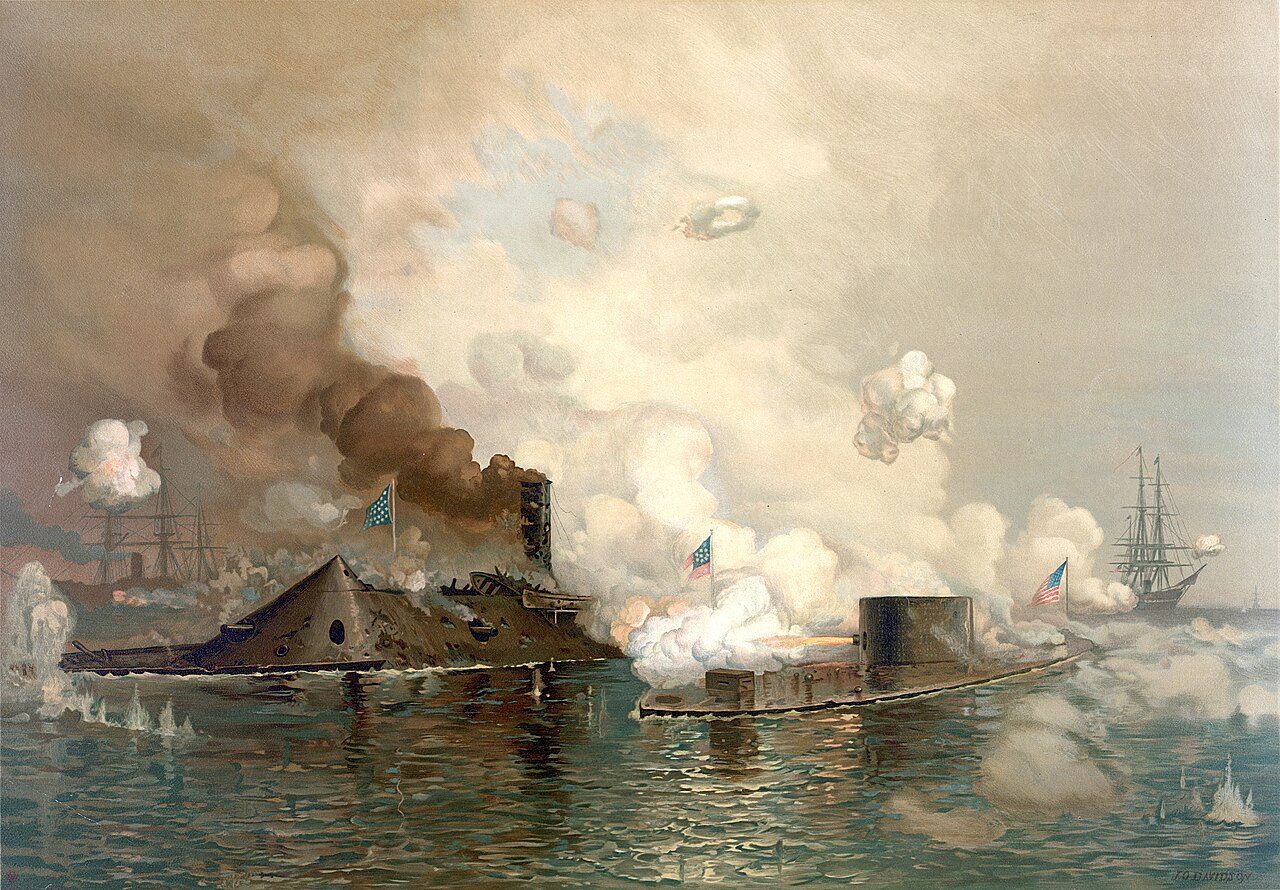
On 9 March 1862, in Hampton Roads, Virginia, the Union ironclad USS Monitor and the Confederate ironclad CSS Virginia fought a four-hour duel — the first battle in history between armoured, steam-powered warships. Neither ship could sink the other, but every wooden navy on earth was made obsolete in a morning. March 9 is also the day The Wealth of Nations was published, Barbie debuted, and Edward R. Murrow took on Senator McCarthy.
Choose another date: open the On This Day calendar to browse events, births and deaths for any day of the year.
At a Glance
- The ships
- CSS Virginia, rebuilt from the burned steam frigate Merrimack with a sloped iron casemate; USS Monitor, a nearly submerged raft carrying two guns in a revolving turret
- The day before
- On 8 March Virginia destroyed the Union warships Cumberland and Congress, killing more than 240 sailors — the U.S. Navy's worst day until Pearl Harbor
- The duel
- About four hours of point-blank fire on 9 March; shot and shell bounced off both ships' armour
- The casualty
- Monitor's captain, Lieutenant John L. Worden, was temporarily blinded when a shell struck the pilothouse as he looked out
- The verdict
- A tactical draw that saved the Union blockade — and ended the age of wooden warships worldwide
Events on this day
- 1776Adam Smith's The Wealth of Nations is published in London, founding modern economics.
- 1796Napoleon Bonaparte marries Joséphine de Beauharnais in Paris, two days before leaving to take command in Italy.
- 1847American forces under Winfield Scott begin landing near Veracruz, opening the campaign that will take Mexico City.
- 1862USS Monitor and CSS Virginia fight the first battle between ironclad warships at Hampton Roads — the featured story above.
- 1916Pancho Villa's raiders attack Columbus, New Mexico, killing Americans and provoking a U.S. punitive expedition into Mexico.
- 1954Edward R. Murrow's See It Now broadcast takes on Senator Joseph McCarthy, a landmark in television's confrontation with McCarthyism.
- 1959The Barbie doll makes her debut at the American International Toy Fair in New York.
- 1961The Soviet Union's Sputnik 9 carries the dog Chernushka into orbit and brings her safely home, a rehearsal for human flight.
- 1964The U.S. Supreme Court decides New York Times Co. v. Sullivan, setting the 'actual malice' standard that protects press freedom.
- 1977Hanafi Muslim gunmen seize three buildings in Washington, D.C., taking some 149 hostages in a siege that lasts into a second day.
Born on this day
- 1814Taras Shevchenko — Ukrainian poet and artist, the foundational voice of modern Ukrainian literature.
- 1890Vyacheslav Molotov — Soviet foreign minister whose name was given, mockingly, to the Finnish petrol bomb.
- 1892Vita Sackville-West — English writer and gardener of Sissinghurst, and Virginia Woolf's model for Orlando.
- 1930Ornette Coleman — American saxophonist who pioneered free jazz.
- 1934Yuri Gagarin — Soviet cosmonaut who in 1961 became the first human in space.
- 1943Bobby Fischer — American chess prodigy who won the world championship from Boris Spassky in 1972.
Died on this day
- 1661Cardinal Mazarin — the Italian-born minister who governed France through Louis XIV's minority and made it Europe's leading power.
- 1888Wilhelm I — king of Prussia and the first German emperor, dead in Berlin in the 'Year of the Three Emperors'.
- 1992Menachem Begin — Israeli prime minister who signed the Camp David peace with Egypt.
- 1994Charles Bukowski — German-American poet and novelist of the Los Angeles lowlife.
- 1997The Notorious B.I.G. — American rapper Christopher Wallace, shot dead in Los Angeles at 24, six months after Tupac Shakur.
The featured story: the ironclads duel at Hampton Roads, 9 March 1862
The Confederate ironclad had already had her day of glory. On 8 March 1862 CSS Virginia — the burned Union frigate Merrimack rebuilt with a sloped armour-plated casemate and a ram — steamed into Hampton Roads and methodically destroyed the wooden Union squadron blockading Virginia's coast, ramming and sinking Cumberland and forcing Congress to surrender and burn. More than 240 Union sailors died; it was the U.S. Navy's worst defeat until Pearl Harbor. Virginia, barely scratched, withdrew with the tide, intending to finish the rest of the fleet in the morning. The North's wooden navy — and every wooden navy — looked finished.
That night, a strange craft arrived, towed down from New York: USS Monitor, designed by the Swedish-American engineer John Ericsson. She was barely a ship at all to look at — a low armoured raft, almost awash, carrying a single revolving turret with two 11-inch guns. When Virginia returned on the morning of 9 March and bore down on the grounded frigate Minnesota, Monitor steamed out to meet her. For about four hours the two ironclads circled and pounded each other at ranges sometimes under a hundred yards, their shot and shell simply bouncing off. Virginia tried to ram and could not catch her nimble opponent; Monitor's guns, firing reduced charges by order, could not pierce the Confederate's sloped plates.
The duel ended when a shell exploded against Monitor's pilothouse at the moment her commander, Lieutenant John L. Worden, was looking through its slits, filling his eyes with iron fragments and powder; blinded, he was carried below, and Monitor sheered off into shallow water. Virginia, her own crew believing the Union ship was retreating for good, and leaking at the waterline with the tide falling, withdrew to Norfolk. Both sides claimed victory. Strategically the draw was a Union success: the blockade survived, Minnesota survived, and Virginia never again ventured out against Monitor's watch.
Militarily, the morning's real casualty was the wooden warship — all of them, everywhere. News of Hampton Roads reached Europe within weeks, and naval ministries understood at once that their fleets of oak and sail-era guns were scrap. Britain and France already had seagoing ironclads building; after 9 March 1862 there was no argument left. Neither duellist long survived her fame: Virginia was burned by her own crew that May to keep her from capture, and Monitor foundered in a storm off Cape Hatteras on the last night of 1862 — her revolving turret, recovered from the Atlantic in 2002, is conserved today at the Mariners' Museum in Newport News, within sight of the waters where she fought.
Why this date matters
March 9 is the calendar's day for publishing things that change the game. Smith published the economics of nations on it in 1776; Murrow published his indictment of McCarthy on it in 1954; the Supreme Court published the Sullivan standard for a free press on it in 1964. And on it in 1862 two experimental ships published, in iron, the news that wooden navies were dead. Even its toys are debuts: Barbie arrived on 9 March 1959. It is a date for first editions — of books, broadcasts, doctrines and dolls — and for the morning the world's admiralties had to start again.
Sources
- Encyclopaedia Britannica — On This Day: March 9
- HISTORY — What Happened on March 9
- Smithsonian Institution — Monitor vs. Merrimac print (National Museum of American History)
- Naval History and Heritage Command (HyperWar mirror) — Hampton Roads, 9 March 1862
The facts on this page were checked against these sources on 19 November 2026. The History Trail's permanent pages are researched and written for this site; the live profiles elsewhere on The History Trail are assembled automatically from Wikipedia and Wikidata.
About the Author
Researched and written by the The History Trail Editorial Team — the accountable editorial function behind this site's permanent story pages. The team works from the published sources cited on each page; it does not invent historians, reviewers or credentials, and it corrects errors openly.
Fact Check
Every load-bearing fact on this page traces to one of the sources listed above, and significant claims link to their source in the text. Our checking method is described on the methodology page; errors can be reported via the corrections page.
Sources & Citations
Cite this page as: The History Trail Editorial Team, The History Trail — this article's title, publication and update dates are shown beneath its headline. The full source list appears under Sources above; the site's source standards are on the sources page.