
On This Day
March 25 in History
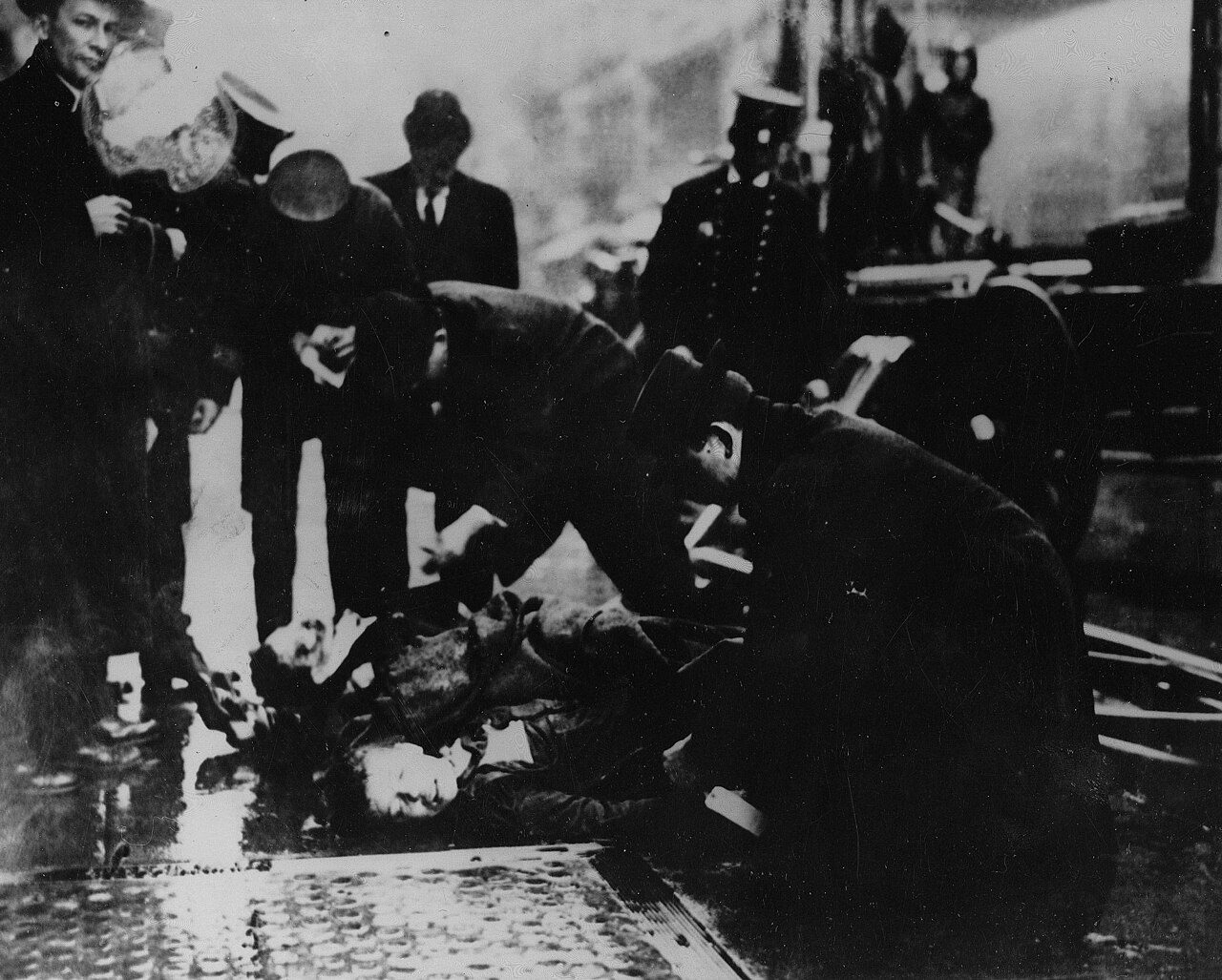
On the afternoon of 25 March 1911, fire broke out in the Triangle Shirtwaist factory on the top floors of a New York loft building, and within half an hour 146 garment workers — most of them young immigrant women — were dead: burned, suffocated, or fallen from windows and a collapsing fire escape past locked doors. The Triangle fire became the disaster that taught America to regulate its workplaces. March 25 is also the day the Treaties of Rome founded the European Community and the Selma marchers reached Montgomery.
Choose another date: open the On This Day calendar to browse events, births and deaths for any day of the year.
At a Glance
- The workplace
- The Triangle Waist Company, top three floors of the Asch Building by Washington Square; about 500 workers, mostly young Jewish and Italian immigrant women
- The fire
- Began about 4:40 p.m. in a scrap bin on the eighth floor, probably from a discarded match or cigarette; the worst was over in under 20 minutes
- Why so many died
- One stairway door locked, an inadequate fire escape that collapsed, no fire drills, and ladders that could not reach the top floors
- The toll
- 146 people killed; six victims were never identified
- The trial
- Owners Max Blanck and Isaac Harris were acquitted of manslaughter; civil suits later settled at $75 for each life lost
- The reform
- New York's Factory Investigating Commission drove through dozens of new safety laws; Frances Perkins, who watched the fire, later built much of it into the New Deal
Events on this day
- 451According to tradition, Venice is founded, as refugees from the mainland settle the lagoon islands of the northern Adriatic.
- 1306Robert the Bruce is crowned king of Scots at Scone, beginning the campaign that wins Scottish independence at Bannockburn eight years later.
- 1655Christiaan Huygens discovers Titan, Saturn's largest moon, with a telescope of his own design.
- 1807Britain's Parliament passes the Slave Trade Act, abolishing the slave trade across the British Empire — and, the same day, the world's first fee-paying passenger railway opens in South Wales, the Swansea and Mumbles line.
- 1911Fire at the Triangle Shirtwaist factory in New York kills 146 garment workers — the featured story above.
- 1957The Treaties of Rome are signed, creating the European Economic Community and Euratom — the founding charters of today's European Union.
- 1965Martin Luther King Jr. and thousands of marchers complete the Selma to Montgomery march at the Alabama state capitol, five days after setting out.
- 1975King Faisal of Saudi Arabia is assassinated in Riyadh by his nephew, Prince Faisal bin Musaid.
- 2002A magnitude 6.1 earthquake in the Hindu Kush region of northern Afghanistan kills more than 1,000 people.
Born on this day
- 1762Thomas-Alexandre Dumas — French general of the Revolutionary wars, the highest-ranking Black officer in a European army of his era, and father of the novelist Alexandre Dumas.
- 1881Béla Bartók — Hungarian composer who fused folk music collected across Eastern Europe into a new modern language.
- 1934Gloria Steinem — American writer and feminist organiser, co-founder of Ms. magazine.
- 1942Aretha Franklin — the 'Queen of Soul', whose voice carried gospel into the centre of American popular music.
- 1947Elton John — British singer, pianist and composer, among the bestselling recording artists in history.
- 1965Sarah Jessica Parker — American actress, star of Sex and the City.
Died on this day
- 1801Novalis (Georg Philipp Friedrich von Hardenberg) — German Romantic poet and philosopher, dead of tuberculosis at 28.
- 1918Claude Debussy — French composer whose music opened the twentieth century, dead in Paris during a German bombardment, at 55.
- 1973Edward Steichen — Luxembourg-born American photographer and museum curator who shaped photography as an art, dead at 93.
- 1975Faisal — king of Saudi Arabia, shot by his nephew at a palace reception in Riyadh.
- 2021Beverly Cleary — American children's author of the Ramona books, dead at 104, a month short of 105.
The featured story: the Triangle Shirtwaist Factory fire, 25 March 1911
The Triangle Waist Company made shirtwaists — the fashionable blouses of the day — on the eighth, ninth and tenth floors of the Asch Building, just east of Washington Square. Its workforce was the new industrial America in one room: roughly 500 people, most of them young women, many of them teenagers, most of them Jewish and Italian immigrants working long hours for a few dollars a week. Two years earlier these same workers had struck for better conditions and been beaten back; the factory's doors were still locked during working hours, management said, to stop theft and unauthorised breaks.
At about 4:40 on the Saturday afternoon of 25 March 1911, minutes before the week's end, fire started in a bin of cloth scraps on the eighth floor and raced through hanging garments and tissue paper. The eighth floor largely escaped; the tenth, warned by telephone, got to the roof. The ninth floor was the trap. Workers found one stairwell door locked and the other choked with flame; the single outside fire escape, narrow and poorly anchored, bent and collapsed under the crowd on it, dropping some twenty people to their deaths. Fire department ladders reached only to the sixth floor, and the nets tore. Onlookers in the street watched girls jump from the ninth-floor windows rather than burn. In less than half an hour, 146 people were dead.
New York had seen industrial death before, but not like this, and not these victims, in public, in the heart of the city. A funeral procession of more than a hundred thousand mourners walked in the rain. The owners, Max Blanck and Isaac Harris, were tried for manslaughter and acquitted — the jury could not be sure they knew the door was locked — and the families who sued in civil court received $75 for each life. The owners collected more on their insurance than the fire had cost them. It was the acquittal, as much as the fire, that made reform unstoppable.
The state created a Factory Investigating Commission, chaired by Senator Robert F. Wagner with Al Smith as vice-chair and a young Frances Perkins among its investigators, and over four years it rewrote New York's labour law: fire exits and drills, sprinklers, unlocked doors opening outward, limits on hours, a strengthened labour department — in all, dozens of statutes that became the model for the nation. Perkins, who had watched the ninth floor burn, became Franklin Roosevelt's secretary of labor and said the New Deal began that day. The building still stands; the doors in it now open outward.
Why this date matters
March 25 is a day of thresholds crossed and doors — locked and unlocked. Rome's treaties opened a road to a united Europe in 1957; the Selma marchers walked through Alabama's door to the vote in 1965; Huygens found a new world around Saturn in 1655. Against them stands the ninth floor of the Asch Building in 1911, where the doors were locked and 146 people died proving why they must not be. The date's lesson, written in both ink and ash, is that who may pass, and on what terms, is the oldest political question there is.
Sources
- Encyclopaedia Britannica — On This Day: March 25
- HISTORY — This Day in History: March 25
- Smithsonian National Portrait Gallery — The Tragedy of the Triangle Shirtwaist Factory
- Kheel Center, Cornell University — The Triangle Factory Fire
The facts on this page were checked against these sources on 19 November 2026. The History Trail's permanent pages are researched and written for this site; the live profiles elsewhere on The History Trail are assembled automatically from Wikipedia and Wikidata.
About the Author
Researched and written by the The History Trail Editorial Team — the accountable editorial function behind this site's permanent story pages. The team works from the published sources cited on each page; it does not invent historians, reviewers or credentials, and it corrects errors openly.
Fact Check
Every load-bearing fact on this page traces to one of the sources listed above, and significant claims link to their source in the text. Our checking method is described on the methodology page; errors can be reported via the corrections page.
Sources & Citations
Cite this page as: The History Trail Editorial Team, The History Trail — this article's title, publication and update dates are shown beneath its headline. The full source list appears under Sources above; the site's source standards are on the sources page.