
On This Day
July 16 in History
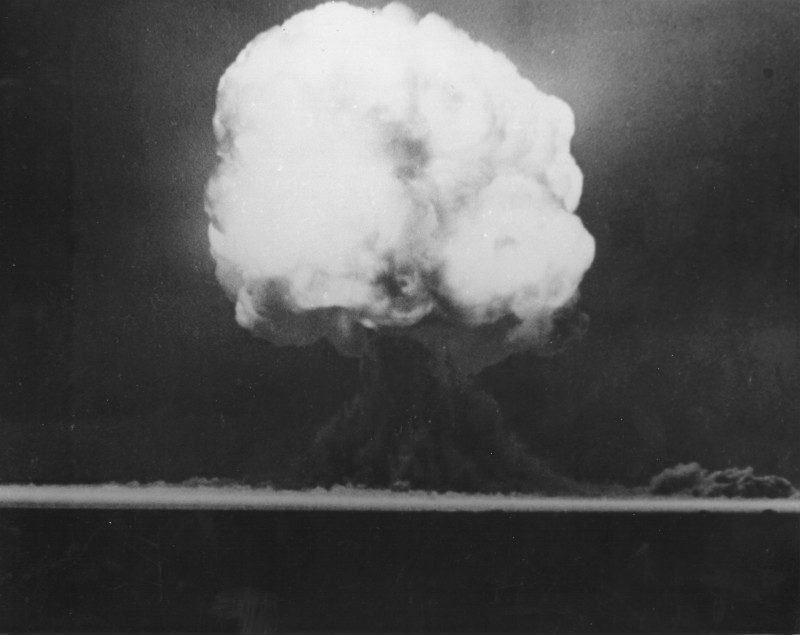
On 16 July 1945, at 5:29 a.m. in the New Mexico desert, the United States detonated the first atomic bomb — the Trinity test, success of the Manhattan Project and the opening of the atomic age. July 16 is also the day Apollo 11 lifted off for the Moon, exactly 24 years later, and the day the Great Schism split Christendom in 1054.
Choose another date: open the On This Day calendar to browse events, births and deaths for any day of the year.
At a Glance
- The time
- 5:29 a.m. Mountain War Time, 16 July 1945, after thunderstorms delayed the shot from 4 a.m.
- The place
- The Jornada del Muerto desert on the Alamogordo Bombing Range, New Mexico, about 210 miles south of Los Alamos
- The device
- 'The Gadget' — a plutonium implosion weapon, hoisted atop a 100-foot steel tower
- The yield
- About 21 kilotons in modern estimates; the blast vaporised the tower and fused desert sand into green glass, trinitite
- The programme
- The Manhattan Project, directed for the Army by General Leslie Groves, with J. Robert Oppenheimer leading the Los Alamos laboratory
- The sequel
- Within three weeks, atomic bombs of both designs were used on Hiroshima (6 August) and Nagasaki (9 August 1945)
Events on this day
- 622The traditional date of the Hijra's first day — 1 Muharram of year 1 of the Islamic calendar, marking Muhammad's migration from Mecca to Medina.
- 1054Papal legates lay a bull of excommunication on the altar of Hagia Sophia in Constantinople, the act that crystallises the Great Schism between the Western and Eastern churches.
- 1769Father Junípero Serra founds Mission San Diego de Alcalá, the first Catholic mission in California.
- 1790The Residence Act, signed by President George Washington, fixes the new United States capital on the Potomac River — the future Washington, D.C.
- 1935The world's first parking meter is installed, in Oklahoma City.
- 1945The Trinity test detonates the first atomic bomb in New Mexico — the featured story above.
- 1951J. D. Salinger's novel The Catcher in the Rye is published in the United States.
- 1969Apollo 11 launches from Cape Kennedy, carrying Neil Armstrong, Buzz Aldrin and Michael Collins toward the first Moon landing.
- 1973Senate testimony reveals the existence of President Nixon's secret White House taping system, the revelation that dooms his presidency.
- 1990An earthquake of magnitude 7.7 strikes Luzon in the Philippines, killing more than 1,600 people.
- 1999John F. Kennedy Jr., his wife Carolyn and her sister Lauren die when his light aircraft crashes into the Atlantic off Martha's Vineyard.
Born on this day
- 1862Ida B. Wells — American journalist whose reporting exposed lynching and helped found the NAACP.
- 1872Roald Amundsen — Norwegian explorer, first to reach the South Pole in December 1911.
- 1907Barbara Stanwyck — American actress of Double Indemnity and a forty-year screen career.
- 1911Ginger Rogers — American dancer and actress, Fred Astaire's partner in ten musicals and an Oscar winner in her own right.
- 1967Will Ferrell — American comedian and actor, from Saturday Night Live to Anchorman and Elf.
Died on this day
- 1882Mary Todd Lincoln — widow of Abraham Lincoln, dead in Springfield, Illinois, in the house where she had married him forty years before.
- 1985Heinrich Böll — German novelist and Nobel laureate, the conscience of post-war West German literature.
- 2012Stephen Covey — American author of The 7 Habits of Highly Effective People, one of the best-selling business books ever written.
- 2017George A. Romero — American director whose Night of the Living Dead created the modern zombie film, dead at 77.
The featured story: Trinity — the first atomic bomb is detonated, 16 July 1945
The Manhattan Project had solved almost every problem except the decisive one. Its scientists at Los Alamos, under J. Robert Oppenheimer, had designed two kinds of bomb: a simple uranium 'gun' device they were confident would work untested, and a far more intricate plutonium weapon that used precisely timed explosive lenses to crush a metal sphere inward — implosion. Plutonium from the Hanford reactors could only be used in the implosion design, and no calculation could prove the design would work. Only a full-scale test could. The chosen ground was a remote corner of the Alamogordo Bombing Range in the Jornada del Muerto — 'journey of the dead man' — desert of southern New Mexico. Oppenheimer named the test Trinity, a name he later connected to a sonnet by John Donne.
The device, called the Gadget, was assembled at the site from 13 July and hoisted to the top of a 100-foot steel tower, with mattresses piled beneath it in case the hoist failed. The shot was set for 4 a.m. on 16 July, but a violent thunderstorm over the desert forced a delay — lightning near a plutonium bomb concentrated minds wonderfully — and the countdown was reset for 5:30. At 5:29:45 the Gadget detonated. Observers ten thousand yards away saw a flash brighter than daylight, a fireball that boiled upward through purple and orange into a mushroom cloud some 40,000 feet high, and then the roar. The tower was vaporised; the sand beneath it had melted into a crater of pale green radioactive glass, later named trinitite.
The yield, officially estimated at the time around 18.6 kilotons and now put near 21, exceeded most expectations. Kenneth Bainbridge, the test director, said to Oppenheimer, 'Now we are all sons of bitches.' Oppenheimer later recalled a line from the Bhagavad Gita: 'Now I am become Death, the destroyer of worlds.' A cover story about an exploded ammunition magazine was issued to the local press, and a coded message went to Secretary of War Henry Stimson, who was with President Truman at the Potsdam Conference in Germany: the news stiffened Truman's hand in his first dealings with Stalin, which began the next day.
Trinity's consequences arrived within weeks. The untested uranium design was dropped on Hiroshima on 6 August; a plutonium weapon of the Trinity type destroyed Nagasaki on 9 August; Japan announced its surrender within days. The longer consequence was the age itself: nuclear arsenals, deterrence, the Cold War's permanent crisis, and a test site in New Mexico that is now a National Historic Landmark, opened to visitors twice a year. Every nuclear weapon since descends, technically or politically, from the fireball over the Jornada del Muerto.
Why this date matters
July 16 is the hinge of the twentieth century twice over. In 1945 it opened the atomic age before dawn in a desert; in 1969, on the same date, it launched the voyage that put human beings on another world — the century's destructive and exploratory summits sharing a calendar square. Around them the day gathers older foundings: a calendar that still orders a fifth of humanity's year, a schism that still divides Europe's churches, a mission that began California's Spanish chapter and a capital city staked out in Potomac marshland. Beginnings with very long half-lives are this day's speciality.
Sources
- Encyclopaedia Britannica — On This Day: July 16
- HISTORY — What Happened on July 16
- Air Force Historical Foundation — 16 Jul 1945: The Trinity Test
- Wikimedia Commons — Trinity: Explosion 15s

The facts on this page were checked against these sources on 19 November 2026. The History Trail's permanent pages are researched and written for this site; the live profiles elsewhere on The History Trail are assembled automatically from Wikipedia and Wikidata.
About the Author
Researched and written by the The History Trail Editorial Team — the accountable editorial function behind this site's permanent story pages. The team works from the published sources cited on each page; it does not invent historians, reviewers or credentials, and it corrects errors openly.
Fact Check
Every load-bearing fact on this page traces to one of the sources listed above, and significant claims link to their source in the text. Our checking method is described on the methodology page; errors can be reported via the corrections page.
Sources & Citations
Cite this page as: The History Trail Editorial Team, The History Trail — this article's title, publication and update dates are shown beneath its headline. The full source list appears under Sources above; the site's source standards are on the sources page.