
On This Day
January 13 in History
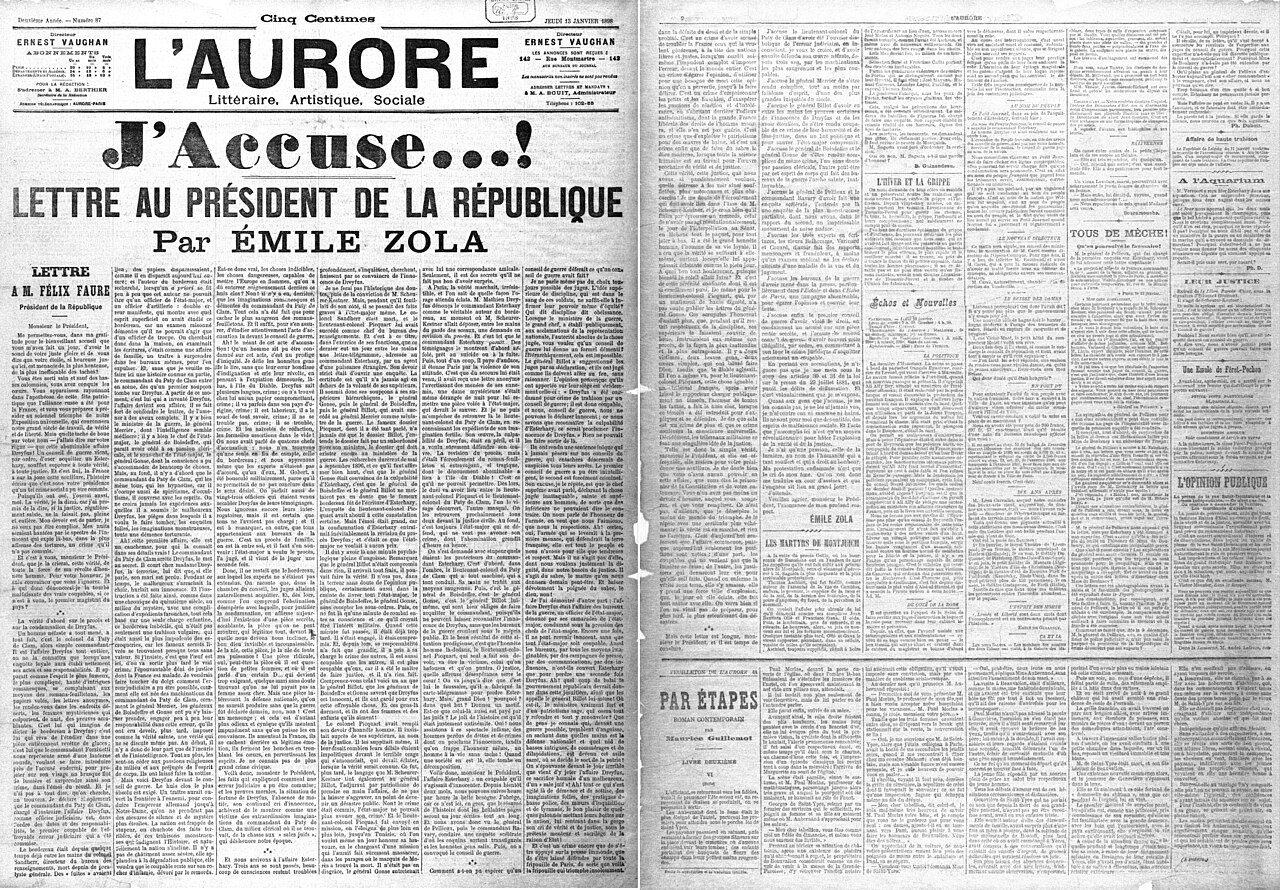
On 13 January 1898 the Paris newspaper L'Aurore printed Émile Zola's open letter 'J'Accuse…!' on its front page, accusing France's army and government of convicting the innocent Alfred Dreyfus and covering it up. It became the most famous newspaper article ever published. January 13 is also the day Johnny Cash recorded at Folsom Prison, a Kabul garrison's sole survivor reached Jalalabad, and Virginia swore in America's first popularly elected Black governor.
Choose another date: open the On This Day calendar to browse events, births and deaths for any day of the year.
At a Glance
- Published
- 13 January 1898, on the front page of the Paris daily L'Aurore
- Addressed to
- Félix Faure, President of the French Republic
- The accused
- The army high command and government, charged with a cover-up and antisemitism
- The case
- Alfred Dreyfus, a Jewish artillery officer wrongly convicted of treason in 1894 and imprisoned on Devil's Island
- The trigger
- The acquittal, two days earlier, of Ferdinand Walsin Esterhazy, the officer evidence actually pointed to
- The price Zola paid
- Convicted of libel in February 1898 and sentenced to a year in prison and a 3,000-franc fine; he fled to England
Events on this day
- 1128Pope Honorius II formally recognises the Knights Templar, the warrior-monks who will guard pilgrims and crusader states for two centuries.
- 1842A sole British survivor, Dr William Brydon, reaches Jalalabad — the remnant of a 16,000-strong force destroyed retreating from Kabul.
- 1898Émile Zola publishes 'J'Accuse…!' in L'Aurore, accusing France's army of framing Alfred Dreyfus — the featured story above.
- 1903The first Korean immigrants to the United States, 102 people aboard the RMS Gaelic, arrive in Hawaii to work its plantations.
- 1950The Soviet Union boycotts the UN Security Council over its refusal to seat Communist China, leaving the West a free hand when Korea erupts.
- 1966Lyndon Johnson appoints Robert C. Weaver to head Housing and Urban Development — the first African American cabinet member in U.S. history.
- 1968Johnny Cash performs for some 2,000 inmates at California's Folsom Prison, recording one of the great live albums.
- 1982Air Florida Flight 90 crashes into Washington's frozen Potomac River shortly after takeoff, killing 78 people.
- 1990Douglas Wilder is sworn in as governor of Virginia — the first African American popularly elected governor of a U.S. state.
- 1999Michael Jordan announces his retirement from basketball for the second time, ending the Chicago Bulls dynasty.
- 2012The cruise ship Costa Concordia strikes a reef off the Italian island of Giglio and capsizes, killing 32 people.
Born on this day
- 1808Salmon P. Chase — American statesman, Lincoln's Treasury secretary and later Chief Justice of the United States.
- 1832Horatio Alger — American novelist whose rags-to-riches tales defined an era's faith in self-improvement.
- 1848Lilla Cabot Perry — American Impressionist painter who helped bring the style home from Giverny.
- 1864Wilhelm Wien — German physicist whose laws of heat radiation won him the Nobel Prize.
- 1926Michael Bond — English author who created Paddington Bear in 1958.
- 1977Orlando Bloom — English actor, Legolas in The Lord of the Rings and Will Turner in Pirates of the Caribbean.
Died on this day
- 1599Edmund Spenser — English poet of The Faerie Queene, the great allegorical epic of Elizabeth's court.
- 1864Stephen Foster — American songwriter of 'Oh! Susanna' and 'My Old Kentucky Home', dead at 37.
- 1929Wyatt Earp — frontier lawman of Tombstone and the O.K. Corral, dead in Los Angeles at 80.
- 1941James Joyce — Irish writer of Ulysses and Dubliners, dead in Zurich at 58, exiled from the city he immortalised.
- 1978Hubert Humphrey — U.S. vice president under Lyndon Johnson and Democratic presidential nominee in 1968.
The featured story: Zola publishes 'J'Accuse…!', 13 January 1898
In the autumn of 1894 a cleaner at the German embassy in Paris fished a torn note — the bordereau — out of a wastebasket: someone in the French army was selling secrets. The army's investigators settled on Captain Alfred Dreyfus, an Alsatian Jew on the general staff, convicted him on flimsy handwriting evidence and a secret dossier he was never shown, and shipped him to Devil's Island. When new evidence pointed to another officer, Ferdinand Walsin Esterhazy, the army closed ranks — and on 11 January 1898 a military court acquitted Esterhazy in a matter of minutes. Two days later, France's most famous living novelist answered.
Émile Zola's letter, printed across the front page of Georges Clemenceau's newspaper L'Aurore under the headline Clemenceau gave it — 'J'Accuse…!' — was addressed to the President of the Republic and named names. As Britannica summarises the charge, Zola blamed the army for covering up the mistaken conviction of Dreyfus. Officer by officer, he accused the men who had framed Dreyfus, acquitted the guilty Esterhazy and buried the truth, and he did it knowing exactly what it would cost: a libel prosecution was the point. Only a trial, he believed, could drag the secret evidence into open court.
The cost came quickly. Zola was tried in February 1898, convicted of libel and sentenced to a year in prison and a fine of 3,000 francs; after a retrial he fled to England, where he lived in exile for nearly a year. France split down the middle — Dreyfusards against anti-Dreyfusards, families and friendships broken over dinner tables — in the defining culture war of the Third Republic. Zola did not live to see the end: he died in 1902, four years before the army finally annulled Dreyfus's conviction and restored him to rank.
The affair outlasted everyone in it. Dreyfus, fully exonerated in 1906, served in the First World War; the separation of church and state in France, the modern idea of the intellectual as public conscience, and the very phrase 'J'accuse' — still reached for whenever a writer indicts a state — all run back to that front page. Zola's ashes were moved to the Panthéon in 1908, a national honour for a man the nation had convicted of libel ten years before.
Why this date matters
January 13 is a day of reckonings delivered in public. Zola indicted an army on a front page in 1898; a lone survivor rode into Jalalabad in 1842 carrying the news of an army's destruction; Johnny Cash sang to prisoners in 1968 and Douglas Wilder took an oath in 1990 that American history had waited two centuries for. Even its disasters — a jet in the Potomac, a cruise ship on a reef — unfolded in front of watching crowds. This is a date that does its business in the open.
Sources
- Encyclopaedia Britannica — On This Day: January 13
- HISTORY — What Happened on January 13
- Encyclopaedia Britannica — J'Accuse
- Encyclopaedia Britannica — Émile Zola
- Wikipedia — January 13 (births and deaths lists)
The facts on this page were checked against these sources on 19 November 2026. The History Trail's permanent pages are researched and written for this site; the live profiles elsewhere on The History Trail are assembled automatically from Wikipedia and Wikidata.
About the Author
Researched and written by the The History Trail Editorial Team — the accountable editorial function behind this site's permanent story pages. The team works from the published sources cited on each page; it does not invent historians, reviewers or credentials, and it corrects errors openly.
Fact Check
Every load-bearing fact on this page traces to one of the sources listed above, and significant claims link to their source in the text. Our checking method is described on the methodology page; errors can be reported via the corrections page.
Sources & Citations
Cite this page as: The History Trail Editorial Team, The History Trail — this article's title, publication and update dates are shown beneath its headline. The full source list appears under Sources above; the site's source standards are on the sources page.