
On This Day
February 28 in History
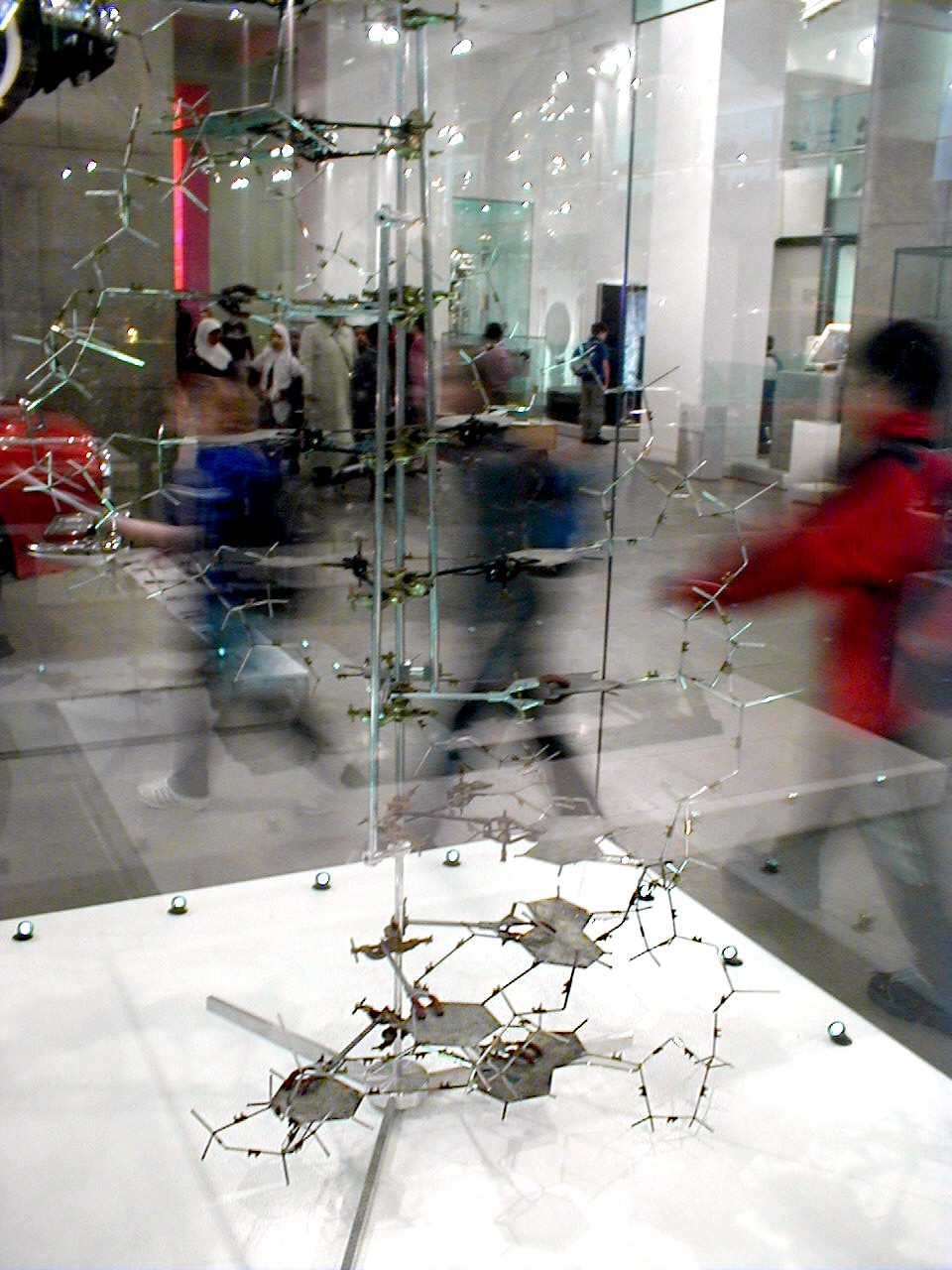
On the morning of 28 February 1953, in Cambridge, James Watson and Francis Crick determined that DNA is a double helix — the discovery that explained heredity and founded modern genetics. February 28 is also the day the M*A*S*H finale drew a record television audience, Sweden's prime minister Olof Palme was assassinated, and Pope Benedict XVI resigned.
Choose another date: open the On This Day calendar to browse events, births and deaths for any day of the year.
At a Glance
- The morning
- 28 February 1953, at the Cavendish Laboratory, Cambridge
- The structure
- A double helix — two strands joined by paired bases: adenine with thymine, guanine with cytosine
- Why it mattered
- The base pairing explained how DNA copies itself, the mechanism of heredity
- The evidence
- Rosalind Franklin's X-ray diffraction work at King's College London, including Photo 51, supplied crucial measurements
- The near miss
- Linus Pauling had just published an incorrect triple-helix model, spurring the Cambridge pair to finish
- The publication
- Nature, 25 April 1953; the Nobel Prize followed in 1962 for Watson, Crick and Maurice Wilkins
Events on this day
- 1784John Wesley charters the first Methodist church in the United States, organising the movement his followers had carried across the Atlantic.
- 1844A cannon explodes aboard the warship USS Princeton during a pleasure cruise on the Potomac, killing senior government officials while President John Tyler, below deck, escapes unharmed.
- 1861Congress creates the Colorado Territory, carving it from parts of Kansas, Nebraska, Utah and New Mexico.
- 1922Egypt proclaims its independence, ending the British protectorate imposed in 1914, though Britain keeps control of the Suez Canal and defence.
- 1953James Watson and Francis Crick determine the double-helix structure of DNA in Cambridge — the featured story above.
- 1975A London Underground train crashes into a dead-end tunnel at Moorgate station, killing 43 people in the Underground's deadliest peacetime disaster.
- 1983The final episode of M*A*S*H, Goodbye, Farewell and Amen, is broadcast in the United States, watched by an estimated 106 million people.
- 1986Swedish prime minister Olof Palme is shot dead on a Stockholm street as he walks home from the cinema; the murder is never definitively solved.
- 1993Federal agents raid the Branch Davidian compound near Waco, Texas, beginning a siege that will end in fire fifty-one days later.
- 1994American jets shoot down four Serb warplanes over Bosnia, the first combat action in NATO's history.
- 2013Pope Benedict XVI resigns the papacy, the first pope to relinquish the office in nearly six hundred years.
Born on this day
- 1533Michel de Montaigne — French writer who invented the essay as a literary form.
- 1823Ernest Renan — French historian and philosopher whose life of Jesus scandalised and fascinated nineteenth-century Europe.
- 1901Linus Pauling — American chemist, the only person to win two unshared Nobel Prizes, in chemistry and in peace.
- 1929Frank Gehry — Canadian-American architect whose swirling buildings, above all the Guggenheim Museum Bilbao, remade modern architecture.
- 1953Paul Krugman — American economist and columnist, winner of the Nobel Prize in Economics.
Died on this day
- 1925Friedrich Ebert — first president of Germany's Weimar Republic, dead in office in Berlin at 54.
- 1986Olof Palme — prime minister of Sweden, assassinated in Stockholm at 59.
- 2016George Kennedy — American actor, Oscar winner for Cool Hand Luke, dead at 91.
The featured story: Watson and Crick determine the structure of DNA, 28 February 1953
By the early 1950s biologists knew that the molecule of heredity was DNA, but nobody knew what it looked like — and its shape was the secret of how it worked. A molecule that carried the instructions for building a living thing, and that could copy itself exactly when cells divided, had to have a very particular structure. The race to find it was run in a handful of laboratories. At King's College London, Rosalind Franklin and Maurice Wilkins were producing X-ray diffraction images of DNA fibres of extraordinary quality, including the image known as Photo 51, whose pattern of reflections held the clues to the molecule's geometry. In California, the great chemist Linus Pauling — who had already unravelled the structure of proteins — published a proposed model of DNA in early 1953. It was wrong: he had built a triple helix with the wrong chemistry. That error bought Cambridge a little time, and Cambridge used it.
At the Cavendish Laboratory, the American biologist James Watson and the English physicist Francis Crick were building physical models of the molecule, testing shapes against the measurements coming out of London. Franklin's data — her measurements of the molecule's dimensions and symmetry, and the evidence of her images — pointed them toward the answer, though the two Cambridge men saw some of that data without her direct collaboration, a fact that has shadowed the story ever since. On the morning of 28 February 1953, fitting the last pieces together, Watson and Crick realised the structure had to be a double helix: two strands wound around each other, held together by pairs of chemical bases, adenine always with thymine and guanine always with cytosine. The pairing was the revelation. If the bases always matched in this way, then each strand carried the information needed to rebuild the other — the molecule's copying mechanism was written into its shape.
The discovery was published in the journal Nature on 25 April 1953, in a paper of famous understatement, accompanied by companion papers from Wilkins and from Franklin and her colleague Raymond Gosling presenting the King's College evidence. The double helix became, almost at once, the most famous shape in science: the icon of genetics, and the working foundation for everything that followed — the cracking of the genetic code, genetic engineering, DNA fingerprinting, the sequencing of the human genome and modern medicine's ability to read, and increasingly to edit, the instructions of life. Watson, Crick and Wilkins shared the Nobel Prize in Physiology or Medicine in 1962.
One name was missing from that prize, and the omission defines the story's afterlife. Rosalind Franklin had died of cancer in 1958, aged 37, and Nobel Prizes are not awarded posthumously. Her experimental work had been indispensable — Watson and Crick's model rested on her measurements — yet for decades the popular story of the double helix largely wrote her out of it. The morning of 28 February 1953 in Cambridge remains one of the great moments in the history of science; the fuller account of who made it possible took the rest of the century to be told. Watson later wrote that Crick, on the day itself, burst into their local pub, the Eagle, announcing that they had found the secret of life.
Why this date matters
February 28 is the year's hinge in miniature — the last ordinary day of February, standing at the door of spring — and it behaves like one, full of endings and beginnings pressed together. A pope resigns for the first time in six centuries; a beloved television series ends before a hundred million people; a Swedish prime minister is murdered on a winter street. And in a Cambridge laboratory, on an ordinary Saturday morning in 1953, two young scientists fit cardboard and metal into a spiral and begin the age of genetics. Few dates hold a before-and-after so cleanly: almost everything in modern biology is dated from the morning of 28 February 1953, when life got its shape.
Sources
- Encyclopaedia Britannica — On This Day: February 28
- HISTORY — This Day in History: February 28
- HISTORY — Watson and Crick discover the chemical structure of DNA
- Encyclopaedia Britannica — Linus Pauling
The facts on this page were checked against these sources on 19 November 2026. The History Trail's permanent pages are researched and written for this site; the live profiles elsewhere on The History Trail are assembled automatically from Wikipedia and Wikidata.
About the Author
Researched and written by the The History Trail Editorial Team — the accountable editorial function behind this site's permanent story pages. The team works from the published sources cited on each page; it does not invent historians, reviewers or credentials, and it corrects errors openly.
Fact Check
Every load-bearing fact on this page traces to one of the sources listed above, and significant claims link to their source in the text. Our checking method is described on the methodology page; errors can be reported via the corrections page.
Sources & Citations
Cite this page as: The History Trail Editorial Team, The History Trail — this article's title, publication and update dates are shown beneath its headline. The full source list appears under Sources above; the site's source standards are on the sources page.