
On This Day
February 24 in History
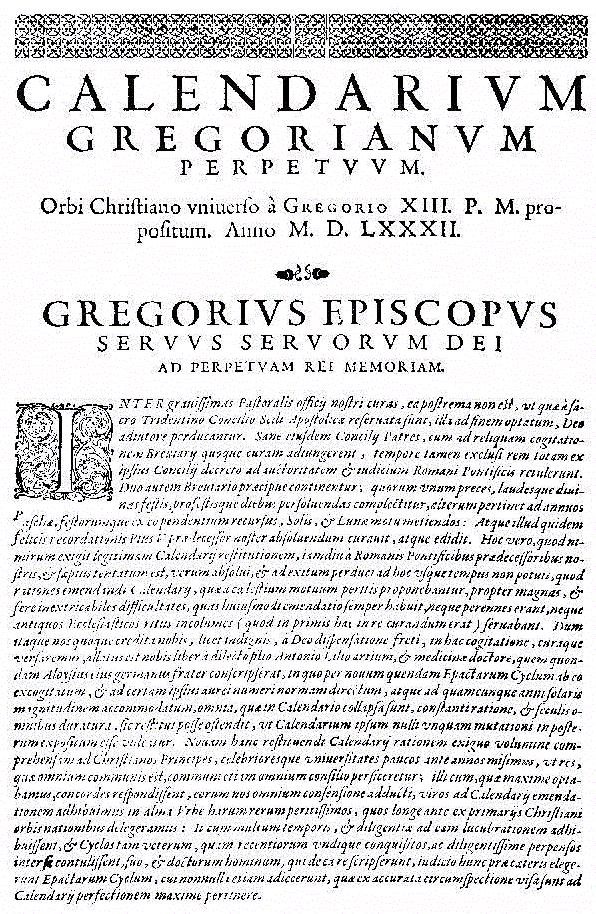
On 24 February 1582 Pope Gregory XIII issued the bull Inter gravissimas, decreeing the reformed calendar — with its famous ten-day jump and its new leap-year rule — that the whole world now uses. February 24 is also the day Marbury v. Madison created judicial review, Andrew Johnson became the first impeached president, and Russia invaded Ukraine in 2022.
Choose another date: open the On This Day calendar to browse events, births and deaths for any day of the year.
At a Glance
- The document
- The papal bull Inter gravissimas, issued by Pope Gregory XIII on 24 February 1582
- The problem
- The Julian calendar had drifted about ten days out of alignment with the seasons and the spring equinox
- The correction
- In adopting countries, Thursday 4 October 1582 was followed by Friday 15 October — ten dates were skipped
- The new rule
- Century years are leap years only when divisible by 400, so 1700, 1800 and 1900 had no 29 February but 2000 did
- The designers
- Based chiefly on the work of Luigi Lilio, and refined and defended by Christopher Clavius
- The spread
- Catholic countries adopted it in 1582; Britain and its colonies waited until 1752, Russia until 1918
Events on this day
- 1582Pope Gregory XIII issues the bull Inter gravissimas, decreeing the calendar reform that bears his name — the featured story above.
- 1803In Marbury v. Madison, the U.S. Supreme Court establishes its power of judicial review, claiming the authority to strike down laws that violate the Constitution.
- 1848King Louis-Philippe of France abdicates and flees Paris as revolution sweeps the capital, part of the wave of uprisings across Europe in 1848.
- 1868The U.S. House of Representatives votes to impeach President Andrew Johnson, making him the first American president to be impeached.
- 1917The intercepted Zimmermann Telegram, in which Germany proposes a military alliance with Mexico against the United States, is given to the American ambassador in London.
- 1946Juan Perón is elected president of Argentina, beginning the era of Peronism in the country's politics.
- 1988The U.S. Supreme Court rules unanimously that parody of public figures is protected speech, throwing out the Reverend Jerry Falwell's lawsuit against Hustler magazine.
- 1991The coalition ground offensive begins in the Gulf War, opening the hundred-hour land campaign that liberates Kuwait.
- 2022Russia launches a full-scale invasion of Ukraine, beginning the largest war in Europe since 1945.
Born on this day
- 1500Charles V — Holy Roman emperor and king of Spain, ruler of an empire on which, it was said, the sun never set.
- 1786Wilhelm Grimm — German scholar who, with his brother Jacob, collected the fairy tales that bear their name.
- 1836Winslow Homer — American painter of seascapes and rural life, among the defining artists of nineteenth-century America.
- 1955Steve Jobs — American entrepreneur who co-founded Apple and reshaped personal computing, music and the telephone.
- 1971Gillian Flynn — American novelist, author of the bestselling thriller Gone Girl.
Died on this day
- 1815Robert Fulton — American engineer whose Clermont made the steamboat a commercial success on the Hudson River.
- 1856Nikolai Lobachevsky — Russian mathematician who developed hyperbolic geometry, overturning two thousand years of Euclidean assumption.
- 1914Joshua Chamberlain — Union general whose stand at Little Round Top helped save the Battle of Gettysburg, later governor of Maine.
- 2020Katherine Johnson — NASA mathematician whose hand calculations guided America's first spaceflights, dead at 101.
The featured story: Pope Gregory XIII issues the Gregorian calendar, 24 February 1582
Every date on this page exists because of what happened on 24 February 1582. The calendar inherited from Julius Caesar, in use for more than sixteen centuries, was quietly wrong: its year was about eleven minutes too long, and those minutes had accumulated, century by century, into days. By the 1580s the calendar had drifted some ten days out of step with the seasons, and the spring equinox — on which the date of Easter depends — no longer fell where the Church's calculations required it to fall, on 21 March. Reform had been discussed for generations, but it took Pope Gregory XIII to force it through. Working chiefly from a scheme devised by the Calabrian physician Luigi Lilio and defended and refined by the Jesuit mathematician Christopher Clavius, Gregory prepared a new calendar and gave it legal force.
On 24 February 1582 the pope issued the bull Inter gravissimas, named for its opening words, which ordered the reform. Its boldest stroke was surgical: in the countries that adopted the new calendar that year, Thursday 4 October 1582 would be followed immediately by Friday 15 October. Ten dates simply vanished from the year, realigning the calendar with the sun at a stroke, while the sequence of weekdays — a rhythm no one dared disturb — ran on unbroken. To stop the drift returning, the bull changed the rule for leap years: century years would be leap years only if divisible by 400. Under the old rule 1700, 1800 and 1900 would all have had a 29 February; under Gregory's rule, none of them did, while the year 2000, divisible by 400, kept its leap day.
Adoption was anything but universal, because in 1582 a calendar from Rome was a confessional act. Catholic states — Italy, Spain, Portugal, France and others — switched in 1582 or soon after. Protestant countries suspected a papal trick and held out, in some cases for more than a century: Britain and its American colonies did not adopt the Gregorian calendar until 1752, by which time the gap had grown to eleven days. Orthodox countries waited longer still, and Russia changed only in 1918, after the revolution — which is why the 'October Revolution' of 1917 is commemorated from a November date. For generations, neighbouring countries lived ten or eleven days apart, and historians still mark dates from the period as Old Style or New Style.
The result of that slow conquest is the calendar the whole world now keeps. The Gregorian system is accurate to within a day in more than three thousand years, and it underlies every diary, timetable and computer clock on Earth — including the date pages of this site, which exist in their present form because a pope, a physician and a Jesuit astronomer persuaded much of the world to skip ten days in the autumn of 1582 and to count its leap years more carefully ever after.
Why this date matters
February 24 is the day the world agreed, eventually, on what day it is. Gregory's bull of 1582 is the invisible architecture under every other entry on this page: the impeachment of Andrew Johnson, the Zimmermann Telegram, the invasion of Ukraine all carry dates in Gregory's system. Around that act of timekeeping the date collects its usual cross-section of power changing hands — a French king fleeing in 1848, Perón elected in 1946, courts in Washington asserting themselves in 1803 and again in 1988. It is fitting that the day which fixed the calendar should also be the birthday of Steve Jobs, who put a clock in everyone's pocket, and the death day of Katherine Johnson, who computed time and trajectory for the space age.
Sources
- Encyclopaedia Britannica — On This Day: February 24
- HISTORY — This Day in History: February 24
- Encyclopaedia Britannica — Gregory XIII
- Encyclopaedia Britannica — Inter gravissimas
- NASA — Katherine Johnson: Biography
The facts on this page were checked against these sources on 19 November 2026. The History Trail's permanent pages are researched and written for this site; the live profiles elsewhere on The History Trail are assembled automatically from Wikipedia and Wikidata.
About the Author
Researched and written by the The History Trail Editorial Team — the accountable editorial function behind this site's permanent story pages. The team works from the published sources cited on each page; it does not invent historians, reviewers or credentials, and it corrects errors openly.
Fact Check
Every load-bearing fact on this page traces to one of the sources listed above, and significant claims link to their source in the text. Our checking method is described on the methodology page; errors can be reported via the corrections page.
Sources & Citations
Cite this page as: The History Trail Editorial Team, The History Trail — this article's title, publication and update dates are shown beneath its headline. The full source list appears under Sources above; the site's source standards are on the sources page.