
On This Day
February 13 in History
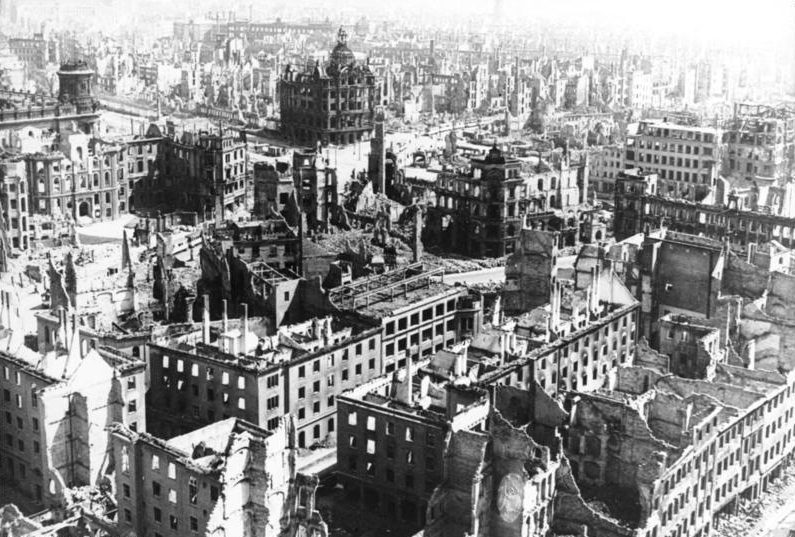
On the night of 13 February 1945, British bombers opened the series of Allied raids that destroyed Dresden, the Saxon capital famed as the Florence of the Elbe. The firestorm that followed killed an estimated 25,000 people and left one of Europe's most beautiful cities in ruins, making Dresden the most morally debated bombing of the Second World War. February 13 is also the day Galileo arrived in Rome to face the Inquisition and William and Mary were proclaimed joint sovereigns of Britain.
Choose another date: open the On This Day calendar to browse events, births and deaths for any day of the year.
At a Glance
- The target
- Dresden — Germany's seventh-largest city, a rail and communications centre swollen with refugees fleeing the Soviet advance
- First raid
- Night of 13 February 1945 — some 800 British bombers drop about 2,700 tons of bombs, many of them incendiaries
- The firestorm
- Fires merge into a self-feeding storm that devastates the city centre; American bombers follow on 14 and 15 February
- The dead
- An estimated 25,000–35,000 people, most of them civilians, in Britannica's account; a city-commissioned study later put the toll at up to 25,000
- The argument
- Allied commanders called Dresden a legitimate transport target; critics have called the raid disproportionate area bombing of a cultural treasure
- The symbol
- The ruined Frauenkirche is left as a memorial for decades; its reconstruction is completed only in 2005
Events on this day
- 1542Catherine Howard, the fifth wife of Henry VIII, is executed at the Tower of London, accused of adultery.
- 1633Galileo Galilei arrives in Rome to face the Inquisition on charges of heresy for teaching that the Earth moves around the Sun.
- 1689William of Orange and his wife Mary are proclaimed joint sovereigns of Britain under the new Bill of Rights, completing the Glorious Revolution.
- 1861Army surgeon Bernard Irwin's rescue mission near Apache Pass, Arizona, becomes the earliest action later awarded the Medal of Honor.
- 1914ASCAP, the American Society of Composers, Authors and Publishers, is founded in New York to protect music creators' earnings.
- 1920The League of Nations formally recognises the perpetual neutrality of Switzerland.
- 1923The New York Renaissance, the first all-Black professional basketball team, is organised.
- 1945Allied bombers begin the raids on Dresden that destroy the city centre in a firestorm — the featured story above.
- 1960France explodes its first atomic bomb, in the Sahara, becoming the world's fourth nuclear power.
- 1965President Lyndon B. Johnson approves Operation Rolling Thunder, the sustained bombing of North Vietnam.
- 2000The last Peanuts comic strip is published, hours after the death of its creator, Charles M. Schulz.
- 2002The Scottish Parliament outlaws hunting wild mammals with dogs, effectively ending foxhunting in Scotland.
- 2008Prime Minister Kevin Rudd formally apologises to Australia's Aboriginal peoples and the Stolen Generations.
Born on this day
- 1891Grant Wood — American painter of American Gothic, the defining image of Midwestern Regionalism.
- 1903Georges Simenon — Belgian writer, creator of Inspector Maigret and one of the most prolific novelists of the 20th century.
- 1933Kim Novak — American film actress, star of Hitchcock's Vertigo.
- 1950Peter Gabriel — English musician, lead singer of Genesis and a pioneering solo artist and world-music promoter.
- 1974Robbie Williams — English pop singer, first with Take That and then one of Britain's best-selling solo artists.
Died on this day
- 1542Catherine Howard — fifth queen consort of Henry VIII, executed at the Tower of London at about 21.
- 1883Richard Wagner — German composer of the Ring cycle and Tristan und Isolde, dead in Venice at 69.
- 1976Murtala Mohammed — military head of state of Nigeria, assassinated in Lagos during an attempted coup.
- 2016Antonin Scalia — associate justice of the U.S. Supreme Court, its leading originalist voice, dead in Texas at 79.
The featured story: the bombing of Dresden begins, 13 February 1945
Dresden had survived nearly six years of war almost untouched. The Saxon capital on the Elbe — a city of baroque churches, palaces and concert halls, nicknamed the Florence of the Elbe — had no great armaments industry, and by February 1945 it was crowded far beyond its peacetime population with refugees fleeing west before the advancing Red Army. On the night of 13 February, Shrove Tuesday, that luck ended. In two waves, roughly 800 aircraft of RAF Bomber Command dropped some 2,700 tons of high explosive and incendiaries on the city centre.
The method was the one perfected over Hamburg in 1943: explosives to blow off roofs and break windows, then incendiaries to set the exposed timbers alight, until thousands of separate fires merged into a single firestorm — a column of superheated air that pulled oxygen in at street level, suffocated people in their shelters and incinerated a city district. American bombers of the Eighth Air Force attacked the rail yards the following day and again on 15 February. By then the old city was a field of ruins, its landmarks — the Zwinger, the Semperoper, the Frauenkirche, whose dome collapsed two days after the raid — gutted or flattened.
The human cost has been argued over ever since, because the numbers were weaponised from the start. Britannica puts the dead at an estimated 25,000 to 35,000; a commission of historians appointed by the city itself concluded in 2010 that the toll was up to 25,000. Nazi propaganda at the time multiplied the figure tenfold, claiming 200,000 or more, and inflated numbers circulated for decades. What is not in dispute is that most of the dead were civilians, many of them refugees whose names were never recorded anywhere.
Dresden became, almost immediately, the standing symbol in the argument over area bombing. The Allied case was that the city was a working rail hub and communications centre through which troops moved to the Eastern Front, and that the Soviet Union had asked for attacks on such centres. The counter-case — pressed by survivors, by Kurt Vonnegut, who lived through the raid as a prisoner of war and turned it into Slaughterhouse-Five, and by many historians since — is that a city of culture and refugees was destroyed out of proportion to any military gain, weeks before a war already won. The argument has never closed, which is precisely why 13 February 1945 is still commemorated, and contested, every year.
Why this date matters
February 13 is a day when authority puts its power on display — and when the display is questioned ever after. Henry VIII executed a young queen in 1542; the Inquisition summoned Galileo in 1633; a revolutionary parliament crowned William and Mary in 1689. Against those assertions stand the day's quieter creations: ASCAP defending songwriters in 1914, the first all-Black professional basketball team in 1923, an official apology to Australia's Stolen Generations in 2008. And over the whole date hangs 1945, when the most powerful air forces on earth demonstrated, on a city of refugees, exactly what their power could do.
Sources
- Encyclopaedia Britannica — On This Day: February 13
- HISTORY — What Happened on February 13
- Encyclopaedia Britannica — Bombing of Dresden
The facts on this page were checked against these sources on 19 November 2026. The History Trail's permanent pages are researched and written for this site; the live profiles elsewhere on The History Trail are assembled automatically from Wikipedia and Wikidata.
About the Author
Researched and written by the The History Trail Editorial Team — the accountable editorial function behind this site's permanent story pages. The team works from the published sources cited on each page; it does not invent historians, reviewers or credentials, and it corrects errors openly.
Fact Check
Every load-bearing fact on this page traces to one of the sources listed above, and significant claims link to their source in the text. Our checking method is described on the methodology page; errors can be reported via the corrections page.
Sources & Citations
Cite this page as: The History Trail Editorial Team, The History Trail — this article's title, publication and update dates are shown beneath its headline. The full source list appears under Sources above; the site's source standards are on the sources page.