
On This Day
August 23 in History
On 23 August 1939 Nazi Germany and the Soviet Union signed a non-aggression pact in Moscow, stunning the world — and, in a secret protocol, divided Eastern Europe between them. Nine days later Germany invaded Poland. August 23 is also the day William Wallace was executed, Fort Morgan surrendered, and Sacco and Vanzetti were executed.
Choose another date: open the On This Day calendar to browse events, births and deaths for any day of the year.
At a Glance
- The signing
- Moscow, late on 23 August 1939, by Joachim von Ribbentrop and Vyacheslav Molotov, with Stalin looking on
- The public terms
- A ten-year non-aggression pact between Nazi Germany and the Soviet Union
- The secret protocol
- Eastern Europe divided into German and Soviet spheres: Poland split, the Baltic states and Bessarabia assigned to Moscow
- The immediate result
- Germany invaded Poland on 1 September 1939; the USSR invaded from the east on 17 September
- The end
- Germany tore up the pact by invading the Soviet Union on 22 June 1941
- The memory
- 23 August is now the European Day of Remembrance for Victims of Stalinism and Nazism
Events on this day
- 1305Scottish leader William Wallace is executed in London after being captured and tried for treason.
- 1514Ottoman forces defeat Safavid Persia at the Battle of Chaldiran, securing eastern Anatolia.
- 1784Four western North Carolina counties declare themselves the breakaway state of Franklin, in what is now Tennessee.
- 1856Eunice Foote's research on carbon dioxide and atmospheric warming is presented to the American Association for the Advancement of Science.
- 1864Fort Morgan surrenders, ending the Battle of Mobile Bay and closing the Confederacy's last major Gulf port.
- 1914British troops fight their first major action of the First World War at the Battle of Mons in Belgium.
- 1927Italian-American anarchists Nicola Sacco and Bartolomeo Vanzetti are executed in Massachusetts after a trial that divided the world.
- 1939Germany and the Soviet Union sign the non-aggression pact in Moscow — the featured story above.
- 1973A botched Stockholm bank robbery begins the six-day hostage crisis that gave psychology the term Stockholm syndrome.
- 2023India's Chandrayaan-3 lands near the Moon's south pole, the first spacecraft to touch down in that region.
Born on this day
- 1754Louis XVI — last king of France before the Revolution, executed in 1793.
- 1769Georges Cuvier — French zoologist who founded comparative anatomy and established extinction as fact.
- 1912Gene Kelly — American dancer and actor who sang in the rain into film history.
- 1926Clifford Geertz — American anthropologist who reshaped the study of culture.
- 1978Kobe Bryant — American basketball star, five-time NBA champion with the Los Angeles Lakers.
- 1988Jeremy Lin — American basketball player whose 2012 run sparked the Linsanity phenomenon.
Died on this day
- 1305William Wallace — Scottish resistance leader, hanged, drawn and quartered at Smithfield, London.
- 1806Charles-Augustin de Coulomb — French physicist whose law of electric force and the unit of charge bear his name.
- 1819Oliver Hazard Perry — American naval hero of the Battle of Lake Erie, dead of yellow fever at 34.
- 1926Rudolph Valentino — Italian-born silent-film idol, dead at 31, sparking mass mourning among fans.
- 1927Nicola Sacco and Bartolomeo Vanzetti — Italian-American anarchists executed after one of America's most contested trials.
- 1960Oscar Hammerstein II — American lyricist of Oklahoma!, South Pacific and The Sound of Music.
- 2006Maynard Ferguson — Canadian jazz trumpeter famed for his stratospheric high notes.
The featured story: the Nazi-Soviet Pact is signed, 23 August 1939
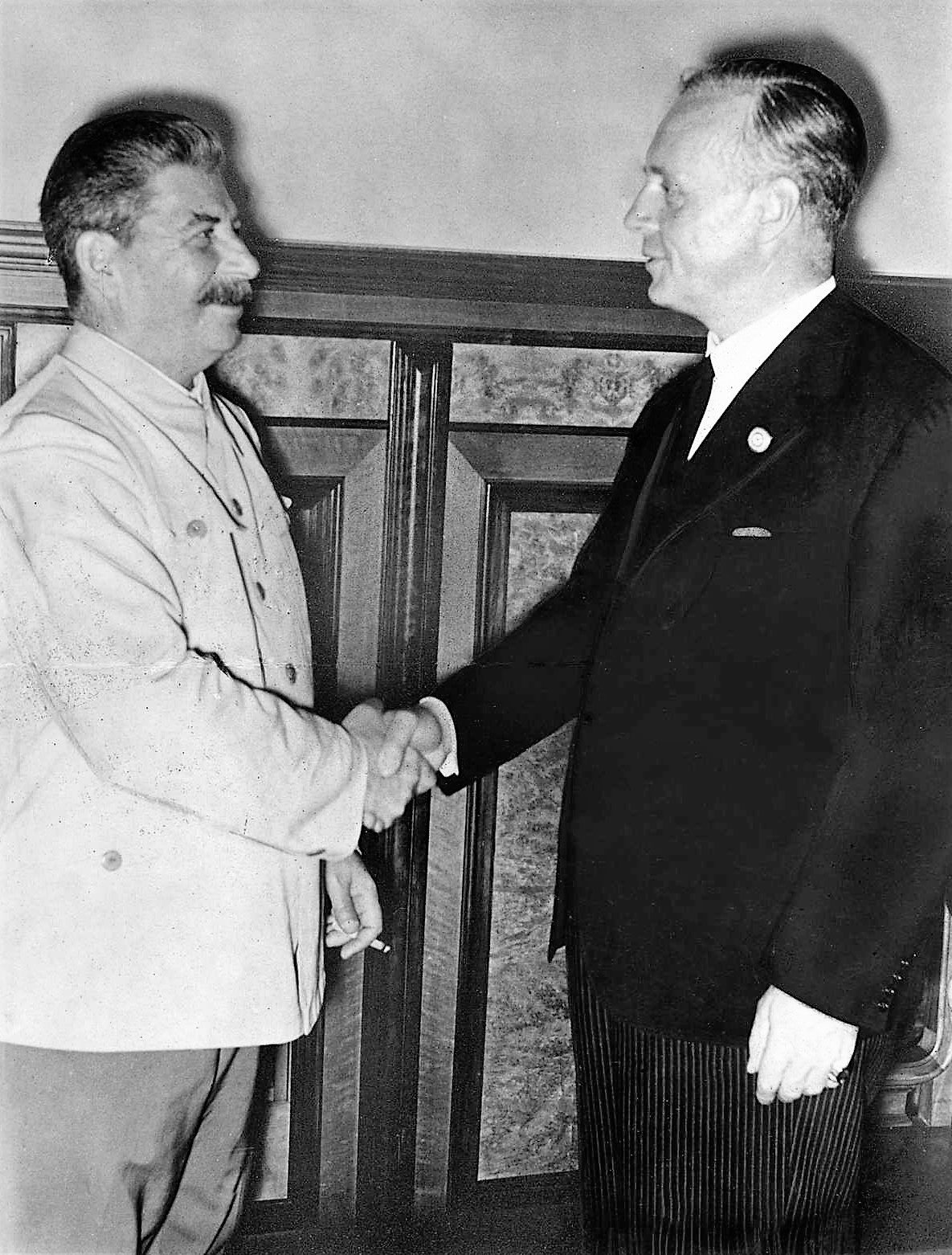
Late on 23 August 1939, in the Kremlin, the foreign ministers of the twentieth century's two most hostile regimes signed a treaty of friendship. Joachim von Ribbentrop for Nazi Germany and Vyacheslav Molotov for the Soviet Union put their names to a non-aggression pact, while Joseph Stalin, who rarely appeared at such ceremonies, stood smiling behind them. The ideological enemies had spent the Spanish Civil War fighting a proxy war against each other; now, with Britain and France unable to close an alliance with Moscow, Stalin chose the deal that paid him in territory and time, and Hitler bought a free hand in the west.
The public text promised ten years of non-aggression. The secret protocol, whose existence the USSR denied until 1989, was the real document: it divided Eastern Europe into spheres of influence. Poland was to be split along the Narew, Vistula and San rivers. Estonia, Latvia and Finland went into the Soviet sphere; Lithuania initially into the German one, later traded. Bessarabia, Romanian territory, was marked for Moscow. It was, in effect, a partition plan for a continent, agreed by the two powers best placed to execute it.
Execution followed at speed. On 1 September 1939 Germany invaded Poland, and Britain and France declared war two days later. On 17 September the Red Army marched into eastern Poland, its soldiers meeting the Wehrmacht at Brest-Litovsk for a joint parade. Over the following two years the Soviet Union annexed the Baltic states, attacked Finland in the Winter War, and supplied German war industry with grain and oil, while Germany conquered Denmark, Norway, the Low Countries and France.
The pact held for twenty-two months. On 22 June 1941 Hitler invaded the Soviet Union in Operation Barbarossa, turning an alliance of convenience into the largest and deadliest theatre of the Second World War. The date of the signing is now observed across Europe as a day of remembrance for the victims of both totalitarian regimes, a reminder that the war in Europe began not with a battle but with a signature, and that the small nations bargained away in its secret clauses paid first.
Why this date matters
August 23 has a double character. It is a day of signatures and scaffolds: a pact signed in the Kremlin that licensed a world war, and, across the centuries, a striking run of executions, Wallace in 1305 and Sacco and Vanzetti in 1927, men killed by states convinced of their own necessity. Against that stand the day's quieter firsts: Eunice Foote describing the warming power of carbon dioxide in 1856, a century and a half before her subject ruled politics, and an Indian spacecraft settling onto the unexplored lunar south pole in 2023. It is fitting that Europe eventually chose this date, rather than the anniversary of any battle, as its shared day of remembrance for the victims of totalitarianism.
Sources
- Encyclopaedia Britannica — On This Day: August 23
- HISTORY — What Happened on August 23
- United States Holocaust Memorial Museum — Nazi-Soviet Pact photograph, 23 August 1939
- Wikimedia Commons — Bundesarchiv Bild 183-H27337, Stalin and Ribbentrop in the Kremlin

The facts on this page were checked against these sources on 19 November 2026. The History Trail's permanent pages are researched and written for this site; the live profiles elsewhere on The History Trail are assembled automatically from Wikipedia and Wikidata.
About the Author
Researched and written by the The History Trail Editorial Team — the accountable editorial function behind this site's permanent story pages. The team works from the published sources cited on each page; it does not invent historians, reviewers or credentials, and it corrects errors openly.
Fact Check
Every load-bearing fact on this page traces to one of the sources listed above, and significant claims link to their source in the text. Our checking method is described on the methodology page; errors can be reported via the corrections page.
Sources & Citations
Cite this page as: The History Trail Editorial Team, The History Trail — this article's title, publication and update dates are shown beneath its headline. The full source list appears under Sources above; the site's source standards are on the sources page.