
On This Day
April 3 in History
On 3 April 1860 the first Pony Express riders galloped out of Missouri and California, opening a relay that carried mail across the continent in about ten days — the fastest communication America had ever known. April 3 is also the day Richmond fell in 1865, the Marshall Plan was signed in 1948 and Martin Luther King Jr. gave his last speech in 1968.
Choose another date: open the On This Day calendar to browse events, births and deaths for any day of the year.
At a Glance
- The route
- St. Joseph, Missouri, to Sacramento, California, roughly 1,900 miles
- The relay
- Riders changed horses every 10–15 miles and handed over the mail every 75–100 miles
- The time
- About ten days coast to coast, against weeks by stagecoach or ship
- The riders
- Young men, many under 18, hired for lightness and nerve
- The news it carried
- Lincoln's election in 1860 and his inaugural address in 1861
- The end
- Closed in October 1861, bankrupt, as the transcontinental telegraph was completed
Events on this day
- 1513Spanish explorer Juan Ponce de León comes ashore on the Florida coast and claims the land for Spain.
- 1776The Continental Congress authorises American privateers to attack British shipping, a cheap navy for a revolution short of money.
- 1860The Pony Express begins, carrying mail by relay rider between Missouri and California in about ten days — the featured story above.
- 1865Richmond, the Confederate capital, falls to Union forces after a ten-month campaign, the clearest sign yet that the Confederacy is ending.
- 1879Sofia, newly liberated from Ottoman rule, is named the capital of Bulgaria.
- 1882Outlaw Jesse James is shot and killed at home in St. Joseph, Missouri, by Robert Ford, a member of his own gang, for the reward.
- 1922Joseph Stalin becomes general secretary of the Soviet Communist Party, acquiring the power base from which his dictatorship grows.
- 1948President Harry Truman signs the Marshall Plan into law, committing the United States to the economic rebuilding of war-shattered Europe.
- 1968In Memphis, Martin Luther King Jr. delivers his 'Mountaintop' speech in support of striking sanitation workers; he is assassinated the next day.
- 1973A Motorola engineer makes the first handheld mobile telephone call, ringing a rival at AT&T's Bell Laboratories.
- 1996FBI agents arrest Theodore Kaczynski at his Montana cabin, ending the 18-year hunt for the Unabomber.
- 2016The Panama Papers, more than 11 million leaked documents, are published by journalists worldwide, exposing the offshore finances of the rich and powerful.
Born on this day
- 1593George Herbert — English poet and priest, among the finest devotional poets in the language.
- 1881Alcide De Gasperi — Italian statesman, prime minister who led his country's postwar reconstruction and European integration.
- 1922Doris Day — American singer and film star of the 1950s musicals and comedies.
- 1924Marlon Brando — American actor of A Streetcar Named Desire and The Godfather, who remade screen acting.
- 1929Fazlur R. Khan — Bangladeshi-American engineer whose tubular designs made the modern skyscraper, including Chicago's Willis Tower, possible.
- 1930Helmut Kohl — chancellor of West Germany and then of the reunified Germany, in office from 1982 to 1998.
Died on this day
- 1936Bruno Hauptmann — convicted kidnapper and murderer of the Lindbergh baby, executed by electrocution in New Jersey.
- 1946Homma Masaharu — Japanese general responsible for the Bataan Death March, executed in Manila for war crimes.
- 1996Ron Brown — U.S. secretary of commerce, killed with 32 others when his Air Force plane crashes near Dubrovnik, Croatia.
The featured story: the Pony Express begins, 3 April 1860
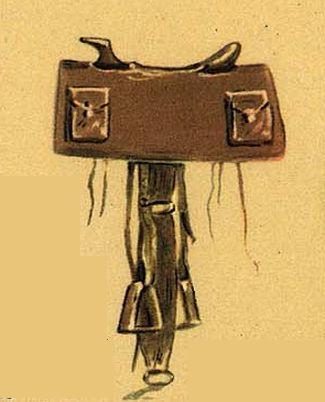
On 3 April 1860, riders galloped out of St. Joseph, Missouri, and Sacramento, California, at the same moment, each carrying a mochila of mail locked to his saddle, and the Pony Express was under way. As Encyclopaedia Britannica tells it, the westbound rider reached Sacramento ten days later to fanfare and celebration: for the first time, a letter could cross the continent in a third of the time the stagecoach or the ship around South America required, and the Express became, at a stroke, the fastest way to move news across America.
The system behind the romance was a relay of remarkable discipline. Riders, many of them teenagers chosen for their lightness and nerve, rode 75 to 100 miles at a stretch, changing horses every 10 to 15 miles at stations scattered across plains, desert and mountains, and handing the mail to a fresh rider at the end of each leg. The firm behind it, the freighting partnership of Russell, Majors and Waddell, built some 190 stations and bought hundreds of horses to keep the line moving in all weathers, through country where the riders' only company was distance itself.
It carried more than letters. In an America tearing itself apart, the Express bound California to the Union with timely news: it delivered word of Abraham Lincoln's election in 1860, and in 1861 it carried his inaugural address west at record speed, helping to hold a wavering California in the Union as the Civil War began. Its riders became folk heroes while the service still ran, none more durable in legend than the young William 'Buffalo Bill' Cody.
It also never made money. The partners had hoped for a government mail contract that never came on the terms they needed, and in October 1861, after just eighteen months, the telegraph reached across the continent and made the whole beautiful machine obsolete overnight. The Pony Express closed, bankrupt, having run for barely a year and a half. But as a demonstration of what speed could do, and as the young republic's favourite image of itself, daring, tireless and westbound, it has never been overtaken.
Why this date matters
April 3 keeps returning to the speed and reach of communication: privateers licensed to carry war across the Atlantic in 1776, a relay of horsemen shrinking a continent in 1860, a Marshall Plan signed to rebuild a world in 1948, a telephone with no wire in 1973, and eleven million documents escaping a filing cabinet in 2016. It is also a day of endings folded inside the beginnings: Richmond falls, Jesse James is shot at his own picture rail, and King, the night before his death, tells a Memphis hall that he has been to the mountaintop.
Sources
- Encyclopaedia Britannica — On This Day: April 3
- HISTORY — What Happened on April 3
- Wikipedia — April 3
- Encyclopaedia Britannica — Pony Express
The facts on this page were checked against these sources on 19 November 2026. The History Trail's permanent pages are researched and written for this site; the live profiles elsewhere on The History Trail are assembled automatically from Wikipedia and Wikidata.
About the Author
Researched and written by the The History Trail Editorial Team — the accountable editorial function behind this site's permanent story pages. The team works from the published sources cited on each page; it does not invent historians, reviewers or credentials, and it corrects errors openly.
Fact Check
Every load-bearing fact on this page traces to one of the sources listed above, and significant claims link to their source in the text. Our checking method is described on the methodology page; errors can be reported via the corrections page.
Sources & Citations
Cite this page as: The History Trail Editorial Team, The History Trail — this article's title, publication and update dates are shown beneath its headline. The full source list appears under Sources above; the site's source standards are on the sources page.