
On This Day
April 28 in History
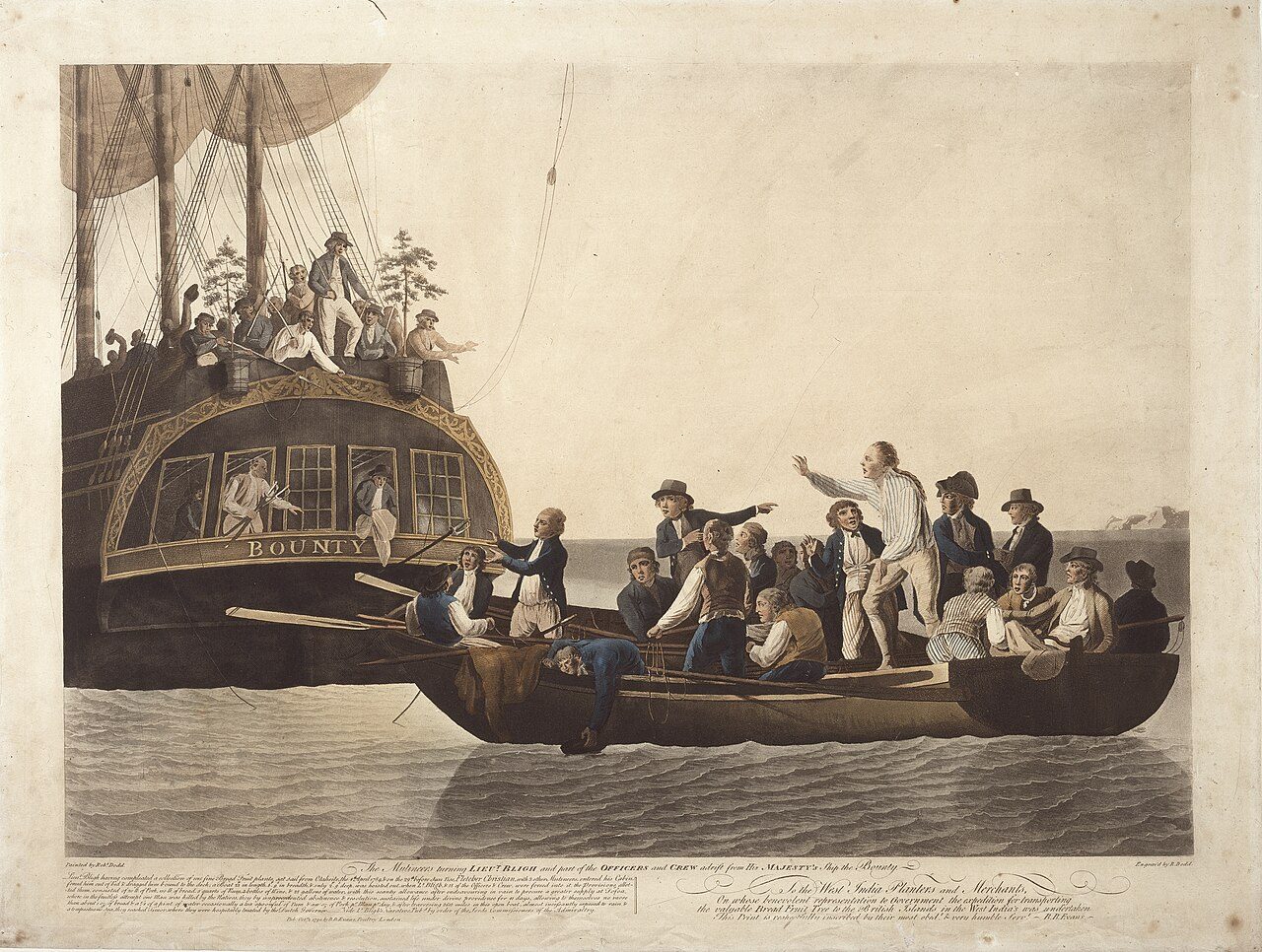
Before dawn on 28 April 1789, in the South Pacific near Tofua, master's mate Fletcher Christian led a mutiny aboard HMS Bounty, seized the ship from Lieutenant William Bligh, and set him and 18 loyal men adrift in an open launch — beginning the most famous mutiny in naval history and one of the greatest survival voyages ever made. April 28 is also the day Mussolini was executed in 1945 and Muhammad Ali refused the draft in 1967.
Choose another date: open the On This Day calendar to browse events, births and deaths for any day of the year.
At a Glance
- The ship
- HMS Bounty, a small armed vessel sent to carry breadfruit plants from Tahiti to the West Indies as cheap food for enslaved plantation workers
- The mutiny
- 28 April 1789, 23 days after leaving Tahiti; Christian and 18 supporters seized the ship without bloodshed
- Cast adrift
- Bligh and 18 loyalists in the Bounty's open launch, 23 feet long, with minimal food, water and no charts
- The voyage
- Bligh navigated the launch some 3,618 nautical miles to Timor in 47 days, losing only one man — a feat still taught as a masterpiece of seamanship
- The mutineers
- Some stayed on Tahiti and were later tried; Christian and eight others, with Tahitian companions, vanished to Pitcairn Island and burned the Bounty
- The verdict
- Bligh was honourably acquitted for the loss of his ship; three captured mutineers were hanged in 1792
Events on this day
- 1789Fletcher Christian leads the mutiny on HMS Bounty and sets Bligh adrift in the Pacific — the featured story above.
- 1818President James Monroe proclaims the naval disarmament of the Great Lakes and Lake Champlain under the Rush–Bagot agreement with Britain.
- 1945Benito Mussolini and his mistress Clara Petacci, captured while fleeing toward Switzerland, are shot by Italian partisans at Lake Como.
- 1946The Tokyo war crimes trial opens proceedings against 28 former Japanese leaders, indicted on 55 counts.
- 1947Thor Heyerdahl and five companions sail from Peru on the balsa raft Kon-Tiki, to prove ancient South Americans could have reached Polynesia by sea.
- 1965U.S. Marines land in the Dominican Republic as civil war erupts; thousands of American troops follow to evacuate foreigners and shape the outcome.
- 1967Heavyweight champion Muhammad Ali refuses induction into the U.S. Army on religious grounds; he is stripped of his title and barred from boxing at his peak.
- 2004CBS's 60 Minutes II broadcasts photographs of prisoner abuse by U.S. guards at Abu Ghraib prison in Iraq, igniting a worldwide scandal.
Born on this day
- 1758James Monroe — fifth president of the United States, whose Monroe Doctrine warned Europe out of the Americas.
- 1878Lionel Barrymore — American actor of stage and screen, patriarch of the Barrymore acting dynasty.
- 1906Kurt Gödel — Austrian-American logician whose incompleteness theorems set limits on mathematics itself.
- 1908Oskar Schindler — German industrialist whose factories sheltered some 1,200 Jews during the Holocaust.
- 1926Harper Lee — American novelist of To Kill a Mockingbird, the defining American novel of conscience.
- 1950Jay Leno — American comedian and long-serving host of The Tonight Show.
Died on this day
- 1945Benito Mussolini — founder of Fascism and Italy's dictator for two decades, shot by partisans at 61 (see Events).
- 1945Clara Petacci — Mussolini's mistress, who refused to leave him and was shot beside him at 33; their bodies were displayed in Milan.
- 1992Francis Bacon — Irish-born British painter of screaming popes and distorted figures, dead in Madrid at 82.
The featured story: the mutiny on the Bounty, 28 April 1789
The Bounty's mission was botanical and brutal: to collect breadfruit saplings in Tahiti and carry them to the Caribbean as cheap food for enslaved people on the sugar plantations. Lieutenant William Bligh — a superb navigator who had sailed with Captain Cook — reached Tahiti in October 1788 and stayed five months while the plants were potted. His men lived ashore, formed attachments, and absorbed an ease utterly unlike naval discipline. When the Bounty sailed on 4 April 1789, laden with a thousand breadfruit plants, it carried a crew half of whom had built a second life they were now ordered to forget.
Relations between Bligh and his master's mate, Fletcher Christian — once his protégé and friend — collapsed in the weeks after departure, in quarrels over coconuts, discipline and blame that both men's accounts magnify. In the early hours of 28 April, near the island of Tofua, Christian and a party of armed men took Bligh from his bunk at bayonet point. Through a chaotic morning — men begging to stay, men begging to go — Bligh and eighteen loyalists were forced over the side into the ship's launch, a 23-foot open boat so laden it floated inches above the water, with a few days' bread and water, a compass and a quadrant, but no charts. Most aboard expected to die.
What Bligh did instead became the other half of the legend. Rationing his men to crumbs and spoonfuls of water, navigating from memory, he sailed the launch 3,618 nautical miles to Timor in 47 days — the greatest open-boat voyage in recorded history — losing only one man, killed by islanders at Tofua. The mutineers, meanwhile, threw the breadfruit overboard and split: most returned to Tahiti, where a Royal Navy ship later arrested them (three were eventually hanged). Christian, with eight mutineers and a group of Tahitian men and women, sailed into the Pacific's blank spaces and found Pitcairn Island — misplaced on the charts, and therefore unfindable — where they burned the Bounty in January 1790.
Pitcairn's colony descended into violence that killed almost all its men, Christian among them; when an American ship found the island in 1808, one mutineer, John Adams, survived with the women and children. Their descendants live on Pitcairn and Norfolk Island today. Bligh was honourably acquitted, promoted, completed the breadfruit mission at the second attempt, survived a second mutiny as governor of New South Wales, and died a vice-admiral. History has argued over the two men ever since — tyrant and driven romantic, or professional and deserter — through novels and three major films. The launch voyage, at least, admits no argument.
Why this date matters
April 28 is a day about authority and its limits. A lieutenant loses his ship to his own crew in 1789; a dictator who boasted of total control ends against a wall in 1945; a champion in 1967 defies his own government and loses his title rather than his conscience; and in 2004 photographs from a prison in Iraq show authority at its most degraded. Between the mutiny and the scandals stands the day's quiet counterweight — Schindler and Lee were both born on it, two very different witnesses to what one person owes another.
Sources
- Encyclopaedia Britannica — On This Day: April 28
- HISTORY — What Happened on April 28
- Royal Museums Greenwich — William Bligh
- HistoryNet — Today in History: April 28
The facts on this page were checked against these sources on 19 November 2026. The History Trail's permanent pages are researched and written for this site; the live profiles elsewhere on The History Trail are assembled automatically from Wikipedia and Wikidata.
About the Author
Researched and written by the The History Trail Editorial Team — the accountable editorial function behind this site's permanent story pages. The team works from the published sources cited on each page; it does not invent historians, reviewers or credentials, and it corrects errors openly.
Fact Check
Every load-bearing fact on this page traces to one of the sources listed above, and significant claims link to their source in the text. Our checking method is described on the methodology page; errors can be reported via the corrections page.
Sources & Citations
Cite this page as: The History Trail Editorial Team, The History Trail — this article's title, publication and update dates are shown beneath its headline. The full source list appears under Sources above; the site's source standards are on the sources page.