
On This Day
April 16 in History
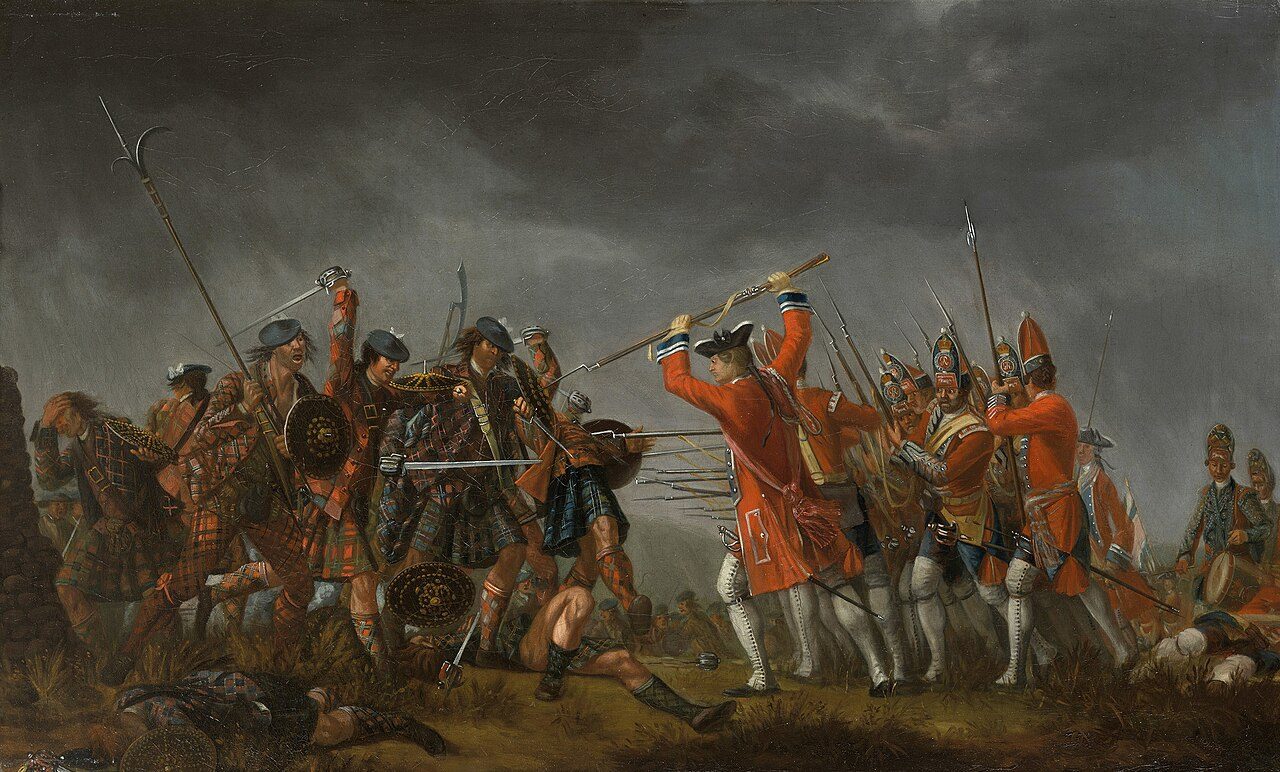
On 16 April 1746, on a moor east of Inverness, the Jacobite army of Charles Edward Stuart was crushed in less than an hour by the government army of the Duke of Cumberland. Culloden ended the rising of 1745, the Stuart cause, and — as the last pitched battle fought on British soil — an era of British history. April 16 is also Charlie Chaplin's birthday and the day Martin Luther King Jr. wrote his Letter from Birmingham Jail.
Choose another date: open the On This Day calendar to browse events, births and deaths for any day of the year.
At a Glance
- The date
- 16 April 1746, on Drummossie Moor near Inverness, Scotland
- The sides
- About 5,000–6,000 Jacobites under Charles Edward Stuart against about 8,000 government troops under the Duke of Cumberland
- The armies' state
- The Jacobites were exhausted and hungry after a failed night march; the government army was rested, fed and well supplied
- The battle
- Artillery fire, one Highland charge broken by disciplined musketry and bayonets; the fighting lasted less than an hour
- The cost
- An estimated 1,500–2,000 Jacobites killed, against about 50 government dead
- The aftermath
- A harsh pacification of the Highlands: disarming, the banning of tartan and the abolition of heritable jurisdictions
Events on this day
- 1746The Jacobite army is destroyed at the Battle of Culloden — the featured story above.
- 1853The first passenger railway in India opens, running from Bombay to Thane.
- 1862President Lincoln signs the act abolishing slavery in the District of Columbia, with compensation to owners.
- 1881Gunfighter Bat Masterson fights his last shootout, in Dodge City, Kansas.
- 1912Harriet Quimby becomes the first woman to fly across the English Channel, piloting from Dover to France.
- 1917Vladimir Lenin returns to Petrograd from exile in a sealed train, to take charge of the Russian Revolution.
- 1945Soviet forces open the Battle of Berlin, the final offensive against the Nazi capital.
- 1947The freighter Grandcamp, loaded with fertiliser, explodes at Texas City, killing nearly 600 people in one of America's worst industrial disasters.
- 1963Martin Luther King Jr., jailed in Birmingham, Alabama, writes his Letter from Birmingham Jail.
- 1972Apollo 16 is launched, the fifth and penultimate crewed landing on the Moon.
- 2007A gunman kills 32 people at Virginia Tech in Blacksburg, Virginia, then himself — at the time the deadliest mass shooting in modern American history.
- 2014The South Korean ferry Sewol capsizes and sinks, killing 304 people, most of them school students.
- 2018Kendrick Lamar wins the Pulitzer Prize for Music, the first popular musician to receive the honour.
Born on this day
- 1867Wilbur Wright — American aviation pioneer who, with his brother Orville, built and flew the first powered aeroplane.
- 1889Charlie Chaplin — English comic actor and filmmaker, creator of the Little Tramp and the defining star of silent cinema.
- 1921Peter Ustinov — English actor, director, playwright and humanitarian, born this day per Britannica's featured biography.
- 1927Joseph Ratzinger, Pope Benedict XVI — German theologian who became pope in 2005 and resigned in 2013.
- 1947Kareem Abdul-Jabbar — American basketball player, the NBA's record scorer for nearly four decades.
Died on this day
- 1828Francisco Goya — Spanish painter of the Black Paintings and The Third of May, dead in exile at Bordeaux at 82.
- 1850Marie Tussaud — French wax modeller who founded the London exhibition that bears her name.
- 1972Yasunari Kawabata — Japanese novelist, the first Japanese winner of the Nobel Prize in Literature.
- 1991David Lean — English director of Lawrence of Arabia and The Bridge on the River Kwai, dead at 83.
The featured story: the Battle of Culloden, 16 April 1746
The rising had begun in romance. In August 1745 Charles Edward Stuart — Bonnie Prince Charlie, the grandson of the exiled James II — raised his father's standard at Glenfinnan with a handful of men, and within weeks held Edinburgh and had routed a government army at Prestonpans. His army marched as far south as Derby, 120 miles from London, before its nerve broke: short of the promised English and French support, the Jacobite council voted to retreat. Through the winter the government concentrated its strength under William Augustus, Duke of Cumberland, the king's son, and on 15 April 1746 the two armies were a few miles apart east of Inverness.
Charles's officers chose the ground badly and then ruined what strength remained. Drummossie Moor was flat, open and firm — perfect for artillery and cavalry, fatal for the Highland charge that was the Jacobites' one great weapon. Worse, on the night of 15 April the Jacobites attempted a surprise march on Cumberland's camp at Nairn, failed to reach it by dawn, and stumbled back exhausted and unfed; many men were asleep or out foraging for food when the battle began. Cumberland's army, by contrast, had rested and celebrated its commander's birthday with extra rations.
The battle, when it came at about one in the afternoon, was decided by preparation. Government cannon opened at long range and tore the Jacobite lines for twenty minutes before Charles gave the order to charge. The Highlanders who reached the government line — mainly on the right — met a bayonet drill redesigned for exactly them: each soldier thrust not at the man in front but at the one to his right, under the raised sword arm. The charge broke. Government cavalry swept around the flanks, and in less than an hour the Jacobite army ceased to exist. An estimated 1,500 to 2,000 Jacobites were killed, many of them in the pursuit; government losses were about fifty dead. Wounded Jacobites were killed on the field in the days after, earning Cumberland the name Butcher.
Culloden was the last pitched battle fought in Britain, and London made sure it was the last of its kind. The Highlands were disarmed, tartan and the pipes proscribed, heritable jurisdictions abolished, and roads and forts driven into the glens. Charles escaped to France after five months as a fugitive and died in Rome in 1788, the cause extinguished with him. What the government could not legislate away was the memory: Culloden became, in Scottish remembrance, less a battle than a wound — the violent end of an old world, inflicted in under an hour on a wet moor.
Why this date matters
April 16 is a day on which old orders end in the open. Culloden closed the Jacobite age in an hour; the Battle of Berlin opened in 1945 to close the Third Reich; Lenin arrived back in Russia in 1917 to begin unmaking another empire. Against those endings the day sets beginnings of a different scale: Chaplin and Wilbur Wright are born, King writes a letter from a jail cell that outlasts the jail, and Apollo 16 leaves for the Moon. It is a day that seems to specialise in turning points you can point to on a map or a page.
Sources
- Encyclopaedia Britannica — On This Day: April 16
- HISTORY — What Happened on April 16
- HISTORY — What Happened on April 16
- National Trust for Scotland — Culloden
The facts on this page were checked against these sources on 19 November 2026. The History Trail's permanent pages are researched and written for this site; the live profiles elsewhere on The History Trail are assembled automatically from Wikipedia and Wikidata.
About the Author
Researched and written by the The History Trail Editorial Team — the accountable editorial function behind this site's permanent story pages. The team works from the published sources cited on each page; it does not invent historians, reviewers or credentials, and it corrects errors openly.
Fact Check
Every load-bearing fact on this page traces to one of the sources listed above, and significant claims link to their source in the text. Our checking method is described on the methodology page; errors can be reported via the corrections page.
Sources & Citations
Cite this page as: The History Trail Editorial Team, The History Trail — this article's title, publication and update dates are shown beneath its headline. The full source list appears under Sources above; the site's source standards are on the sources page.