
Things
Consciousness
Consciousness is the one thing each of us knows directly and science explains least completely. Descartes made it the definition of thought, twentieth-century psychology banished it for fifty years, and its return since the 1980s has mapped much of its machinery while leaving its central question, why experience exists at all, openly unsolved.
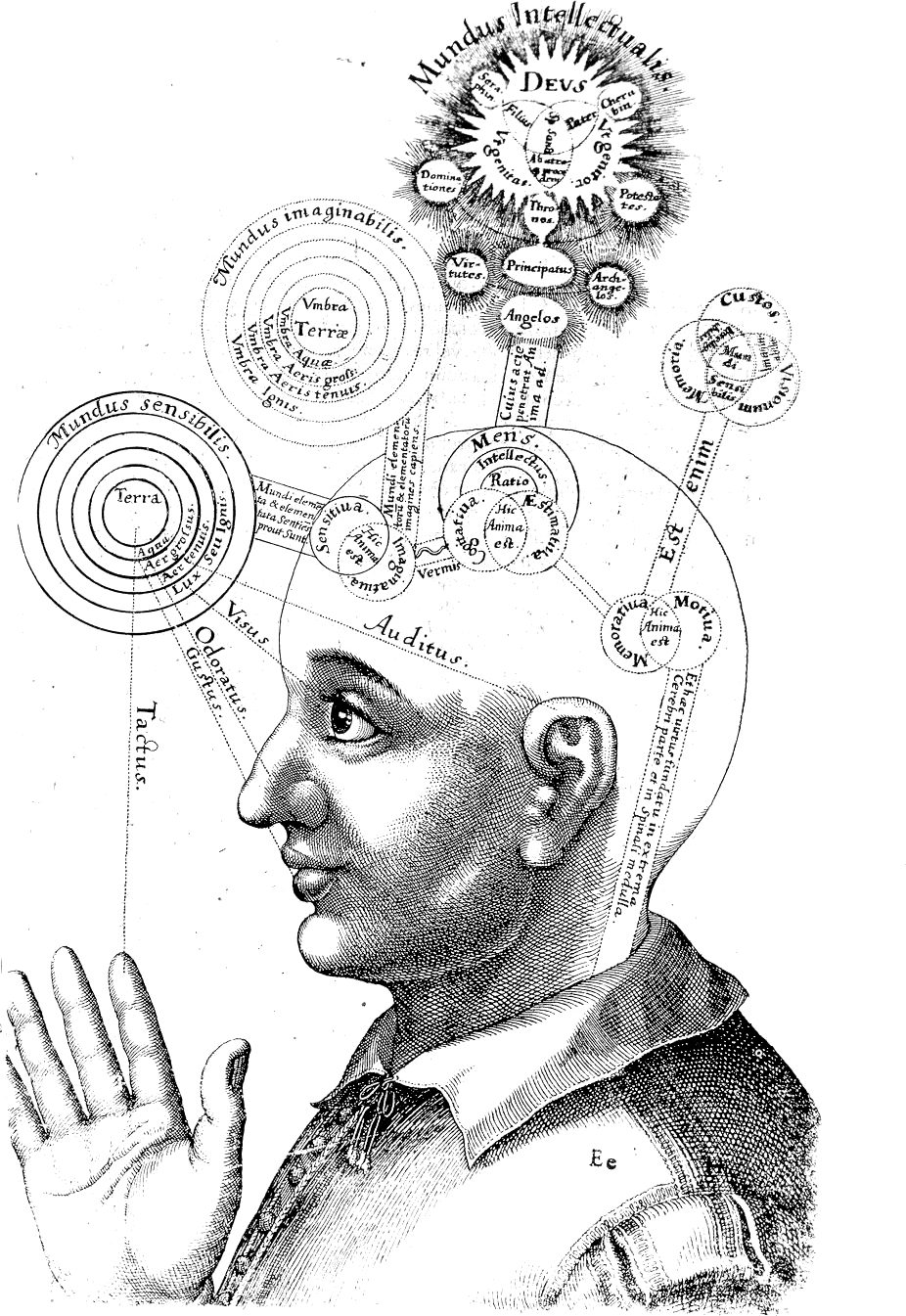
At a Glance
- Core notion
- Phenomenal consciousness: the subjective, what-it-is-like character of experience
- Classic criterion
- Thomas Nagel (1974): a being is conscious if there is something it is like to be it
- The hard problem
- David Chalmers (1995): why physical processing is accompanied by experience at all
- Leading theory 1
- Global workspace theory (Baars, 1988): consciousness as information broadcast widely in the brain
- Leading theory 2
- Integrated information theory (Tononi, 2004): consciousness as integrated information
- Scientific exile
- Behaviourism set consciousness aside in psychology for much of the 20th century
- Status
- Neural correlates increasingly mapped; no consensus solution to the hard problem
Introduction
Consciousness is the fact that there is something it is like to be you: that colours look a way, pains feel a way, and thoughts occur to someone. Philosophers call this phenomenal consciousness, the subjective character of experience, and distinguish it from the mind's more mechanical work, most of which runs entirely without it. You digest, balance and parse grammar unconsciously; the redness of red and the ache of a tooth are the parts that seem to require a witness, and explaining why any physical process should come with a witness at all is the problem this subject is about.
No aspect of the mind is at once more familiar and more puzzling. Every datum anyone has ever had arrived through consciousness, yet science describes the brain in third-person terms that seem to leave the first-person fact out. The history of consciousness as a subject is the history of that gap being named, forgotten under behaviourism, and then, from the 1980s, taken up again by philosophy and neuroscience together, with real progress on the machinery and the central mystery, so far, intact.
Background
The modern framing begins with René Descartes, who in the 1640s defined thought itself in terms of consciousness: by the word thought, he wrote in the Principles of Philosophy, I understand all that of which we are conscious as operating in us. John Locke, later in the seventeenth century, gave a similarly central place to awareness in his Essay Concerning Human Understanding. Through the eighteenth and nineteenth centuries consciousness was widely treated as the defining mark of the mental, and early psychology, in the work of Wilhelm Wundt and William James, studied it directly by trained introspection.
That centrality collapsed in the early twentieth century, especially in the United States, where behaviourism under John B. Watson and later B. F. Skinner rebuilt psychology around observable behaviour and set consciousness aside as unmeasurable, while Gestalt psychologists in Europe kept experience in view. The cognitive revolution of the 1960s restored the mind as a scientific object, but as information processing, which could be studied while bracketing what experience felt like. The bracket held until philosophers forced the question back open.
Timeline
- 1644
René Descartes publishes the Principles of Philosophy, defining thought in terms of consciousness or self-awareness.
- 1689
John Locke's Essay Concerning Human Understanding makes awareness central to his account of mind and personal identity.
- 1890
William James publishes The Principles of Psychology, with its famous account of consciousness as a stream of thought.
- 1913
John B. Watson's behaviourist manifesto redirects psychology toward observable behaviour; consciousness is largely exiled from the science for decades.
- 1974
Thomas Nagel publishes What Is It Like to Be a Bat?, arguing that subjective experience is the core of consciousness and resists purely physical description.
- 1988
Bernard Baars publishes A Cognitive Theory of Consciousness, proposing the global workspace model of how information becomes conscious.
- 1995
David Chalmers sets out the hard problem: distinguishing the easy problems of function from why physical processing is accompanied by experience at all.
- 2004
Giulio Tononi publishes the first statement of integrated information theory, proposing consciousness corresponds to a system's integrated information.
- 2023
Results are reported from an adversarial collaboration testing global workspace and integrated information theories against each other with pre-registered predictions.
Significance
The revival since the 1980s has produced genuine science. Researchers can now track the difference between conscious and unconscious perception in the brain, identify signatures that distinguish wakefulness from anaesthesia and deep sleep, and test theories against each other. Global workspace theories, developed from Baars's model, hold that information becomes conscious when it is broadcast widely across brain systems; integrated information theory, Tononi's rival account, identifies consciousness with a system's capacity to integrate information and assigns it a mathematical measure. The two theories make different predictions, and large adversarial collaborations have been organised precisely to let the data arbitrate.
What this progress has not done is close the question Chalmers named. Explaining how the brain reports, attends and integrates is the programme Chalmers called the easy problems, easy only by contrast; why any of it should feel like something remains, on his formulation, the hard problem, and no consensus exists that it has been solved, or even that all parties agree on what a solution would look like. Positions in the current debate range from physicalist confidence to panpsychism, the view that experience is a fundamental feature of matter, which neuroscientists including Tononi and Christof Koch have explored in a modern form.
Legacy
Consciousness studies is now an established interdisciplinary field, with its own journals, societies and clinical stakes: measuring consciousness in patients who cannot speak, in anaesthesia, and in infancy are live practical problems where theory touches medicine directly. The same questions have acquired a new edge from artificial intelligence, since deciding whether a machine could be conscious requires exactly the criterion the field still lacks.
The subject's legacy inside philosophy is a disciplined mystery. Where Descartes could treat consciousness as the one certainty, the modern field treats it as the best-documented open problem in the science of mind: surrounded by measurements, constrained by experiments, and not yet explained. That combination, total familiarity and total resistance, is why the bat question of 1974 is still the one every new theory has to answer first.
Sources
- Stanford Encyclopedia of Philosophy — Consciousness
- Internet Encyclopedia of Philosophy — Consciousness
- Wikipedia — Consciousness
The facts on this page were checked against these sources on 19 November 2026. The History Trail's permanent pages are researched and written for this site; the live profiles elsewhere on The History Trail are assembled automatically from Wikipedia and Wikidata.
About the Author
Researched and written by the The History Trail Editorial Team — the accountable editorial function behind this site's permanent story pages. The team works from the published sources cited on each page; it does not invent historians, reviewers or credentials, and it corrects errors openly.
Fact Check
Every load-bearing fact on this page traces to one of the sources listed above, and significant claims link to their source in the text. Our checking method is described on the methodology page; errors can be reported via the corrections page.
Sources & Citations
Cite this page as: The History Trail Editorial Team, The History Trail — this article's title, publication and update dates are shown beneath its headline. The full source list appears under Sources above; the site's source standards are on the sources page.