
Vehicles
Concorde — faster than the turning Earth
Concorde carried passengers at twice the speed of sound, crossing the Atlantic in under four hours, for 27 years. No airliner before or since has matched it in scheduled service — and none has replaced it.
At a Glance
- First flight
- 2 March 1969, from Toulouse, France
- Makers
- British Aircraft Corporation and Sud Aviation (later Aérospatiale), United Kingdom and France
- Entered service
- 21 January 1976, with British Airways and Air France
- Maximum cruise
- Mach 2.04 — 2,179 km/h (1,354 mph)
- Passengers
- Up to about 100 in airline service
- Built
- 20 aircraft, of which 14 entered airline service
- Retired
- 2003 — Air France in May, British Airways in October
Mach 2 With Passengers
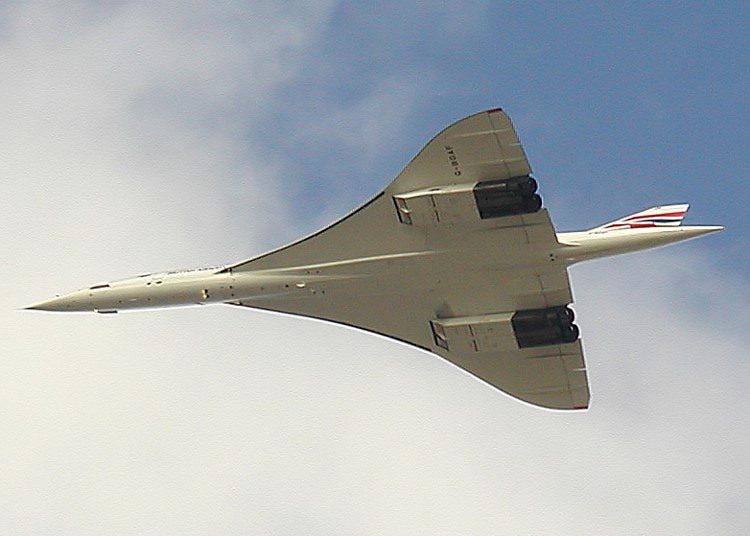
Concorde was an airliner built around a single, extravagant promise: speed. Its slender delta wing, needle nose and four Olympus engines let it cruise at Mach 2.04, more than twice the speed of sound, at heights where passengers could see the curvature of the Earth. A London to New York journey that took other jets the better part of a working day took Concorde about three hours.
The Smithsonian's National Air and Space Museum, which preserves an Air France Concorde, calls it a stunning technological achievement that could not overcome serious economic problems. Both halves of that judgement matter. Concorde worked, reliably and for decades — but it worked for very few passengers, at very high fares, on very few routes.
Only 20 aircraft were ever built, and just 14 entered service, all with British Airways and Air France. When the fleets retired in 2003, scheduled supersonic passenger flight ended with them, and it has not returned.
Two Nations, One Treaty, 1962
Concorde began as two national projects that became one. Through the 1950s Britain and France each studied supersonic airliners, and on 29 November 1962 the two governments signed a treaty to share the cost and the risk of building one together. Britannica describes it as the first major cooperative venture of European countries to design and build an aircraft — a rehearsal, in many ways, for the Airbus partnership that followed.
The airframe was shared between the British Aircraft Corporation and France's Sud Aviation, later Aérospatiale, while the Olympus 593 engines were developed jointly by Rolls-Royce and SNECMA. Almost every part of the aeroplane demanded new thinking: a droop nose that lowered for landing so the crew could see the runway, fuel that was pumped between tanks in flight to trim the aircraft, and the first analogue fly-by-wire controls fitted to an airliner.
Development costs grew far beyond the original estimates and were never recovered. The 1973 oil crisis made airlines wary of a thirsty aircraft, and bans on supersonic flight over land, imposed because of the sonic boom, confined Concorde largely to ocean crossings. Orders from other airlines melted away, leaving the two state carriers to take the aircraft they had helped create.
Timeline
- 29 November 1962
Britain and France sign the treaty to develop a supersonic transport together, sharing costs and risks.
- 2 March 1969
The first prototype, 001, makes Concorde's maiden flight from Toulouse, piloted by André Turcat.
- 26 September 1973
Concorde makes its first transatlantic crossing, demonstrating the ocean routes it was built for.
- 21 January 1976
Scheduled supersonic passenger service begins: British Airways flies London to Bahrain and Air France flies Paris to Rio de Janeiro on the same day.
- November 1977
Regular Concorde services to New York begin, establishing the flagship transatlantic route.
- 7 February 1996
A British Airways Concorde flies New York to London in 2 hours, 52 minutes and 59 seconds, the fastest transatlantic crossing by an airliner.
- 25 July 2000
Air France Flight 4590 crashes shortly after take-off from Paris, killing all 109 people on board and four on the ground. The fleets are grounded and modified before returning to service in 2001.
- 31 May 2003
Air France ends its Concorde operations.
- 24 October 2003
British Airways operates its final commercial Concorde flight, from New York to London.
- 26 November 2003
Concorde G-BOAF flies from Heathrow to Filton, Bristol — the last flight of any Concorde.
A Routine Supersonic Service — With a Rival
Concorde proved that a supersonic airliner could be built, certified and operated safely as a routine — if exclusive — public service for more than a quarter of a century. It carried heads of state, film stars and business travellers who treated breakfast in London and lunch in New York as a single day's work, and it became a national symbol in both Britain and France, cheered by crowds wherever it appeared. Concorde was not the only supersonic airliner: the Soviet Tu-144 also carried fare-paying passengers, from 1977, but its passenger service lasted only months. Concorde's distinction is not uniqueness but endurance — a routine supersonic service sustained for more than a quarter of a century.
Its deeper significance is industrial. The programme taught two countries to design, build and support one aircraft across a border, with shared engines, shared production lines and shared risk. The Science Museum has noted the fork in the road Concorde represented: in the 1960s aviation could chase speed or capacity. It tried both; the wide-body jets won the market, but Concorde won the imagination.
Museums Full, Skies Slower
Eighteen of the 20 Concordes survive in museums in Europe and North America, an unusually complete preservation for an airliner, and they remain among the most visited exhibits wherever they stand. The fleet's retirement left a strange gap in aviation: for the first time in the jet age, the fastest way for a passenger to cross an ocean became slower, and it remains slower today.
New supersonic projects are periodically announced, promising quieter booms and better economics. None has yet carried a paying passenger. Concorde's legacy is therefore double-edged — a triumph of engineering that still defines what speed in the sky looked like, and a standing warning that a machine can be magnificent and still not add up.
Sources
- Smithsonian National Air and Space Museum — Concorde, Fox Alpha, Air France
- Science Museum Blog — Concorde's legacy
- Encyclopaedia Britannica — Concorde
- Smithsonian Magazine — Au Revoir, Concorde
- Wikipedia — Concorde (corroboration)
The facts on this page were checked against these sources on 18 November 2026. The History Trail's permanent pages are researched and written for this site; the live profiles elsewhere on The History Trail are assembled automatically from Wikipedia and Wikidata.
About the Author
Researched and written by the The History Trail Editorial Team — the accountable editorial function behind this site's permanent story pages. The team works from the published sources cited on each page; it does not invent historians, reviewers or credentials, and it corrects errors openly.
Fact Check
Every load-bearing fact on this page traces to one of the sources listed above, and significant claims link to their source in the text. Our checking method is described on the methodology page; errors can be reported via the corrections page.
Sources & Citations
Cite this page as: The History Trail Editorial Team, The History Trail — this article's title, publication and update dates are shown beneath its headline. The full source list appears under Sources above; the site's source standards are on the sources page.