
Things
Don Quixote
Don Quixote is Miguel de Cervantes' two-part novel (1605 and 1615) about an ageing Spanish gentleman who reads too many romances of chivalry, renames himself a knight and rides out to revive a world that no longer exists. Conceived as a parody, it became what scholars standardly call the prototype — often simply the first — modern novel.
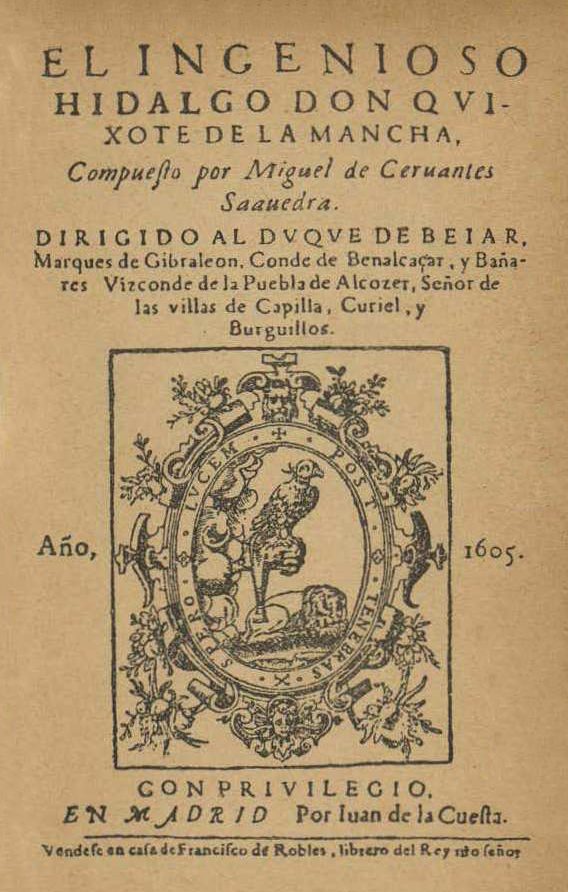
At a Glance
- Author
- Miguel de Cervantes (1547–1616)
- Published
- Part I, Madrid, 1605; Part II, 1615
- Original title
- El ingenioso hidalgo don Quijote de la Mancha
- Hero and squire
- Don Quixote (Alonso Quijano) and Sancho Panza
- First English translation
- Thomas Shelton, Part I in 1612
- The fake sequel
- Avellaneda's spurious Part II, 1614
Introduction
Don Quixote answers its own question in its first pages: what happens when a man believes the books he reads? Alonso Quijano, a minor gentleman of La Mancha, consumes so many romances of chivalry that he loses his grip on reality, polishes an ancestor's armour, names his thin horse Rocinante, chooses a peasant girl he has barely seen as his lady Dulcinea, and rides out as Don Quixote to right wrongs. The inns he takes for castles and the windmills he charges as giants are the most famous jokes in European literature.
Cervantes published the first part in Madrid in 1605, and it was an immediate success, translated into English by Thomas Shelton as early as 1612. Ten years later came the second part — written partly in answer to a rival's fake sequel — in which the knight and his squire Sancho Panza meet people who have read Part I. That self-awareness, layered over comedy, cruelty and genuine pathos, is why the book is standardly described as the prototype of the modern novel.
Background
Cervantes came to the book late and battered. He had fought at the Battle of Lepanto in 1571, where he was wounded, and spent five years as a captive in Algiers before returning to Spain, where he worked at unglamorous jobs including tax collecting. He sold the rights to Part I to the publisher Francisco de Robles for an unknown sum; the book was printed by Juan de la Cuesta in Madrid and appeared in January 1605. Its success made Cervantes famous across Europe, but the sale of the rights meant he made little further money from it.
His target was a genre, not just a man. Romances of chivalry — tales of giants, enchantments and perfect knights — had been in vogue for a century, and Cervantes set out, as Britannica puts it, with a work 'originally conceived as a parody' of them. The parody outgrew its purpose: Quixote's madness is funny, but the innkeepers, goatherds, convicts and dukes he meets are drawn from real Spanish life, and Sancho, promised the governorship of an island, answers fantasy with proverbs, appetite and shrewd common sense.
Timeline
- 1571
Cervantes is wounded fighting at the Battle of Lepanto, an experience he later called the most glorious occasion past ages had seen.
- 1575–1580
Captured by Barbary corsairs, Cervantes spends five years as a captive in Algiers, repeatedly attempting escape.
- January 1605
Part I of Don Quixote is published in Madrid by Juan de la Cuesta for the bookseller Francisco de Robles.
- 1612
Thomas Shelton's English translation of Part I appears — the first of very many translations.
- 1613
Cervantes publishes his Exemplary Novels and promises a second part of Don Quixote.
- 1614
A spurious sequel appears in Tarragona under the name Alonso Fernández de Avellaneda, insulting Cervantes in its prologue.
- 1615
Cervantes' own Part II is published in Madrid, answering the fake sequel inside the fiction itself.
- 1616
Cervantes dies in Madrid, a year after completing the genuine Quixote.
- 1620
Shelton's English translation of Part II completes the novel for English readers.
Significance
What makes the book 'modern' is its machinery. Cervantes pretends the story is translated from an Arabic manuscript by one Cide Hamete Benengeli, interrupts it, doubts it and comments on it, so the novel is about storytelling itself. In Part II the device completes itself: Quixote and Sancho are celebrities, recognised by readers of Part I, and their adventures are staged by people who know the script. Fiction about fiction, written in 1615, is the direct ancestor of techniques novelists still use.
The range of voices matters as much. Britannica notes that Cervantes 'gave voice to a dazzling assortment of characters with diverse beliefs and perspectives', mixing high and low speech, argument and farce. Quixote and Sancho also change each other across two long books — the squire grows wiser, the knight sadder — and that slow mutual education, rather than the windmills, is the achievement later novelists from Fielding and Smollett onward learned from. The word 'quixotic' entered English as the permanent receipt.
Legacy
Don Quixote has been translated more widely than almost any secular book, adapted for stage, opera, ballet and film, and illustrated by artists including Gustave Doré, whose engravings fixed the knight's gaunt silhouette in the world's imagination. The Biblioteca Nacional de España's interactive edition of the 1605 first edition is one sign of its continuing status as Spain's national book. Its pairing of an idealist and a pragmatist, locked in argument across a whole country, became a reusable engine for fiction.
Cervantes died in 1616 having made little money from the most influential novel ever written in Spanish. The reputation came anyway, and it has not receded: writers and critics continue to treat the book as the point where prose fiction learned to doubt itself, laugh at itself and contain a whole society at once. Every unreliable narrator and every hero who has read too much descends from the knight of La Mancha.
Sources
- Encyclopaedia Britannica — Don Quixote
- Encyclopaedia Britannica — Miguel de Cervantes: Publication of Don Quixote
- The Rosenbach Museum & Library — Collecting Cervantes
- Wikipedia — Don Quixote
The facts on this page were checked against these sources on 19 November 2026. The History Trail's permanent pages are researched and written for this site; the live profiles elsewhere on The History Trail are assembled automatically from Wikipedia and Wikidata.
About the Author
Researched and written by the The History Trail Editorial Team — the accountable editorial function behind this site's permanent story pages. The team works from the published sources cited on each page; it does not invent historians, reviewers or credentials, and it corrects errors openly.
Fact Check
Every load-bearing fact on this page traces to one of the sources listed above, and significant claims link to their source in the text. Our checking method is described on the methodology page; errors can be reported via the corrections page.
Sources & Citations
Cite this page as: The History Trail Editorial Team, The History Trail — this article's title, publication and update dates are shown beneath its headline. The full source list appears under Sources above; the site's source standards are on the sources page.