
Things
Hamlet
Hamlet is William Shakespeare's tragedy of a Danish prince ordered by his father's ghost to avenge a murder — and it answers the question of why he delays with four centuries of argument. Written about 1600, it is Shakespeare's longest play, the source of 'To be, or not to be', and a text that survives in three strikingly different early versions.
At a Glance
- Author
- William Shakespeare
- Written
- About 1599–1601
- Setting
- Elsinore, Denmark
- Form
- Tragedy in five acts; a revenge tragedy
- Early texts
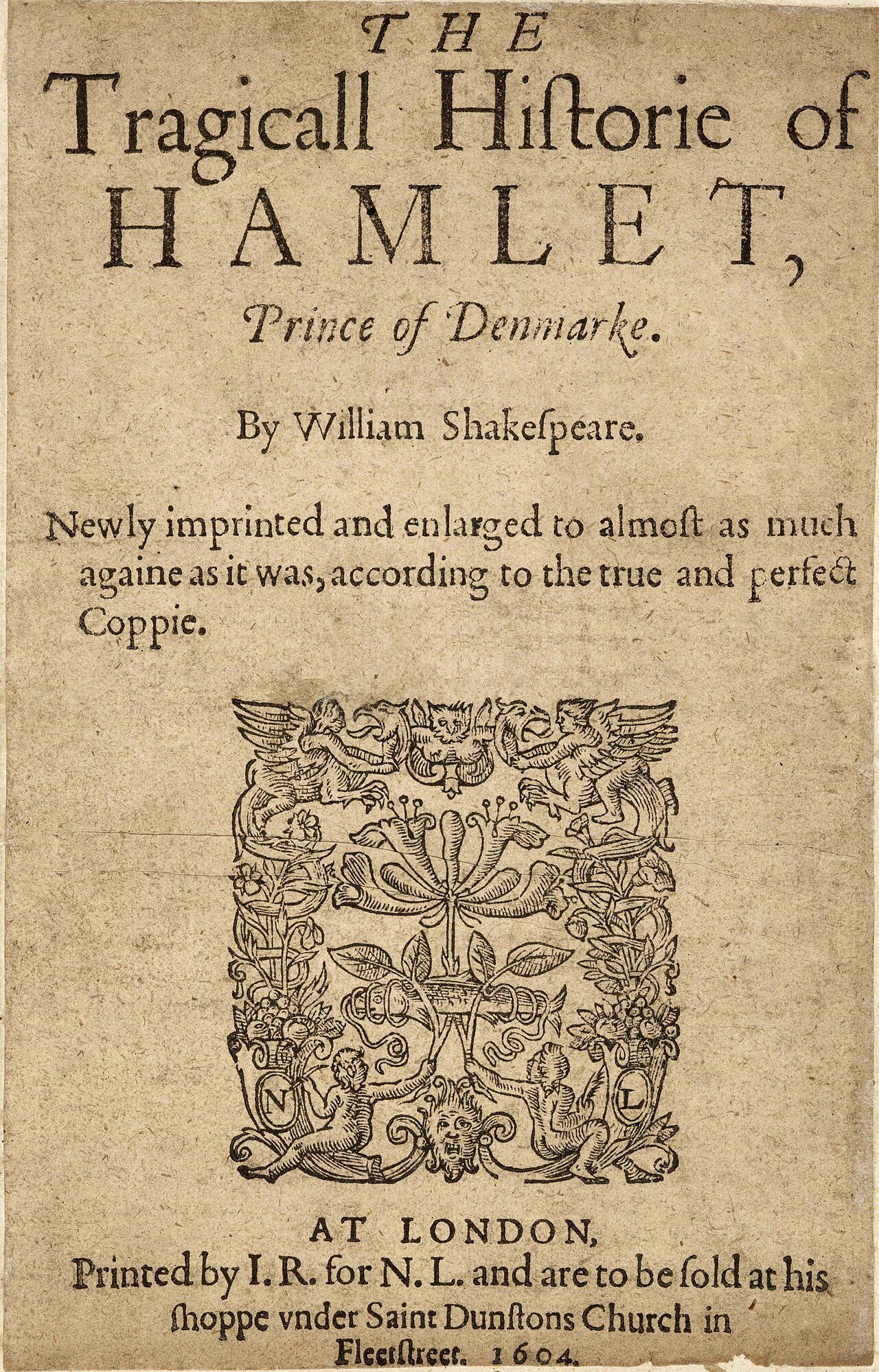
- First Quarto (1603), Second Quarto (1604), First Folio (1623)
- Principal source
- Saxo Grammaticus's Amleth legend, via Belleforest
- Famous line
- 'To be, or not to be' (Act 3, Scene 1)
Introduction
Hamlet is a tragedy by William Shakespeare, written about 1599–1601, in which Prince Hamlet of Denmark learns from his father's ghost that the old king was murdered by his brother Claudius, who now sits on the throne and has married Hamlet's mother, Gertrude. Ordered to take revenge, Hamlet instead hesitates, tests, feigns madness and thinks — and that hesitation, stretched across Shakespeare's longest play, is exactly why the work still dominates stages and classrooms.
The play follows the shape of a revenge tragedy, a popular Elizabethan form with a ghost, a villain and a final bloodbath. What Shakespeare did inside that shape was different: he gave his revenger a mind that questions every step, including whether the ghost can be trusted and whether killing Claudius at prayer would send the villain to heaven. The result is a thriller that keeps stopping to ask what action, memory and death itself mean.
Origins
The story is much older than Shakespeare. Its root is the legend of Amleth, preserved in Books III and IV of the Gesta Danorum, the 12th-century history of the Danes by Saxo Grammaticus. In Saxo's version the prince feigns madness after his father is killed by his uncle, who marries the widow — the skeleton of the plot Shakespeare inherited. The tale reached Elizabethan England largely through François de Belleforest's Histoires tragiques of 1570, a free French retelling of Saxo.
Shakespeare was probably not even the first English dramatist to stage it. References from 1589 onward point to an earlier, now lost play on Hamlet, conventionally called the Ur-Hamlet, with Thomas Kyd, author of The Spanish Tragedy, often conjectured as its writer. No copy survives, so its exact relationship to Shakespeare's play cannot be proved. What is certain is that Shakespeare reworked familiar material — a known story, a known genre, possibly a known earlier play — into something audiences are still arguing about.
Timeline
- c. 1200
Saxo Grammaticus records the legend of Amleth in his Gesta Danorum, the earliest surviving form of the Hamlet story.
- 1570
François de Belleforest retells Saxo's story in volume 5 of his Histoires tragiques, the version most likely to have reached Shakespeare.
- 1589
Thomas Nashe's writing contains a reference usually read as pointing to an earlier Hamlet play — the lost work scholars call the Ur-Hamlet.
- c. 1600–01
Shakespeare's Hamlet is performed by the Lord Chamberlain's Men, probably at the Globe Theatre in London.
- 1602
A Hamlet play 'as it was lately acted by the Lord Chamberlain his servants' is entered in the Stationers' Register.
- 1603
The First Quarto (Q1) is published — a short, unauthorised text, very different from the version read today.
- 1604
The Second Quarto (Q2) appears, based on Shakespeare's own papers and the basis of most modern editions.
- 1623
The First Folio (F1) prints Hamlet again, with passages Q2 lacks and lacking some that Q2 has.
- 1823
A copy of the forgotten First Quarto is discovered, reopening the question of how the three early texts relate.
Significance
Hamlet's central soliloquies — above all 'To be, or not to be', in which the prince weighs life against death and action against endurance — turned a revenge plot into an exploration of consciousness. Britannica calls the play 'often considered the greatest drama of all time', and its hero became the model of the thinking protagonist: a character whose inner life, not his sword arm, drives the story. Generations of critics have read him as melancholic, as a philosopher, as a procrastinator and as a man paralysed by a corrupt court, and the text supports each reading uncomfortably well.
The play also changed what English drama could carry. Its mixture of high philosophy and low comedy, its play within the play — Hamlet stages a re-enactment of the murder to catch Claudius's conscience — and its sheer scale, more than 4,000 lines in the longest texts, stretched the commercial theatre of its day. Phrases from it passed into everyday English, and its structure echoes through later literature, from Goethe to modern film and fiction.
Myths and disputes
The three-text problem is real, and it is not a myth. Q1 (1603) is roughly half the length of Q2, renames Polonius as Corambis, and places 'To be, or not to be' much earlier. Q2 (1604) is the longest text and claims on its title page to be 'enlarged to almost as much again as it was'. F1 (1623) drops some 200 lines found in Q2 but adds others. Editors must therefore choose, combine or present parallel texts — there is no single original Hamlet to recover.
How Q1 came to exist is genuinely disputed. The traditional 'bad quarto' theory holds that it was reconstructed from memory, perhaps by an actor. Others argue it preserves an early draft, or a version cut for touring. Scholarly consensus does not exist, and honest editions say so. The same caution applies to the Ur-Hamlet: it is a well-evidenced inference from contemporary references, not a surviving play, and Kyd's authorship remains conjecture.
Legacy
Hamlet has never left the repertoire. It has been performed in countless translations and settings, filmed repeatedly — Laurence Olivier's 1948 film is among the most famous screen versions — and reimagined in novels, operas and animations. Sarah Bernhardt, whose portrait illustrates many editions, was among the celebrated stage Hamlets of the 19th century, a reminder that the role has long attracted actors who want to test themselves against it.
Its endurance is not only theatrical. Hamlet gave the language a vocabulary for hesitation and grief, and gave later writers a template for the self-divided hero. Four centuries after a Danish legend passed through a lost play and three quarrelling printed texts, the prince who could not stop thinking remains the character world literature thinks with.
Sources
- Encyclopaedia Britannica — Hamlet
- Cambridge University Press — The Cambridge Introduction to Shakespeare's Tragedies: Hamlet
- National Endowment for the Humanities — Shakespeare Quartos
- Folger Shakespeare Library — Teaching Hamlet at the Folger
- Wikipedia — Hamlet
The facts on this page were checked against these sources on 19 November 2026. The History Trail's permanent pages are researched and written for this site; the live profiles elsewhere on The History Trail are assembled automatically from Wikipedia and Wikidata.
About the Author
Researched and written by the The History Trail Editorial Team — the accountable editorial function behind this site's permanent story pages. The team works from the published sources cited on each page; it does not invent historians, reviewers or credentials, and it corrects errors openly.
Fact Check
Every load-bearing fact on this page traces to one of the sources listed above, and significant claims link to their source in the text. Our checking method is described on the methodology page; errors can be reported via the corrections page.
Sources & Citations
Cite this page as: The History Trail Editorial Team, The History Trail — this article's title, publication and update dates are shown beneath its headline. The full source list appears under Sources above; the site's source standards are on the sources page.