
Things
Renminbi
The renminbi — literally 'the people's currency' — was issued on 1 December 1948, ten months before the People's Republic of China itself was proclaimed. Created to replace the chaos of competing wartime currencies, it unified a continent-sized economy under one money, and in 2016 took its place in the IMF's basket of world reserve currencies.
At a Glance
- Introduced
- 1 December 1948
- Country
- People's Republic of China
- ISO code
- CNY
- Unit
- The yuan, divided into jiao and fen
- Issued by
- People's Bank of China
- Name means
- 'The people's currency'
- Banknote series
- Five series issued since 1948
- Reserve status
- Fifth currency in the IMF's SDR basket, from 1 October 2016
Introduction
The renminbi was born before the state it serves. In the closing phase of the Chinese Civil War, the areas under Communist control each circulated their own currencies, alongside the collapsing money of the Nationalist government and a residue of foreign and silver currencies that had haunted Chinese markets for a century. On 1 December 1948, in Shijiazhuang, Hebei Province, three regional banks were consolidated into a new institution, the People's Bank of China — and on the same day it put the renminbi into circulation as legal tender.
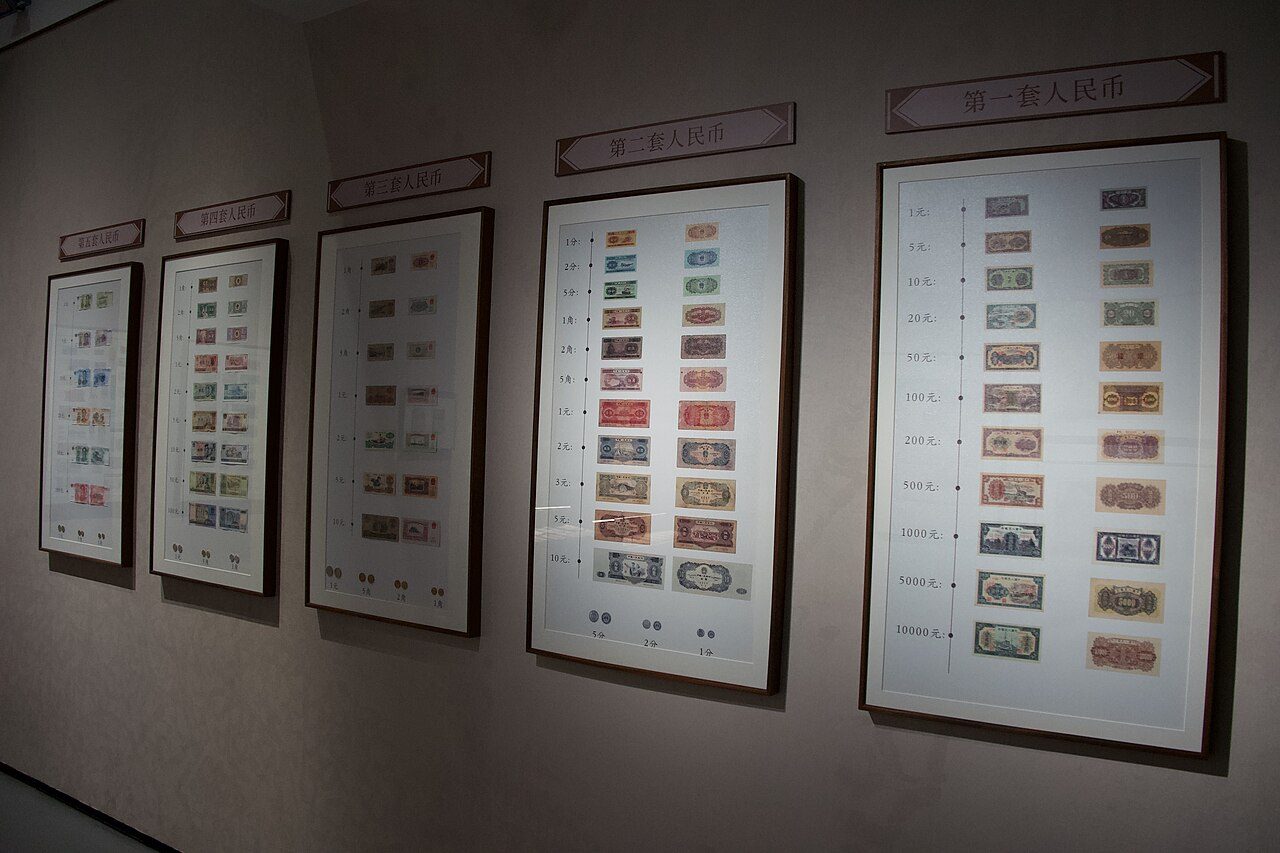
The name was the programme: renminbi means 'the people's currency', and its basic unit is the yuan, divided into jiao and fen. The first series was paper only, issued in a profusion of denominations and designs — twelve denominations in dozens of variants — because its first job was not elegance but replacement: to give the liberated areas one money, end the inflation that had destroyed the old regime's currency, and make a single market possible. By the end of 1951 the renminbi was the only legal currency across mainland China.
Background
For its first three decades the renminbi operated inside a planned economy, where the People's Bank was both central bank and the country's mono-bank — managing currency circulation, providing credit and implementing the economic plan. Prices and the exchange rate were set administratively, and the currency's second series, issued from 1 March 1955, performed the classic tidying operation: one new yuan exchanged for 10,000 old, wiping four zeros of wartime inflation from the nation's price tags in a single conversion.
Reform changed the currency's job. From January 1979 the banking system began to diversify, and on 1 January 1984 the People's Bank began functioning purely as a central bank; in 1995 its status was confirmed in law. As China's trade grew, the renminbi was drawn steadily outward — first as the money foreign visitors and traders had to reckon with, then, in the twenty-first century, as a currency the rest of the world began to hold. Its fifth series of banknotes, introduced in 1999, gave the unified currency a unified face.
Timeline
- 1 December 1948
The People's Bank of China is established in Shijiazhuang from three regional banks, and the renminbi is put into circulation the same day.
- June 1949
The new money takes the name renminbi — 'the people's currency' — as the standard name for the unified issue.
- End of 1951
The renminbi becomes the sole legal currency across mainland China, replacing the patchwork of regional and Nationalist currencies.
- 1 March 1955
The second series is issued; one new yuan exchanges for 10,000 yuan of the first series, removing the legacy of wartime inflation.
- 1 January 1984
The People's Bank begins to function exclusively as China's central bank, shedding its commercial banking role.
- 18 March 1995
The Law on the People's Bank of China confirms the Bank's central-bank status in legislation, with sole authority to issue the renminbi.
- 1 October 1999
The fifth series of renminbi banknotes begins to be issued, the design family still in use today.
- 1 October 2016
The renminbi enters the IMF's Special Drawing Rights basket as its fifth currency, with a weighting of 10.92 per cent.
- 2019
The People's Bank releases an updated edition of the fifth series of banknotes and coins.
Significance
Domestically, the renminbi's achievement is unification. China had spent more than a century with fragmented money — treaty-port dollars, provincial issues, military notes and hyperinflating national currencies. The 1948 issue ended that fragmentation in under three years, and the currency has never since been replaced or renamed: the same 'people's currency' that paid for reconstruction pays for high-speed rail tickets today, a continuity that underwrites its credibility at home.
Internationally, its significance is the speed of its arrival. When the IMF's executive board voted to admit the renminbi to the Special Drawing Rights basket — the first currency added since the euro, and the first from a developing economy — it certified that the yuan was 'freely usable' in world payments and trade. With a weighting of 10.92 per cent, third behind the dollar and the euro and ahead of the yen and the pound, the renminbi joined a club that had contained only the currencies of the advanced West and Japan.
Legacy
Five series of banknotes trace the country's transformation in miniature: the first series' trains, ships and harvests, printed in dozens of variants; the workers and nationalities of the third; and the single portrait and flowers of the fifth. The People's Bank marked the currency's seventieth anniversary in 2018 with a commemorative issue whose design literally arranges the patterns of all five series in rings, like the growth rings of a tree.
The renminbi's legacy is still being written, in cross-border payment systems, offshore yuan markets and the slow diversification of world reserves. But its founding lesson is already historical: a currency introduced amid civil war to end monetary chaos became, within one lifetime, one of the five currencies in which the world officially keeps its savings. Few monies have travelled further in seventy-five years.
Sources
- People's Bank of China — A Brief History of the People's Bank of China
- People's Bank of China — About the PBC
- People's Bank of China — 70th Anniversary of Renminbi Issuance commemorative issue (2018)
- IMF approves inclusion of China's RMB in SDR basket (Xinhua, via China.org.cn)
- Wikipedia — Renminbi
The facts on this page were checked against these sources on 19 November 2026. The History Trail's permanent pages are researched and written for this site; the live profiles elsewhere on The History Trail are assembled automatically from Wikipedia and Wikidata.
About the Author
Researched and written by the The History Trail Editorial Team — the accountable editorial function behind this site's permanent story pages. The team works from the published sources cited on each page; it does not invent historians, reviewers or credentials, and it corrects errors openly.
Fact Check
Every load-bearing fact on this page traces to one of the sources listed above, and significant claims link to their source in the text. Our checking method is described on the methodology page; errors can be reported via the corrections page.
Sources & Citations
Cite this page as: The History Trail Editorial Team, The History Trail — this article's title, publication and update dates are shown beneath its headline. The full source list appears under Sources above; the site's source standards are on the sources page.