
Things
Santa Claus
Santa Claus was not invented by any one person. He grew from Saint Nicholas, a fourth-century bishop famed for secret gifts, through Dutch Sinterklaas, an 1823 poem, a Civil War cartoonist and Coca-Cola advertising, into the red-suited gift-bringer the whole world now recognises.
At a Glance
- Root figure
- Saint Nicholas, 4th-century bishop of Myra in modern Turkey, famed for secret generosity
- The name
- An American softening of Sinterklaas, the Dutch form of Saint Nicholas, carried to New Amsterdam (now New York)
- The poem
- "A Visit from St. Nicholas" (1823) fixed the sleigh, the eight reindeer, the chimney descent and the "jolly old elf"
- The face
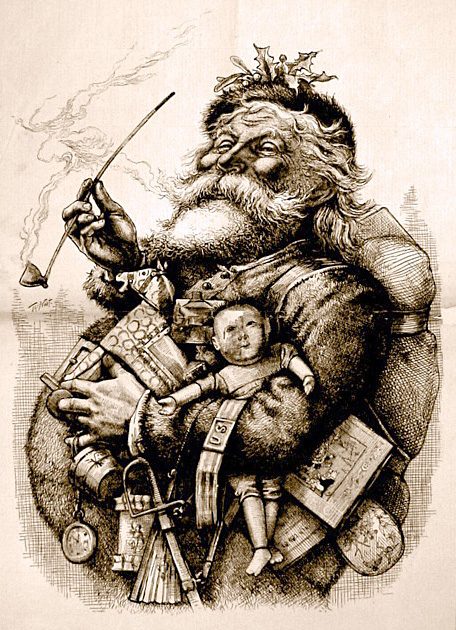
- Thomas Nast's 33 Harper's Weekly drawings (1863-86), above all "Merry Old Santa Claus" (1881)
- The red suit
- Standardised, not invented, by Haddon Sundblom's Coca-Cola paintings from 1931 - red-suited Santas predate Coke by decades
- The ninth reindeer
- Rudolph, created by copywriter Robert L. May for Montgomery Ward in 1939; some 2.4 million booklets were given away that year
- Tracked since
- 1955, when a child's wrong-number call to the CONAD operations centre in Colorado Springs started the NORAD Tracks Santa tradition
Introduction
Every December, one figure appears everywhere: a portly, white-bearded old man in a red suit with white fur trim, who lives at the North Pole, keeps a list of the naughty and the nice, and flies around the world on Christmas Eve behind a team of reindeer. Britannica calls him the traditional patron of Christmas in the United States and many other countries. Yet almost nothing about him is ancient in its present form. His generosity is seventeen centuries old; his sleigh is two hundred years old; his face is younger than the American Civil War; and his most famous reindeer began life as a department-store giveaway.
Santa's history is therefore a story of layers. A real bishop stands at the bottom of it. Dutch settlers carried his legend across the Atlantic. New York writers then rebuilt him for a new nation, a cartoonist gave him a body, advertisers gave that body a uniform, and a military command eventually gave him an annual flight plan.
Origins: A Bishop, a Legend and a Dutch Name
The root figure is Nicholas, bishop of Myra in Lycia, in what is now Turkey, in the fourth century. Almost nothing certain is known of his life, but his reputation for generosity and kindness gave rise to legends of secret help for the poor - above all the story that he gave bags of gold, in secret and by night, as dowries for three girls whom poverty would otherwise have ruined. That one legend explains most of what followed: the night-time visit, the gift that arrives unseen, and the giver who wants no thanks.
Nicholas became one of the most popular saints in Europe, patron of children and sailors among many others, and his feast day, 6 December, became a gift-giving day in its own right. The Dutch kept his cult with particular warmth under the name Sinterklaas - their shortened form of Sint Nikolaas - and Dutch colonists carried the legend to New Amsterdam, now New York City, in the seventeenth century. In English-speaking mouths, Sinterklaas softened into Santa Claus.
America Reinvents Him: Irving, a Poem and a Cartoonist
The American Santa was largely written in New York. In 1809 Washington Irving published his satirical Knickerbocker's History of New York, in which St. Nicholas appears as a jolly Dutch figure who rides over the rooftops in a wagon, smokes a long pipe and drops presents down chimneys. Irving stripped the bishop of his solemnity and made him a folk character - the first draft of the modern Santa.
The decisive text came in December 1823, when the Troy Sentinel published, anonymously, the poem "A Visit from St. Nicholas" - the poem the world now knows by its opening line, "'Twas the Night Before Christmas." It shrank the saint into a "right jolly old elf," gave him a miniature sleigh and eight named flying reindeer, sent him down the chimney with a bundle of toys, and moved his visit from his own feast day to Christmas Eve. The poem is traditionally credited to Clement Clarke Moore, though Henry Livingston Jr.'s family has argued ever since that Livingston wrote it.
Forty years later the cartoonist Thomas Nast gave the poem's elf a body. Nast, a Bavarian immigrant working for Harper's Weekly, first drew Santa in January 1863, in the middle of the Civil War, distributing presents in a Union army camp in a jacket of stars and striped trousers - Santa as Union propaganda. He drew him 33 times by 1886, building the round belly, the beard and the workshop world of the modern figure. His "Merry Old Santa Claus" of 1 January 1881 is the portrait that fixed the image: a life-sized, rosy grandfather in red, laden with toys.
Timeline
- 4th century
Nicholas, bishop of Myra in modern Turkey, wins a reputation for secret generosity; legends of his gifts to the poor spread after his death.
- 6 December
Nicholas's feast day becomes a gift-giving occasion for children across much of Europe.
- 17th century
Dutch colonists carry Sinterklaas to New Amsterdam (now New York City), where the name softens into Santa Claus.
- 1809
Washington Irving's Knickerbocker's History of New York recasts St. Nicholas as a jolly Dutchman who flies over rooftops and drops gifts down chimneys.
- 1823
"A Visit from St. Nicholas" is published anonymously in Troy, New York, fixing the sleigh, eight reindeer, chimney descent and Christmas Eve visit.
- January 1863
Thomas Nast draws Santa for Harper's Weekly for the first time, handing out presents in a Union camp during the Civil War.
- 1 January 1881
Nast's "Merry Old Santa Claus" appears in Harper's Weekly - the most famous of his 33 Santa drawings.
- 1931
Haddon Sundblom begins painting Santa for Coca-Cola; his annual advertisements run until 1964 and standardise the image worldwide.
- 1939
Robert L. May creates Rudolph in a giveaway booklet for Montgomery Ward; some 2.4 million copies are handed out.
- 1949
Johnny Marks's song of Rudolph, recorded by Gene Autry, carries the ninth reindeer into permanent folklore.
- 1955
A child's wrong-number call reaches the CONAD operations centre; Col. Harry Shoup answers with Santa's location, starting the tracking tradition.
Significance
Santa matters because he is where several histories meet: a saint's cult, a colonial migration, a young nation's folklore, illustrated magazines, and modern advertising. He also marks a change in Christmas itself. As Christmas moved from a public, rowdy festival into a private, child-centred family occasion, it needed a figure who belonged to the home. Santa - secretive, nocturnal, and interested only in children - fitted the new festival exactly.
The twentieth century added the final layers. In 1939 the Chicago retailer Montgomery Ward asked copywriter Robert L. May to write a free Christmas booklet, and May produced Rudolph, the misfit reindeer whose glowing nose guides the sleigh; Johnny Marks's 1949 song, sung by Gene Autry, made him the ninth and most famous reindeer.
Myths and disputes
Did Coca-Cola invent Santa's red suit? No - and this page corrects the claim plainly because it is the most repeated error in Santa's history. Red-suited Santas predate Coke by decades: Nast's Santas wore red in the nineteenth century, and a cheerful, bearded, red-clad Santa was already common in the 1910s and 1920s. What Coca-Cola did, from 1931, was commission Haddon Sundblom to paint a wholesome, human-sized, rosy-cheeked Santa and then repeat that one consistent image, year after year until 1964, in magazines and on billboards around the world. Coke standardised the suit; it did not create it. The company itself claims only a big role in shaping the jolly character, not his invention.
Who wrote "A Visit from St. Nicholas"? The poem appeared anonymously in 1823 and was later claimed by Clement Clarke Moore, who included it in his own book of poems in 1844. The family of Henry Livingston Jr. maintained that Livingston wrote it years before publication; the argument remains unresolved, and honest accounts credit Moore while noting the dispute.
Even the NORAD story has two tellings. NORAD's own account says a child in 1955, trying to reach Santa, misdialled a number printed in a department-store advertisement and reached the Continental Air Defense Command (CONAD) operations centre in Colorado Springs, where Col. Harry Shoup, the commander on duty, told the child where Santa was. The popular version turns the misdial into a misprint in the advertisement itself. Either way, the tradition continued when NORAD was formed in 1958.
Legacy
Santa's legacy is a single image understood on every continent: the bishop of Myra would not recognise the sleigh, the elves or the North Pole workshop, but he might recognise the transaction - a gift, given in secret, to a child, by someone who asks for nothing back. The figure has proved endlessly adaptable precisely because each age has rebuilt him from the materials at hand: a poem, a cartoon, an advertisement, a radar network.
He also survives as a case study in how traditions are actually made. No committee designed Santa Claus. A legend, a satire, an anonymous poem, a wartime cartoonist, a department store and a soft-drink company each added one layer, and repetition did the rest - until the layers fused into a figure who now feels, to each new generation of children, as if he had always existed.
Sources
- Encyclopaedia Britannica - Santa Claus
- Smithsonian Magazine - A Civil War Cartoonist Created the Modern Image of Santa Claus as Union Propaganda
- HISTORY - Santa Claus: St. Nicholas, Origins & Legend
- NORAD - NORAD Tracks Santa
- Encyclopaedia Britannica - St. Nicholas
The facts on this page were checked against these sources on 19 November 2026. The History Trail's permanent pages are researched and written for this site; the live profiles elsewhere on The History Trail are assembled automatically from Wikipedia and Wikidata.
About the Author
Researched and written by the The History Trail Editorial Team — the accountable editorial function behind this site's permanent story pages. The team works from the published sources cited on each page; it does not invent historians, reviewers or credentials, and it corrects errors openly.
Fact Check
Every load-bearing fact on this page traces to one of the sources listed above, and significant claims link to their source in the text. Our checking method is described on the methodology page; errors can be reported via the corrections page.
Sources & Citations
Cite this page as: The History Trail Editorial Team, The History Trail — this article's title, publication and update dates are shown beneath its headline. The full source list appears under Sources above; the site's source standards are on the sources page.