
Things
Saguaro
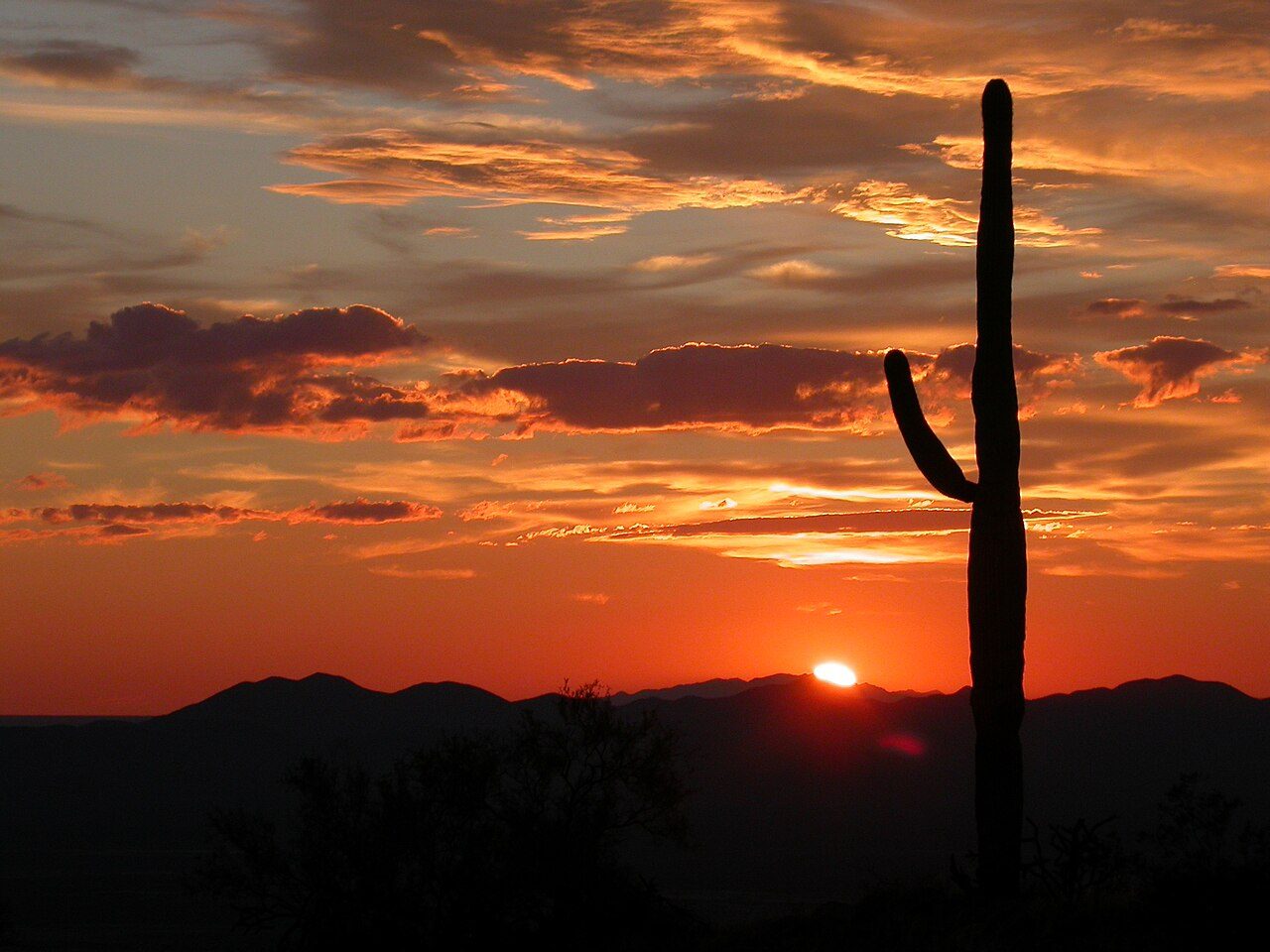
The saguaro, Carnegiea gigantea, is the largest cactus in the United States, growing only in the Sonoran Desert, commonly to 40 feet and living, in the National Park Service's figures, 150 to 175 years. Sacred to the Tohono O'odham, whose fruit harvest and rain ceremony follow its calendar, it is protected by Saguaro National Park, created as a monument in 1933, and by Arizona law on every piece of land in the state.
At a Glance
- Scientific name
- Carnegiea gigantea, the largest cactus in the United States, commonly reaching 40 feet, according to the National Park Service
- Where it grows
- Only the Sonoran Desert of southern Arizona, southeastern California and northwestern Mexico, from sea level to about 4,000 feet
- Growth
- In Saguaro National Park, 1 to 1.5 inches in the first eight years; first flowers at about 35 years; arms normally at 50 to 70 years, up to 100 in drier areas (National Park Service)
- Lifespan
- Adulthood at about 125 years; average lifespan probably 150 to 175 years, some over 200 years (National Park Service)
- The Tohono O'odham
- The saguaro is sacred to the Tohono O'odham, used for ceremony and sustenance; its fruit is made into wine for the Nawait I'i rain ceremony
- The park
- Saguaro National Monument was proclaimed on 1 March 1933; the Tucson Mountain District was added in 1961; Congress made it a national park in 1994
- State protection
- The saguaro blossom is Arizona's state flower, and the Arizona Native Plant Law protects every saguaro, requiring a permit to move or destroy one
Introduction
The saguaro is the largest cactus in the United States and the defining silhouette of the Sonoran Desert. The National Park Service describes the saguaro, Carnegiea gigantea, as commonly reaching 40 feet in height, growing only in the Sonoran Desert of the United States and Mexico, and providing food and shelter for a wide range of desert species. Its pleated column stores water, its arms rise like a candelabrum, and a single old plant may have stood in the same place since before the United States existed.
For the Tohono O'odham the saguaro is not scenery but a relative and provider, harvested for fruit, wine, building ribs and ceremony for centuries. For Arizona it became an emblem so strong that the state protects every wild plant by law. This page traces that relationship: a very slow plant, and the peoples who live by its calendar.
A Plant That Keeps Desert Time
Everything about the saguaro is slow, and the Park Service's figures, gathered in Saguaro National Park, show how slow. A saguaro there grows only about 1 to 1.5 inches in the first eight years of its life, sheltered, if it is lucky, in the shade of a nurse tree. It begins to produce flowers at around 35 years of age. Branches, the famous arms, normally begin to appear at 50 to 70 years of age, and in drier areas may take up to 100 years. The Park Service puts adulthood at about 125 years, the average lifespan at probably 150 to 175 years, and some plants at more than 200 years. At Organ Pipe Cactus National Monument the Service gives a similar scale in different figures: ten years for a seedling to reach one inch, first arms at 70 to 90 years, an average height of 40 feet, and the tallest saguaro ever measured at over 78 feet.
That slowness is a strategy. The saguaro's pleats expand after rain to store water and draw in during drought; its shallow, wide roots catch brief rain before it evaporates; and its thousands of seeds wait for the rare run of wet, mild years in which a seedling can survive. A saguaro forest is therefore a record of past climates: tall, many-armed plants mark ground where conditions were kind more than a century ago.
The Tohono O'odham and the Harvest
Archaeological evidence shows the Hohokam people of the Tucson area used the saguaro in daily life, the Park Service records, and the present-day Tohono O'odham, believed to be descendants of the Hohokam, hold the saguaro sacred, used for both ceremony and sustenance. At Organ Pipe the Service puts the relationship more strongly still: to the Tohono O'odham the saguaros are not plants but a different type of humanity, respected members of the community. The ribs of dead saguaros become building material and the long harvesting poles, called kuipad, with which the ripe fruit is knocked down.
The fruit harvest, in the hottest weeks of early summer, traditionally opens the Tohono O'odham year. Families make the red fruit into jam, syrup and a ceremonial wine ritually consumed during the Nawait I'i rain ceremony, as Arizona's state plant fact sheet records, to call the summer rains on which desert planting depends. The saguaro thus sits at the centre of a calendar, a cuisine and a theology at once.
Timeline
- Centuries before Europeans
The Hohokam of the Tucson area use the saguaro in daily life; their descendants, the Tohono O'odham, continue the harvest and ceremony.
- 1848-1854
The saguaro's core range is divided by the new US-Mexico border after the Mexican-American War and the Gadsden Purchase, while the plants and the O'odham homeland span both sides.
- 1908
The saguaro's scientific name, Carnegiea gigantea, honours the philanthropist Andrew Carnegie, whose institution supported desert research in Tucson.
- 1931
Arizona designates the saguaro blossom as its state flower, according to Arizona state sources.
- 1 March 1933
President Herbert Hoover proclaims Saguaro National Monument east of Tucson, the Park Service records, to protect the giant cactus forest.
- 1961
President John F. Kennedy adds the Tucson Mountain District, west of Tucson, to the monument.
- 1994
Congress elevates Saguaro to national park status; the two districts flank Tucson as Saguaro National Park.
- Today
The Arizona Native Plant Law classifies the saguaro as a highly safeguarded native plant; moving or destroying one without a state permit is unlawful.
Protection: A Park and a Law
Protection came in two forms, a place and a statute. The place began on 1 March 1933, when, in the last days of his presidency, Herbert Hoover proclaimed Saguaro National Monument in the desert east of Tucson, the Park Service's history of the park records. In 1961 President Kennedy added the Tucson Mountain District to the west of the city, and in 1994 Congress made the combined area Saguaro National Park, about 91,000 acres of Sonoran Desert in two districts, created to study, interpret and protect the giant cactus and the desert community around it.
The statute reaches beyond the park. Under the Arizona Native Plant Law, the saguaro is classed as a highly safeguarded protected native plant. It is unlawful to destroy, dig up, collect, cut or move one, even on private land, without a permit, and illegal destruction can be prosecuted as a felony. The severity is written in the plant's timetable: a vandalised 150-year-old saguaro cannot be replaced in any human lifetime.
Significance
The saguaro is a keystone species. Its flowers feed bats, bees and birds in late spring; its fruit ripens in the driest weeks, when little else is available; and its trunk shelters nesting birds, from Gila woodpeckers, which excavate nest holes, to elf owls that move into the holes they leave. The Park Service notes that it provides food and shelter for a variety of desert species, and even a dead saguaro goes on working, its ribs used by people.
Culturally, the saguaro has become the universal sign for the desert Southwest, used far beyond its real, narrow range in films and cartoons set anywhere dry, which makes its fame an invitation to protect the one landscape it actually calls home.
Questions readers ask
How old is a saguaro with arms? Older than it looks, and the honest answer is a range, because growth depends on rainfall, soil and shelter. The Park Service's Saguaro National Park figures put first arms at 50 to 70 years, up to 100 in drier places; its Organ Pipe figures put first arms at 70 to 90 years. A many-armed giant is safely over a century old, and this page attributes every such figure to the Service rather than giving a single number, because the Service itself gives different figures for different places.
Is it really illegal to cut down a saguaro in your own garden in Arizona? Yes, without a permit. The Arizona Native Plant Law protects saguaros on private as well as public land, and landowners who need to move or remove one must obtain a permit from the Arizona Department of Agriculture. The popular claim of a fixed 25-year prison sentence for cutting a saguaro is a myth repeated online; penalties in fact depend on the charge brought, and illegal destruction can be charged as a felony, which is serious enough without the folklore.
Legacy
The saguaro's future is a climate question. Park Service research notes that seedlings establish only in favourable runs of cooler, wetter years, and that the long drought that began in the 1990s and buffelgrass invasion press on a plant whose replacement cycle is measured in centuries. The park's censuses and long-term plots exist because a species this slow cannot be managed without records kept across generations.
Its legacy is secure in two keeping places: the desert east and west of Tucson, where protected forests still rise, and the living culture of the Tohono O'odham, whose families still raise the kuipad poles each summer and make the wine for the rain ceremony, as their ancestors did long before there was a park or a law to protect the plant.
Sources
- National Park Service - Saguaro Cactus: Sentinel of the Southwest
- National Park Service - Saguaro Cactus, Organ Pipe Cactus National Monument
- National Park Service - The Beginning of Saguaro National Park
- National Park Service - Climate Change and Other Factors Influencing the Saguaro Cactus
- Arizona Department of Education - Plant Fact Sheet: Saguaro Cactus
- LegalClarity - Why Is It Illegal to Cut Down a Saguaro Cactus?
The facts on this page were checked against these sources on 19 November 2026. The History Trail's permanent pages are researched and written for this site; the live profiles elsewhere on The History Trail are assembled automatically from Wikipedia and Wikidata.
About the Author
Researched and written by the The History Trail Editorial Team — the accountable editorial function behind this site's permanent story pages. The team works from the published sources cited on each page; it does not invent historians, reviewers or credentials, and it corrects errors openly.
Fact Check
Every load-bearing fact on this page traces to one of the sources listed above, and significant claims link to their source in the text. Our checking method is described on the methodology page; errors can be reported via the corrections page.
Sources & Citations
Cite this page as: The History Trail Editorial Team, The History Trail — this article's title, publication and update dates are shown beneath its headline. The full source list appears under Sources above; the site's source standards are on the sources page.