
Things
Andromeda Galaxy
The Andromeda Galaxy is the farthest thing visible to the naked eye — a trillion-star spiral 2.5 million light-years away. A century ago it was a blurry 'nebula' at the centre of astronomy's Great Debate; one variable star turned it into the proof that the universe is full of galaxies.
At a Glance
- Catalogue names
- Messier 31 (M31), NGC 224
- Type
- Spiral galaxy
- Distance
- About 2.5 million light-years from Earth
- Constellation
- Andromeda
- Apparent magnitude
- 3.1 — visible to the naked eye, best observed in November
- Stars
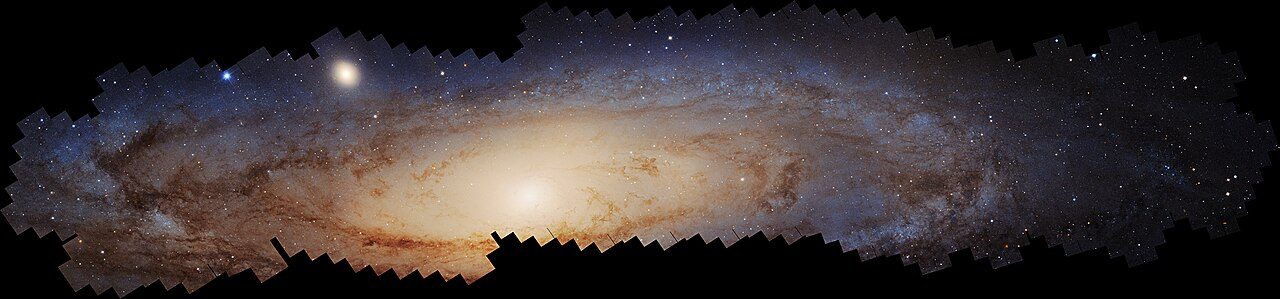
- Estimated at about one trillion; Hubble has resolved some 200 million of them
- Relationship
- The nearest major galaxy to the Milky Way; the two dominate the Local Group
- First known report
- Recorded by Abd al-Rahman al-Sufi in The Book of Fixed Stars, 964
Introduction
On a dark November night, far from city lights, the Andromeda Galaxy is the most distant thing you can see with your unaided eyes: a faint, cigar-shaped smudge in the constellation Andromeda, magnitude 3.1, whose light set out about 2.5 million years ago — before there were humans to see it arrive. It is the nearest major galaxy to our own Milky Way, a spiral of perhaps a trillion stars, and because we cannot step outside our own galaxy to photograph it, Andromeda is the stand-in astronomers use to understand what the Milky Way looks like.
For most of history, nobody knew any of that. Andromeda was catalogued as a nebula — a fuzzy patch among the fixed stars — and as late as 1920 the best astronomers in the world were publicly debating whether it was a small cloud inside our galaxy or an island universe in its own right. The answer, when it came from a single variable star, did not just settle a debate. It multiplied the size of the known universe at a stroke.
Background
The first known report of the object is old: the Persian astronomer Abd al-Rahman al-Sufi recorded it in his Book of Fixed Stars in the year 964. Charles Messier later catalogued it as the 31st entry in his list of fuzzy objects — M31 — and through the nineteenth century it was photographed, admired and argued over as the 'Andromeda Nebula', its spiral form clear in images but its nature unknown. Everything turned on distance, and distance was exactly what nobody could measure.
The argument peaked on 26 April 1920 in the 'Great Debate' at the Smithsonian in Washington, where Harlow Shapley defended a vast Milky Way containing the nebulae, and Heber Curtis argued for 'island universes' — spiral nebulae as galaxies in themselves. Both men were partly right and partly wrong, and the debate ended in a draw. What it needed was not rhetoric but a measuring rod, and one already existed: Cepheid variable stars, whose pulsing period reveals their true brightness, and therefore their distance — if anyone could find one in Andromeda.
Timeline
- 964
Persian astronomer Abd al-Rahman al-Sufi records the object in The Book of Fixed Stars — the first known report of the Andromeda Galaxy.
- 18th century
Charles Messier catalogues the fuzzy patch as M31, the 31st object in his list of comet-like smudges.
- 26 April 1920
The 'Great Debate': Shapley and Curtis argue at the Smithsonian over whether spiral nebulae lie inside the Milky Way or are island universes beyond it.
- October 1923
Edwin Hubble, using the 100-inch Hooker telescope at Mount Wilson, identifies a Cepheid variable star — V1 — in Andromeda.
- 1 January 1925
Hubble's distance result is formally presented: Andromeda lies far beyond the Milky Way. The universe is suddenly full of galaxies.
- 2011
The Hubble Space Telescope is trained on V1 again — the single star that changed the size of the universe.
- January 2015
The Panchromatic Hubble Andromeda Treasury releases the sharpest large mosaic ever made of the galaxy, from hundreds of hours of exposures.
- 2025
Hubble's completed survey of Andromeda — more than 1,000 orbits over more than a decade — resolves some 200 million of its stars.
Significance
Andromeda's significance begins with what it did to cosmology. Hubble's Cepheid gave a distance — he calculated about 900,000 light-years, less than half the modern figure of 2.5 million, but already more than three times the size of Shapley's entire universe. The 'nebulae' were galaxies; the Milky Way was one among multitudes; and every later discovery about the expanding universe, its age and its contents descends from that recalibration of scale. NASA notes that without Andromeda as a proxy, astronomers would know far less about the structure and evolution of our own spiral, because we are embedded inside the Milky Way with no outside view.
The galaxy is still working. The Hubble survey completed in 2025 — two treasury programmes, over a thousand orbits, more than a decade of observing — resolved 200 million stars and found Andromeda's history written differently from ours: its stellar halo, its past mergers and its star formation tell a more turbulent story than the Milky Way's. Andromeda is our control sample: the one other great spiral we can dissect star by star.
Legacy
Andromeda's far future is bound up with our own. The two great spirals of the Local Group are approaching, and NASA's Hubble measurements have long been read as showing the Milky Way destined for a head-on encounter with Andromeda in several billion years — though recent modelling cautions that a direct collision is far from certain. Either way, the timescales dwarf everything human: the galaxy will go on shining, and being measured, long after every telescope that has studied it is dust.
Its nearer legacy is simpler and available to anyone. Of the trillions of galaxies astronomers now tally, exactly one can be seen across 2.5 million light-years by an unaided human eye on an autumn night. It still offers the cheapest ticket out of our galaxy: a dark sky, a clear night, and a faint smudge that is not a cloud at all.
Sources
- NASA Science — Messier 31 (The Andromeda Galaxy), Hubble Messier Catalog
- NASA — Hubble Traces Hidden History of Andromeda Galaxy (via ScienceDaily)
- BBC Sky at Night Magazine — The Great Debate of 1920: how it changed astronomy
- Astronomy Magazine — How Edwin Hubble won the Great Debate
The facts on this page were checked against these sources on 19 November 2026. The History Trail's permanent pages are researched and written for this site; the live profiles elsewhere on The History Trail are assembled automatically from Wikipedia and Wikidata.
About the Author
Researched and written by the The History Trail Editorial Team — the accountable editorial function behind this site's permanent story pages. The team works from the published sources cited on each page; it does not invent historians, reviewers or credentials, and it corrects errors openly.
Fact Check
Every load-bearing fact on this page traces to one of the sources listed above, and significant claims link to their source in the text. Our checking method is described on the methodology page; errors can be reported via the corrections page.
Sources & Citations
Cite this page as: The History Trail Editorial Team, The History Trail — this article's title, publication and update dates are shown beneath its headline. The full source list appears under Sources above; the site's source standards are on the sources page.