
Things
Pride and Prejudice
Pride and Prejudice is Jane Austen's novel of Elizabeth Bennet and Mr Darcy, first drafted in 1796-97 as First Impressions, refused unread by a London publisher, and finally published anonymously on 28 January 1813 in three volumes, credited only to the author of Sense and Sensibility. It sold out within the year and has never been out of print since.
At a Glance
- Author
- Jane Austen (1775-1817), published anonymously in her lifetime
- First drafted
- October 1796 to August 1797, as First Impressions, at Steventon, Hampshire, when Austen was 20-21
- First rejection
- Offered by her father to publisher Thomas Cadell in November 1797 and declined by return of post, unread
- Published
- 28 January 1813, in three volumes by Thomas Egerton, London, priced 18 shillings
- Title page credit
- By the author of Sense and Sensibility - Austen's name appeared on none of her books in her lifetime
- The copyright
- Sold to Egerton for 110 pounds; Austen had asked for 150, and the publisher took the profits
- The story
- A fiction: Elizabeth Bennet and Fitzwilliam Darcy overcome her prejudice and his pride in Regency Hertfordshire and Derbyshire
Introduction
Pride and Prejudice is a novel - a work of fiction - by Jane Austen, and this page traces the documented history of the book itself: how it was written, rejected, rewritten, published and read. It opens with the most famous first sentence in English fiction, written as irony, not advice: it is a truth universally acknowledged, that a single man in possession of a good fortune, must be in want of a wife. In the story, Elizabeth Bennet, second of five sisters with no fortune of their own, spars with the wealthy, reserved Fitzwilliam Darcy, and both must unlearn their first judgements - her prejudice, his pride - before they can marry.
The book's own story is almost as improbable. Austen drafted it at twenty, saw it refused unread by a London publisher, and put it away for some fifteen years. When it finally appeared in January 1813, it did so anonymously, in three volumes, credited only to the author of Sense and Sensibility. It sold out its first edition within the year, and Jane Austen's House records that it has never been out of print since, selling more than 20 million copies.
First Impressions: Written at Twenty, Refused Unread
Austen wrote the first version between October 1796 and August 1797, at the rectory in Steventon, Hampshire. Its title was First Impressions. The family read it aloud and admired it, and in November 1797 her father, the Reverend George Austen, wrote to the London publisher Thomas Cadell offering the manuscript and asking what it would cost to publish.
Cadell refused by return of post, without seeing the manuscript. The episode is the founding fact of the book's history: the most popular novel Austen ever wrote was declined, unread, on the strength of a single letter. First Impressions went into a drawer, and for more than a decade Austen published nothing at all.
Chawton, Revision and the 1813 Publication
The turn came in 1809, when Austen, her mother and her sister Cassandra settled at Chawton in Hampshire, in a cottage on her brother Edward's estate. There she took out her early manuscripts and revised them for publication. Sense and Sensibility appeared in 1811, published on commission by Thomas Egerton of the Military Library, Whitehall - Austen herself carried the financial risk - and credited simply to a Lady. It succeeded, and Egerton agreed to take the revised First Impressions outright.
Austen revised the manuscript substantially in 1811 and 1812 and gave it a new title, Pride and Prejudice. She sold Egerton the copyright for 110 pounds, writing to her friend Martha Lloyd that she would rather have had 150, but we could not both be pleased. It was a costly bargain: she took a single payment, and the profits of her most successful book went to her publisher. Egerton published the novel in three volumes on 28 January 1813, priced at eighteen shillings, as by the author of Sense and Sensibility. Austen received her copy the next day and called the book, in a letter to Cassandra, her own darling child - while also judging it, a week later, too light and bright and sparkling, and wanting shade.
Timeline
- October 1796 - August 1797
Austen, aged 20-21, writes the first version, titled First Impressions, at Steventon rectory in Hampshire.
- November 1797
Her father offers the manuscript to London publisher Thomas Cadell, who declines it by return of post, unread.
- 1809
Austen settles at Chawton cottage in Hampshire and begins revising her early manuscripts for publication.
- 1811
Sense and Sensibility, her first published novel, appears anonymously, credited to a Lady; its success opens the way for the next.
- 1811-1812
Austen substantially revises First Impressions, retitles it Pride and Prejudice, and sells the copyright to Thomas Egerton for 110 pounds.
- 28 January 1813
Pride and Prejudice is published in three volumes by Egerton, priced at 18 shillings, as by the author of Sense and Sensibility.
- 1813
The first edition sells out within the year and a second edition follows.
- December 1817
After Austen's death in July 1817, Northanger Abbey and Persuasion appear - the first of her books to name her as author.
- 1832-1833
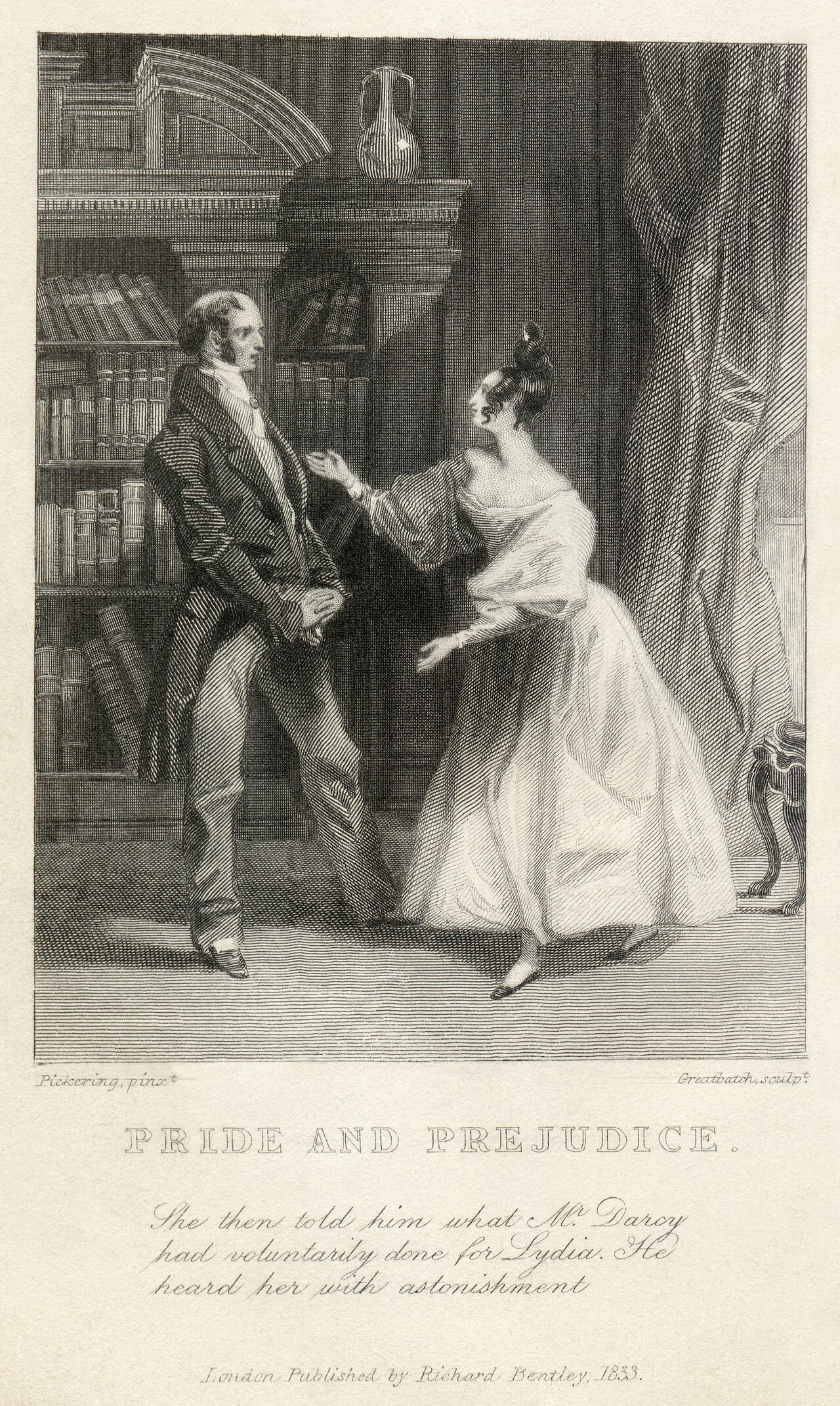
Bentley's Standard Novels series reissues Austen's novels in cheap single volumes.
- 1923
R. W. Chapman's scholarly edition establishes the standard modern text.
- 1995
The BBC adaptation, with Jennifer Ehle and Colin Firth, triggers a worldwide surge in sales.
Reception: A Fashionable Novel Becomes a Classic
The novel was well received at once. Britannica records that it was well received by critics and readers and that its first edition sold out within the first year; Austen's biographers describe it as the fashionable novel of its season. The praise came without a name to attach to it - reviewers praised the author of Sense and Sensibility, and Austen's name first appeared on a title page only after her death, in December 1817.
Through the nineteenth century the book never disappeared: Bentley's cheap reissues of the 1830s kept it in circulation, and each generation of critics raised Austen's standing. The twentieth century made her an academic subject and then a screen industry. The 1940 film with Greer Garson and Laurence Olivier, the BBC's 1995 serial - whose Colin Firth Darcy became a cultural reference point - and Joe Wright's 2005 film with Keira Knightley each recruited new readers, and Britannica counts about fifteen Pride and Prejudice films besides the television versions.
Significance
Within Austen's work, this is the novel where her method is most perfectly balanced: a comedy of manners in which the jokes carry the moral weight. The entail that will leave the Bennet sisters homeless, the income attached to every eligible man, the difference between a fortune inherited and one made in trade - the economics are the machinery of the plot, and Elizabeth's wit is exercised inside a system that gives her almost no safe choices. Britannica singles out its incisive wit and superb character delineation, and its plot turns on a device Austen made her own: the heroine must revise a confident first judgement, and the reader, who shared it, must revise it with her.
Its first sentence has become the most quoted opening in English fiction and the model for ironic openings ever since - a statement the novel immediately shows to be the neighbourhood's belief, not the truth. That gap between what society universally acknowledges and what is actually true is the whole book in miniature.
Questions readers ask
Why was the title changed? Because another novel called First Impressions had been published in 1800, making the old title unusable. The replacement is often traced to the closing pages of Fanny Burney's Cecilia, where the phrase pride and prejudice is repeated as the moral of the story. That origin is plausible and widely repeated, but it is an inference, not a documented statement by Austen.
Did Austen really earn only 110 pounds from her most famous book? Yes - for the copyright, paid once. She had asked for 150. Because Egerton owned the copyright, the profits of the first two editions - calculated by the scholar Jan Fergus at roughly 450 pounds for the publisher - were his.
Are Elizabeth and Darcy based on real people? There is no evidence for originals. They are fictional characters, built from Austen's observation of her own social world in Hampshire. Claims identifying a real-life Darcy surface regularly and none has documentary support.
Legacy
Pride and Prejudice is now the centre of a small industry and a large affection. Jane Austen's House at Chawton, where the revision was done, is a museum; the book is a set text in schools across the English-speaking world; its story has been retold as a Bollywood film, a web series, a murder mystery sequel and a zombie parody, and new screen versions are still being produced.
The lasting point is the one Austen made herself. She called the book her darling child and, in the same week, found it too light and bright and sparkling. Posterity kept the first judgement and argued with the second for two hundred years - which is why the novel is still read for pleasure, and not only for study.
Sources
- Encyclopaedia Britannica - Pride and Prejudice
- Encyclopaedia Britannica - Jane Austen
- Smithsonian Magazine - How Jane Austen's Pride and Prejudice Became One of the World's Most Beloved Novels
- Jane Austen Centre - Pride and Prejudice by Jane Austen: History, Plot and Facts
The facts on this page were checked against these sources on 19 November 2026. The History Trail's permanent pages are researched and written for this site; the live profiles elsewhere on The History Trail are assembled automatically from Wikipedia and Wikidata.
About the Author
Researched and written by the The History Trail Editorial Team — the accountable editorial function behind this site's permanent story pages. The team works from the published sources cited on each page; it does not invent historians, reviewers or credentials, and it corrects errors openly.
Fact Check
Every load-bearing fact on this page traces to one of the sources listed above, and significant claims link to their source in the text. Our checking method is described on the methodology page; errors can be reported via the corrections page.
Sources & Citations
Cite this page as: The History Trail Editorial Team, The History Trail — this article's title, publication and update dates are shown beneath its headline. The full source list appears under Sources above; the site's source standards are on the sources page.