
Things
Barbie
Barbie is an 11-inch plastic fashion doll with the figure of an adult woman, introduced by the American toy company Mattel on 9 March 1959 and created by Ruth Handler, who modelled her on the German Bild Lilli doll. First sold as a teenage fashion model, she became a global brand, a long-running subject of debate about body image and materialism, and in 2023 the star of the year's highest-grossing film.
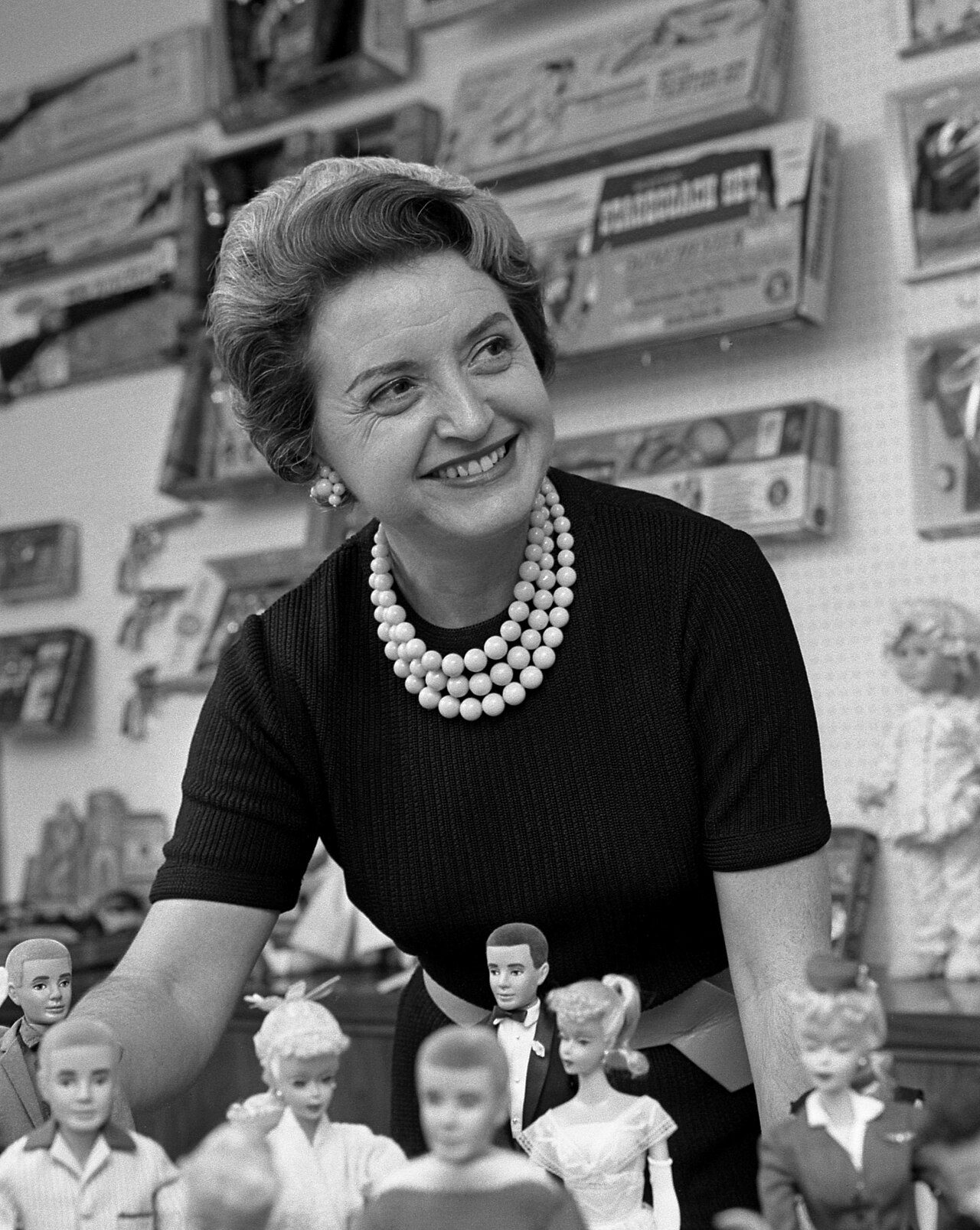
At a Glance
- What it is
- An 11-inch (29-cm) plastic fashion doll with an adult woman's figure, made by Mattel, Inc.
- Creator
- Ruth Handler, who cofounded Mattel with her husband Elliot in 1945 and spearheaded the doll's introduction
- Debut
- 9 March 1959, at the American International Toy Fair in New York City; the first doll cost $3 and 300,000 were sold in the first year
- Full name
- Barbara Millicent Roberts, named after the Handlers' daughter Barbara
- Modelled on
- The Bild Lilli doll, produced in West Germany from 1955 to 1964 as a risque gag gift for men, based on a cartoon in the newspaper Bild Zeitung
- Careers
- More than 250, according to Mattel, including astronaut (1965, before any American woman reached space), doctor, airline pilot and presidential candidate
- Body changes
- After decades of criticism of the doll's proportions, Mattel widened the waist around 2000 and in 2016 added petite, tall and curvy body types
Introduction
Most dolls sold to American girls in the 1950s were babies, designed to be fed, rocked and put to bed. Barbie was something different: a grown-up. The Smithsonian's National Museum of American History, which holds an early doll, describes her as a teenage fashion model who could date, drive and wear fabulous clothes - a figure children projected futures onto, rather than practised mothering with. That change of premise made her one of the most successful toys ever sold, and one of the most argued about.
Barbie's history is therefore two histories at once: a business story - a family company, a borrowed design and television advertising aimed directly at children - and a cultural one, in which the doll has been read, decade after decade, as both a symbol of women's expanding choices and a symbol of an unattainable body and an acquisitive lifestyle.
Origins: Paper Dolls and a Family Company
Mattel was founded in southern California in 1945 by Ruth Handler, her husband Elliot Handler and Harold Matson. Ruth Handler's own account, repeated by Smithsonian Magazine, begins with her daughter Barbara playing with paper dolls and giving them adult lives - careers, romances, futures. The dolls on sale offered nothing like that in three dimensions, and Handler concluded that girls wanted a doll onto which they could project what they might become. Her summary, from her 1994 autobiography, was that through the doll a little girl could be anything she wanted to be, and that Barbie represented the fact that a woman has choices.
The idea met resistance inside and outside the company: a doll with a woman's figure, including breasts, was thought unsuitable and unsellable. What Handler lacked was proof such a doll could be manufactured and would work as a toy. She found it in Europe in 1956.
The Bild Lilli Origin
On a family trip to Europe in 1956 - Smithsonian Magazine places the encounter in Switzerland - Handler found the Bild Lilli doll. Lilli was not a children's toy in origin. She was a cartoon character created by Reinhard Beuthin for the West German tabloid Bild Zeitung, a wisecracking young woman, and from 1955 a doll version was sold in West Germany, in Britannica's words, as a risque gag gift for men. Handler bought Lilli dolls, took them back to Mattel, and had the design reworked into a teenage fashion model for the American market, softened in face and presentation but keeping the adult figure that was the whole point of the design.
The new doll was named Barbie after Handler's daughter Barbara; her full fictional name is Barbara Millicent Roberts. Mattel later acquired the rights to Bild Lilli, in 1964, and Lilli's production ended. The Lilli origin is not a rumour attached to Barbie afterwards: it is stated plainly by Britannica. The wholesome American teenager began as an adult novelty.
Launch, Careers and a Changing Doll
Barbie debuted on 9 March 1959 at the American International Toy Fair in New York, wearing a black-and-white striped swimsuit, priced at $3. Some 300,000 dolls sold in the first year. Mattel, which had sponsored Disney's Mickey Mouse Club in 1955, advertised directly to children on television - a novelty that bypassed parents who, in Mattel's own 1958 market research, had criticised the doll for having too much of a figure. A world accumulated around her: Ken, named for the Handlers' son, in 1961; her friend Midge in 1963; her sister Skipper in 1964; and Christie, a Black friend doll, in 1968. The first Black Barbie doll herself, designed by Kitty Black Perkins, came only in 1980, the year a Latina Barbie also appeared.
Her careers multiplied in step with - and sometimes ahead of - women's working lives. Astronaut Barbie appeared in 1965, eighteen years before Sally Ride became the first American woman in space. Britannica lists airline pilot, doctor, Olympic athlete and United States presidential candidate among her roles; Mattel counts more than 250 careers in total. She was never given a husband or children of her own: when buyers wanted a baby in the early 1960s, Mattel issued a Barbie Baby-Sits set instead. The body, meanwhile, slowly changed under criticism - a wider waist and smaller bust around the turn of the century, then, in 2016, petite, tall and curvy versions alongside the original.
Timeline
- 1945
Ruth and Elliot Handler cofound Mattel in southern California with Harold Matson.
- 1955
The Bild Lilli doll goes on sale in West Germany, an adult novelty based on a Bild Zeitung cartoon character.
- 1956
On a family trip to Europe, Ruth Handler finds Bild Lilli and takes examples back to Mattel.
- 9 March 1959
Barbie debuts at the American International Toy Fair in New York, priced at $3; 300,000 sell in the first year.
- 1961
Ken, named after the Handlers' son, is introduced as Barbie's boyfriend.
- 1968
Christie, a Black doll in Barbie's circle of friends, is introduced.
- 1980
The first Black Barbie, designed by Kitty Black Perkins, and the first Latina Barbie are released.
- 1992
Barbie runs for president for the first time; Teen Talk Barbie's line 'Math class is tough!' draws criticism the same year.
- 2016
Mattel adds petite, tall and curvy Barbie body types to the original.
- 2023
Greta Gerwig's film Barbie, starring Margot Robbie, becomes the highest-grossing film of the year, taking over $1.4 billion.
Significance
Barbie's significance is that a toy became a standing argument about what girls should want. Supporters credit her with offering an alternative to the restrictive roles of the 1950s: she worked, earned, owned her own house and car, and answered to no husband or family. Critics answer with the other half of the record - the cars, houses and clothes sold as accessories, which Britannica summarises as a charge of materialism, and a body that no human woman could safely have. Both readings draw on real features of the same product, which is why the argument has lasted more than sixty years.
Commercially, the doll also helped invent modern toy marketing: a relatively cheap doll sold once, and then an endless, separately sold wardrobe and world around her, promoted on children's television. Britannica notes annual Barbie sales of more than a billion dollars.
Myths and disputes
Was Barbie's body really impossible? On the central factual claim, the critics' arithmetic is documented. Researchers in Finland reported in 1994 that if Barbie were a real woman she would not have enough body fat to menstruate; scaled-up estimates of her measurements have been widely published since. Mattel's response was not to deny the proportions but, eventually, to change them - revising the mould around 2000 and adding the three new body types in 2016. Whether playing with the doll harms girls' body image remains a genuinely contested research question, and this page states the criticism as criticism, not as settled science.
Two origin stories also need separating. Handler's paper-doll account - watching Barbara give paper dolls adult roles - is her own telling, and Smithsonian Magazine notes a second version in which the adult novelty doll seen in Switzerland was itself the starting point. The two are compatible, but the Lilli debt is sometimes softened in retelling into 'inspiration'. The record is stronger than that: Barbie's appearance was modelled on Lilli, the doll was reworked from Lilli examples, and Mattel bought the Lilli rights in 1964. Finally, the chant heard at the 1970 Women's Strike for Equality - 'I am not a Barbie doll!' - shows the criticism is as old as the success, not a recent invention.
Legacy
Barbie's legacy is endurance under argument. The doll has been a Warhol portrait subject, a museum object at the Smithsonian, a byword for shallowness in popular slang and, in 2023, the centre of a film that staged the whole debate - idealisation, body image, corporate self-interest and all - and became the highest-grossing film ever made by a solo female director. Mattel shipped more than 86 million dolls from the Barbie universe in 2021 alone. Few products are loved and loathed in public for six decades and keep selling through both.
Sources
- Encyclopaedia Britannica - Barbie
- Smithsonian Magazine - A Cultural History of Barbie
- Smithsonian Institution, National Museum of American History - Barbie Doll
- Encyclopaedia Britannica - Barbie (film)
- Victoria and Albert Museum - Barbie, Young V&A Collection
The facts on this page were checked against these sources on 19 November 2026. The History Trail's permanent pages are researched and written for this site; the live profiles elsewhere on The History Trail are assembled automatically from Wikipedia and Wikidata.
About the Author
Researched and written by the The History Trail Editorial Team — the accountable editorial function behind this site's permanent story pages. The team works from the published sources cited on each page; it does not invent historians, reviewers or credentials, and it corrects errors openly.
Fact Check
Every load-bearing fact on this page traces to one of the sources listed above, and significant claims link to their source in the text. Our checking method is described on the methodology page; errors can be reported via the corrections page.
Sources & Citations
Cite this page as: The History Trail Editorial Team, The History Trail — this article's title, publication and update dates are shown beneath its headline. The full source list appears under Sources above; the site's source standards are on the sources page.