
Things
Printing press
The printing press was not invented once, or by one man. Movable type was created in Song-dynasty China by Bi Sheng around the 1040s, and Korean printers were casting type in metal centuries before Europe: the Jikji, printed in Korea in 1377, is the oldest surviving book printed with movable metal type. What Johannes Gutenberg built in Mainz around 1440-1450 was an independent European system - hand-cast metal type, oil-based ink and a screw press combined - and it was that system that multiplied Europe's books from thousands of manuscripts to, by Britannica's estimate, more than 9,000,000 printed volumes by 1500.
At a Glance
- First movable type
- Bi Sheng's baked-clay type, made in Northern Song China during the Qingli era (1041-1048) and described by Shen Kuo in his Dream Pool Essays
- Oldest surviving metal-type book
- The Jikji, a Buddhist anthology printed with cast metal type at Cheongju, Korea, in 1377 - 78 years before the Gutenberg Bible; inscribed on UNESCO's Memory of the World Register in 2001
- Gutenberg's system
- Developed in Mainz, Germany, around 1440-1450: type cast in a hand mould from a lead, tin and antimony alloy, oil-based ink, and a wooden screw press adapted from wine and oil presses
- The Gutenberg Bible
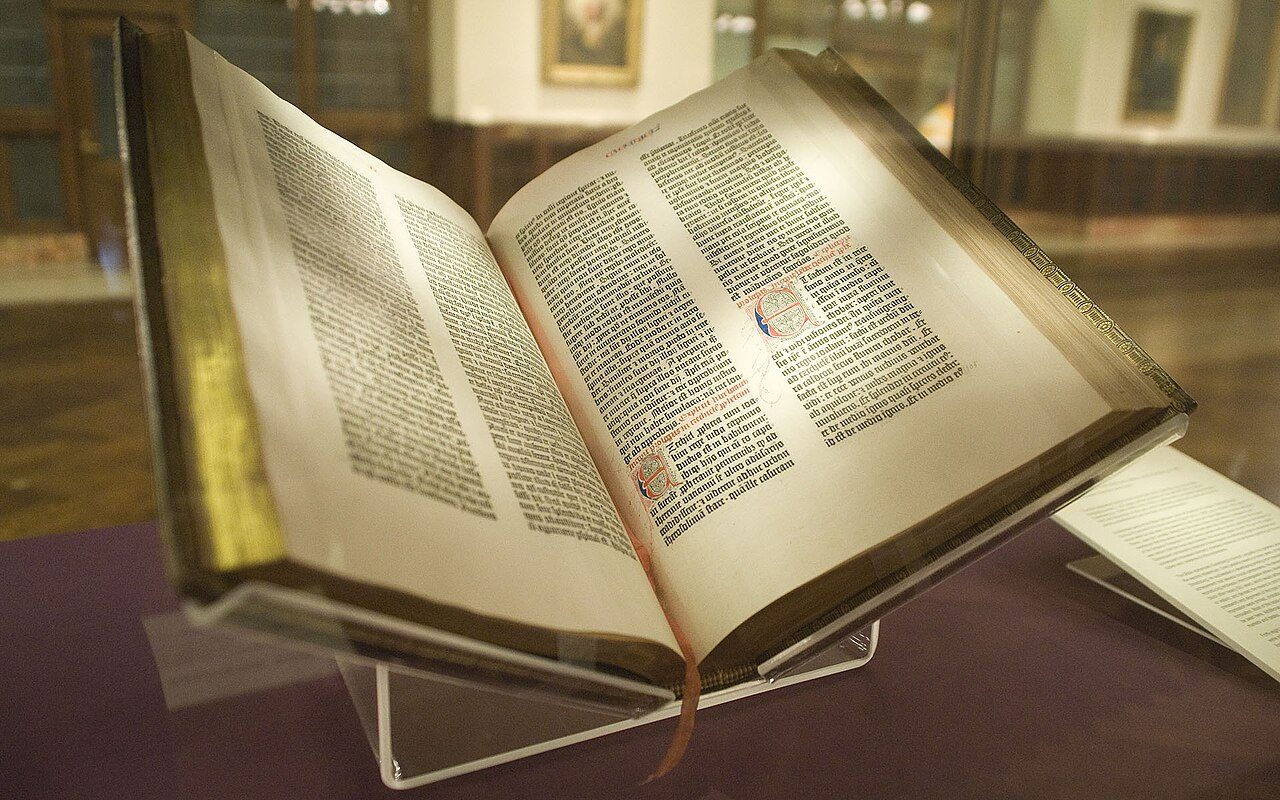
- The 42-line Bible, completed in Mainz about 1455; an estimated 180 copies were printed, of which 48-49 survive in whole or in part
- The spread
- Presses reached Cologne by 1464, Italy by 1462-63, Paris in 1470 and England in 1476; by 1500 Venice alone had no fewer than 150 presses, according to Britannica
- The output
- Britannica estimates more than 9,000,000 books in Europe by 1500, against manuscript books previously countable in thousands; other scholarly estimates run higher, up to about 20 million
Introduction
Before print, every book was a manuscript: copied letter by letter, chained in libraries, priced like jewellery. Printing changed the arithmetic of knowledge. Instead of one scribe producing one copy, a printer could set a page once and strike it hundreds of times, then break up the type and set another. The idea at the heart of it - movable type, individual characters that can be arranged, inked, printed and rearranged - arose first in East Asia, and this page states that plainly, because the older European habit of crediting Gutenberg with the whole invention is wrong.
Gutenberg's achievement was real, but specific: a complete, commercially viable European system, built independently in Mainz, whose spread over the following fifty years is one of the best-documented technology diffusions in history.
Before Gutenberg: Movable Type in China and Korea
The first recorded movable type was made in China during the Qingli era, 1041-1048, by Bi Sheng, a commoner artisan of the Northern Song dynasty. The scholar-official Shen Kuo described the method in his Dream Pool Essays: characters cut into moist clay, fired hard like porcelain, set into an iron plate coated with resin and wax, printed, then released by reheating so the type could be reused. Clay type was fragile; later Chinese printers, among them Wang Zhen by the end of the 13th century, carved more durable type from wood, and copper type was used in China from the 12th century.
The decisive step to metal came in Korea. Printers of the Goryeo dynasty were casting movable type in bronze by the early 13th century. What does survive is the Jikji, an anthology of Buddhist teachings printed with cast metal type at Heungdeok Temple in Cheongju in July 1377. The Bibliotheque nationale de France, which holds the surviving second volume, describes it as the oldest known book printed with movable metal type, 78 years before the Gutenberg Bible; UNESCO inscribed it on the Memory of the World Register on 4 September 2001. Movable type did not displace woodblock printing in East Asia, where a script of thousands of characters made huge type founts expensive - one reason the European development, working with a small alphabetic character set, had such explosive effect.
Mainz: Gutenberg's Workshop and System
Johannes Gutenberg, a goldsmith of Mainz, spent the 1440s assembling his system from crafts he already knew. Its elements were: type cast quickly and identically in an adjustable hand mould, from an alloy of lead, tin and antimony that melted low, cast sharp and lasted; an oil-based ink that would stick to metal type where water-based inks slid off; and a wooden screw press adapted from the wine and olive presses of the Rhine valley. No single element was wholly new, but the combination was a system that could be taught, sold and copied.
Gutenberg financed the work with loans from the Mainz financier Johann Fust, and the partnership ended in a lawsuit: in 1455 Fust foreclosed, and Gutenberg lost his workshop just as his great book appeared. That book, the Latin Bible known from its page layout as the 42-line Bible, was completed in Mainz about 1455. Cambridge University Library records perhaps 180 copies printed, on paper and on vellum - the future Pope Pius II, who saw specimen pages at Frankfurt in March 1455, cited figures of 158 or 180. Of the edition, 48 or 49 copies survive in whole or part - Harvard Library counts 48 surviving, 23 complete - each still finished by hand with painted decoration, a printed book dressed as a manuscript.
The Spread: Fifty Years That Multiplied Books
Print spread along trade routes, carried largely by German printers, as Britannica traces it: Cologne had a press by 1464, Basel by 1466, and printing reached Italy as early as 1462-63 at the Benedictine monastery of Subiaco, whose printers moved on to Rome in 1467. Paris gained a press in 1470, at the Sorbonne; Budapest followed in 1473, Cracow in 1474, and England in 1476, when William Caxton set up at Westminster and printed mostly in English. Venice became the trade's capital, with at least 150 presses by 1500.
The totals are estimates, and this page attributes them rather than stating them as exact. Britannica puts the change starkly: before printing, the manuscript books of Europe could be counted in thousands; by 1500, after only fifty years of printing, there were more than 9,000,000 books; other scholarly estimates run higher, toward twenty million copies.
Timeline
- 868
The Diamond Sutra, the earliest dated printed book to survive, is printed from carved wooden blocks in Tang-dynasty China; it is now held by the British Library.
- 1041-1048
Bi Sheng creates movable type from baked clay in Northern Song China; Shen Kuo records the method in his Dream Pool Essays.
- Late 13th century
Wang Zhen and other Chinese printers develop durable wooden movable type.
- c. 1234
Korean printers produce books with cast bronze movable type; the cited early set, compiled by Choe Yun-ui, does not survive.
- 1377
The Jikji is printed with movable metal type at Heungdeok Temple, Cheongju - the oldest surviving book printed with movable metal type.
- c. 1440-1450
Johannes Gutenberg develops his printing system in Mainz: hand-mould-cast metal type, oil-based ink and a screw press.
- c. 1455
The 42-line Gutenberg Bible is completed in Mainz; that same year, Gutenberg's partner Johann Fust forecloses and takes over the workshop.
- 1464-1470
Presses open in Cologne (1464), Basel (1466) and Rome (1467); in 1470 German printers set up Paris's first press at the Sorbonne.
- 1476
William Caxton sets up England's first press at Westminster, publishing mainly in English.
- 1500
Venice alone has at least 150 presses; Britannica estimates Europe's printed books now exceed 9,000,000.
- 2001
UNESCO inscribes the Jikji on the Memory of the World Register as the world's oldest surviving metal-type book.
Significance
The press mattered because it made texts identical, cheap and hard to suppress. A printed edition put the same words, diagrams and tables in front of readers in a dozen cities at once, which changed what scholarship, law, religion and science could be: errors could be corrected against a fixed text, and an argument - as Europe would see in the Reformation pamphlet wars of the 1520s - could be everywhere in weeks. In its first century, Britannica notes, the printer dominated the trade as his own typefounder, editor, publisher and bookseller.
Myths and disputes
Did Gutenberg invent printing? No, and the claim should be retired in its simple form. Printing itself - inked impressions from carved blocks - is centuries older than Gutenberg in China, where the Diamond Sutra was block-printed in 868. Movable type is older than Gutenberg too, by about four centuries, and metal movable type by at least a century and a half, as the Jikji proves in surviving form. What Gutenberg invented was the European system described above, and the honest credit is the narrower, larger one: not the first printer, but the builder of the system that industrialised the book in the West.
Did he learn it from Asia? That remains genuinely unresolved. No document shows a route by which East Asian type technology reached Mainz, and historians generally treat Gutenberg's work as an independent development rather than a proven borrowing, while noting that paper itself, and block-printed images, had travelled west from Asia earlier. Why the same invention transformed one book trade in fifty years and coexisted with woodblock for centuries in another is a question of script size, markets and patronage, not ingenuity.
Legacy
Every later information technology is measured against the press, usually in the press's own terms: the internet is routinely called a new Gutenberg moment, a comparison Britannica's figures explain - a fifty-year shift from thousands of books to millions is the benchmark for a communications revolution. The physical legacy survives in the 48 or 49 Gutenberg Bibles in libraries worldwide and in the Jikji's single volume in Paris.
Sources
- Encyclopaedia Britannica - History of publishing: The age of early printing, 1450-1550
- Bibliotheque nationale de France - Jikji, a treasure of the world of printing
- Cambridge University Library - Treasures of the Library: Gutenberg Bible
- Harvard Library - The Gutenberg Bible
- University of Cambridge, Faculty of Divinity - Gutenberg Bible (50 Treasures)
The facts on this page were checked against these sources on 19 November 2026. The History Trail's permanent pages are researched and written for this site; the live profiles elsewhere on The History Trail are assembled automatically from Wikipedia and Wikidata.
About the Author
Researched and written by the The History Trail Editorial Team — the accountable editorial function behind this site's permanent story pages. The team works from the published sources cited on each page; it does not invent historians, reviewers or credentials, and it corrects errors openly.
Fact Check
Every load-bearing fact on this page traces to one of the sources listed above, and significant claims link to their source in the text. Our checking method is described on the methodology page; errors can be reported via the corrections page.
Sources & Citations
Cite this page as: The History Trail Editorial Team, The History Trail — this article's title, publication and update dates are shown beneath its headline. The full source list appears under Sources above; the site's source standards are on the sources page.