
Things
Cheese
Cheese is preserved milk: curds separated from whey, salted and ripened so that a food that spoils in days keeps for months. The earliest direct evidence is over 7,000 years old - milk residues in perforated pottery sieves from Poland - and the oldest solid cheese ever found, some 3,200 years old, was buried in an Egyptian tomb.
At a Glance
- Earliest evidence
- Milk residues in perforated pottery sieves from Kuyavia, Poland, dated to 5200-4900 BCE - the earliest direct evidence for cheesemaking
- Oldest solid cheese
- A whitish mass in the Saqqara tomb of Ptahmes, mayor of Memphis in the 13th century BCE, identified in 2018 as cheese about 3,200 years old
- Why it mattered
- Cheese concentrates about ten volumes of milk into one volume of food, keeps far longer, and is much lower in lactose than fresh milk
- The factory turn
- Joseph Harding standardised cheddar in the 19th century; the first cheese factories followed in the 1850s
- Wartime
- In Second World War Britain most milk was directed to a single factory cheddar, nicknamed Government Cheddar, and cheese was rationed from 1941
- Protected today
- Names such as Roquefort and Parmigiano Reggiano are legally protected designations of origin, tied to a place and a method
Introduction
Cheese making probably began soon after humans first took milk from domesticated animals, and for a simple reason: milk is perishable, cheese is not. Britannica notes that cheesemaking reduces about ten volumes of milk to one volume of cheese. Curdling the milk, draining the watery whey, salting and ripening the curds turns a daily surplus into a portable, tradable food - and one far lower in lactose than milk itself, which mattered long before most adults could digest fresh milk comfortably.
For most of that long history the craft was local and guarded. Britannica describes cheesemaking as an art whose process was a closely kept secret, passed down from generation to generation, with distinct varieties arising largely by accident - a change of cave, climate, milk or mould - rather than by design. The science arrived only in the 19th century. The archaeology, remarkably, goes back to the Stone Age.
Origins: Sieves in Poland, a Tomb in Egypt
The earliest direct evidence comes from Kuyavia in central Poland. In the 1970s archaeologist Peter Bogucki excavated fragments of pottery pierced with small holes at sites of the Linear Pottery culture, dated to 5200-4900 BCE, and suggested they were cheese strainers. In 2012 a team led by Melanie Salque of the University of Bristol tested the residues in the clay and found abundant milk fats. As Salque put it, the presence of milk residues in sieves that look like modern cheese-strainers constitutes the earliest direct evidence for cheesemaking - farmers separating fat-rich curds from lactose-heavy whey more than 7,000 years ago.
The oldest actual cheese is far younger, and it survived by being buried. In the Saqqara tomb of Ptahmes, a high-ranking official and mayor of Memphis in the 13th century BCE, excavators found a broken jar holding a solidified whitish mass. Analysis published in Analytical Chemistry in 2018 identified it as a hard cheese made from cow's milk mixed with sheep or goat milk, about 3,200 years old - probably the most ancient solid residue of cheese ever found. The same study detected traces of Brucella melitensis, the bacterium behind brucellosis, a reminder that unpasteurised cheese always carried risk. Egyptian tomb murals from about 2000 BCE already show cheesemaking, so Ptahmes was buried with a food his culture had made for centuries.
Empires, Monasteries and Named Cheeses
The ancient Greeks and Romans knew and valued cheese, Britannica records, as did early peoples in northern Europe, and cheesemaking spread with the Roman Empire as far as England. Cheese was rations, rent and trade goods: a food that travelled. In the Middle Ages, monks and merchants made cheese an established food of Europe. Monasteries were ideal cheese houses - they kept herds, worked to a disciplined daily routine, needed meatless foods for fast days, and, crucially, could write. Monastic communities refined and recorded varieties that villages had made by feel: Munster takes its name from monasterium, the Latin for monastery, and cheeses such as Maroilles, Epoisses and the hard grating cheeses of the Po valley all carry monastic roots.
Place became identity. Roquefort's blue veins develop in the cool, damp caves of Roquefort, and in 1411 a French decree reserved the name to cheese made there - an early act of protection. Parmigiano in Italy was already traded as a named cheese of its region in the 13th and 14th centuries. For centuries, though, production stayed on farms: until the middle of the 19th century, cheese remained a local farm product.
The Factory: Harding, Cheddar and Government Cheese
The change came with measurement. The Somerset dairyman Joseph Harding, called the father of cheddar, gave cheddar making its first modern system based on scientific principles: controlled scalding, acidity testing, dairy hygiene and new equipment such as his revolving curd breaker, published in the Journal of the Royal Agricultural Society of England in 1860. Harding and his family taught the method in Scotland and North America, and his sons carried it to Australia and New Zealand. In 1851 Jesse Williams opened one of the first cheese factories in Oneida County, New York, pooling neighbours' milk - the farmhouse craft had become an industry, and cheddar its world standard.
War then showed how fragile variety was. In Britain during the Second World War the government directed most milk into a single standardised factory cheddar, remembered as Government Cheddar, and cheese joined the ration in May 1941, beginning at an ounce a week. Farmhouse production of cheeses such as Stilton, Wensleydale and Lancashire collapsed; makers who numbered in the thousands before the First World War were reduced to fewer than a hundred by 1945, and rebuilding took decades.
Timeline
- 5200-4900 BCE
Farmers in Kuyavia, Poland, strain curds through perforated pottery sieves - the earliest direct evidence of cheesemaking.
- About 2000 BCE
Egyptian tomb murals depict cheesemaking; cheese is an established food of the ancient world.
- 13th century BCE
A jar of cheese is buried in the Saqqara tomb of Ptahmes, mayor of Memphis - the oldest solid cheese yet found.
- By about 1000 BCE
Cow's milk is being used for cheesemaking; Greeks and Romans know and value cheese, and the craft spreads with Rome.
- Middle Ages
Monasteries refine and record named varieties across Europe, among them Munster, named for the monastery itself.
- 1411
A French decree reserves the name Roquefort to cheese produced in its home region.
- 1851
Jesse Williams opens an early cheese factory in Oneida County, New York, making cheddar from pooled milk.
- 1860
Joseph Harding publishes his scientific system of cheddar making, the template for factory production.
- May 1941
Cheese is rationed in Britain; most milk goes to a single Government Cheddar for the rest of the war.
- 1996
Parmigiano Reggiano is registered as a European protected designation of origin (DOP).
- 2012 and 2018
Residue analysis confirms the Polish sieves as cheese strainers; protein analysis identifies the Ptahmes tomb cheese.
Significance
Cheese changed what milk could do. It let farming communities store a summer surplus against winter, feed people who could not digest fresh milk, and trade a high-value food over long distances - which is why cheese appears so early wherever herding appears. It also became a store of local knowledge: hundreds of varieties encode the milk, microbes, caves and habits of particular places, which is exactly what modern origin protection tries to defend.
Questions readers ask
Who invented cheese? No one person did, and Britannica repeats the famous legend of an Arabian merchant whose milk, carried in a pouch made from a sheep's stomach, curdled in the desert heat into curds and whey. That story is a legend, not evidence - but it captures the real chemistry, since rennet from animal stomachs does curdle milk. The documented beginning is the Polish evidence: ordinary farmers, specialised pottery, and milk fat in the clay.
What did the first cheese taste like? Probably mild, soft and fresh rather than aged and hard. Salque and her colleagues suggested the Polish product was likely bland and comparable to cottage cheese, and the Ptahmes cheese has been described as a sharp, acidic, chevre-like cheese that would have spoiled quickly. Hard, long-ripened cheeses came later, with salt, pressing and caves.
Is the Egyptian cheese really the oldest? It is the oldest solid cheese residue identified so far - a claim its own researchers phrase carefully as probably the most ancient ever found. The Polish sieves prove cheesemaking itself is more than twice as old; the cheese itself simply did not survive.
Legacy
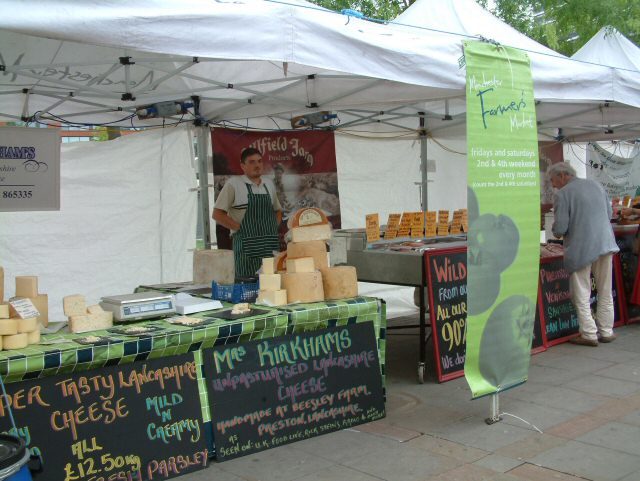
Today cheese is both a global factory product and a defended inheritance. The same century that standardised cheddar also produced the legal idea that a name belongs to a place: Roquefort's 1411 decree grew into France's appellation system and then Europe's protected designations, under which Parmigiano Reggiano, Feta, Stilton and hundreds of others may only be made in defined areas by defined methods. Against the factory block stands a revived farmhouse sector - the stalls, caves and small dairies that wartime nearly erased - selling the argument the Polish sieves already make: cheese was never just food. It was a technology for keeping milk, and a record of where it was made.
Sources
- Smithsonian Magazine - New Discovery of 7000-Year-Old Cheese Puts Your Trader Joe's Aged Gouda to Shame
- Encyclopaedia Britannica - Cheese
- Encyclopaedia Britannica - Dairy product: Cheese and cheese making
- The Conversation via Phys.org - The surprising role cheese played in human evolution
- Museo del Parmigiano Reggiano - Timeline
The facts on this page were checked against these sources on 19 November 2026. The History Trail's permanent pages are researched and written for this site; the live profiles elsewhere on The History Trail are assembled automatically from Wikipedia and Wikidata.
About the Author
Researched and written by the The History Trail Editorial Team — the accountable editorial function behind this site's permanent story pages. The team works from the published sources cited on each page; it does not invent historians, reviewers or credentials, and it corrects errors openly.
Fact Check
Every load-bearing fact on this page traces to one of the sources listed above, and significant claims link to their source in the text. Our checking method is described on the methodology page; errors can be reported via the corrections page.
Sources & Citations
Cite this page as: The History Trail Editorial Team, The History Trail — this article's title, publication and update dates are shown beneath its headline. The full source list appears under Sources above; the site's source standards are on the sources page.